


How To Make A Cigar-Box Railway Line
Description
This section is from the book "The Boy's Book Of Mechanical Models", by William Bushnell Stout. Also available from Amazon: The Boy's Book Of Mechanical Models.
How To Make A Cigar-Box Railway Line
I HAVE already told you how to make a toy automobile, but this is going a step farther, being a description of a complete railway line, with its engine, truck, freight cars, and coaches, all made from cigar boxes.

We will make the engine or locomotive first, and I've drawn one in Figure I.
Pick out a pretty long cigar box, - they are not all the same size, you know, - and with a saw, being careful about striking nails, cut down the length of the box on a line drawn two inches in from the edge, and cut this to within two and a half inches of the other end, where you saw a line down to meet it at right angles, so that when this is done you can take the piece out and the box will be left the shape of the piece A as in Figure 1.

The part sticking up at the back at C is the cab, and you can cut out the windows with a sharp knife or fret saw, or just mark them out as you wish.
The top of the boiler is covered by a strip of cigar-box wood B where the opening was left in cutting out the dotted portion of the box.
The roof of the cab is made more realistic by fastening on a piece D of half-inch wood cut a little wider than the top of the cab, so that it can stick over the edges a little to form "eaves," and an inch and a half longer than the cab top so that it can stick out backwards over the platform E.
This platform E is a piece of inch wood as wide as the bottom of the box and fastened on underneath to look like the firebox and to stick out in back for a platform. The cab roof and this platform should stick out about the same distance.

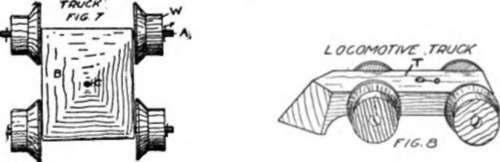
The next thing to do is to make the front truck as in Figure 8.
Here you can see how the inch block T is shaped with the "cow-catcher" at the front and the hole 0 at the center between the wheels through which a screw runs up through some washers of cigar-box wood as shown at t in Figure I and into the bottom of the boiler up front.
The wheels are halves of common spools turned around so the flanges are in and are fastened on with small screws that fit the center hole of the spool, or they may turn on little wooden axles of a width to suit the gauge of your truck.
The big back wheels you can cut out of half-inch wood, with a piece of tin cut in a little larger circle and tacked on the inside to form the flange; this kind of a wheel will do very well if you are good at cutting circles. Another way is to take two blacking-box covers, or the boxes themselves, so long as both are the same size, and, holding the rim on the edge of some surface, such as the edge of a vise, as in Figure 5, strike the edge lightly over the edge of the vise, turning the can around as you work, until the whole edge is turned over into a flange. Then inside this cover fasten a cross stick a with brads and through this bore the hole for the axle.
Fig.4.
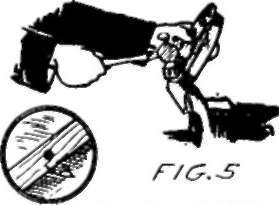
Making the big wheel from a blacking box.
The two wheels can be connected by a round wooden axle through holes in the box sides, or they can be mounted on a wire axle. If they are not too big, you might mount them on round-headed screws screwed into E. Be sure the hole for the axle, wherever it is, is just high enough up, and that the big wheels will be in a line with those on the truck up front, so they will all track.
If you want to add cylinders and machinery to the engine to make it more like a real one, you can mount spools at the side of the boiler up front, as in the drawing of the whole train, and run wire connecting rods from them to a small brad crank on the drive wheel as shown.
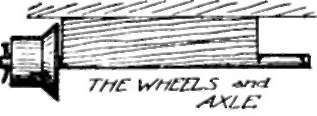
The locomotive tender is cut from a common cigar box, like Figure 2, the line through the middle showing how it is cut. The wheels - spools, as in the other case - are mounted on the wooden axle as in Figure 4, and fastened with a pin at the outer end so they won't slip off.
The blind baggage car, next in line, is made from one of the big square boxes. The roof is cut of half-inch wood curved at the ends, as in Figure 3, and rounded off at the sides too, only not quite so steep.
This piece should be cut big enough so it will stick out an eighth of an inch on either side and a quarter of an inch on the end; that is, it must be a quarter of an inch wider and half an inch longer than the top of the box. It is fastened in place with small nails.
Before putting it in place, however, cut the doors of the car, being careful to get them in the center and the same size.
On this car, in Figure 3, is shown one way of many that you can use for coupling the cars together. Hooks are screwed into the car ends at b and then a ring of wire is used to connect the two hooks. There are many other ways that you can do this, and I am only suggesting this one. Perhaps you can think of an automatic coupler.
The flat car is easy to make and is only a common small cigar box with the wheels fastened on their axles near each end - that is, a quarter of the length of the box in from each end.
Next comes the freight car, and this is a little more of a job. I have shown it in a separate drawing in Figure 6.

For this you take two large cigar boxes of the same size. This is going to be a good-sized car, so you had better get some wood from a cracker box to help out.
Knock an end out of each box and connect them with a board F running the entire length of the bottom of both and holding them about three inches apart to form the side doors.
On either side, at the top and bottom, nail sticks G shaped in section like the little upper sketch of Figure 6, so that when you cut out two little wooden doors of the cigar-box wood, as at K, they will fit in and slide between these strips, while at the same time the strips act as connectors for the boxes.
You can nail on the slanting piece to brace the door if you want to do so.
The roof of the car is made of a piece of half-inch wood, sticking out a bit all around and slanted off with a plane so that it is highest down the middle line of the roof, and will thus shed the rain.
At each end of the car cut a small window, shown in the car in the train drawing, and then fasten on the roof piece with brads.
The brake wheels can be made of checker men, and the brake shafts of wire. The brakes can be put on or not as you wish, though it is doubtful if you will use them if they are on.
This car is too long to work with the wheels arranged as the others have been, so we will make two trucks like Figure 7 or Figure 8 with four wheels to a truck and we will pivot each truck to its place on the bottom of the car by a nail or screw up through the hole C into the car bottom. Each truck will be fastened a quarter of the length of the car in from the end.
Be sure you get By Figure 7, in this truck of the right width, - the same as T, Figure 8, on the engine, - so that the cars will run on the same track as the engine, and all cars stay on the track on the curves.
The passenger car is made a great deal like the freighter: of two big boxes end to end, only with no space between, for there are no side doors.
The rest of the passenger car I leave you to work out, for it is much the same except that windows are cut on the sides and doors on the ends.
You can arrange a track of laths and draw your train with a cable or cord between the tracks, or run it by a water motor or steam engine if you have one. There are many things also that you can add, according to what you have to work with and your own ingenuity in devising them.
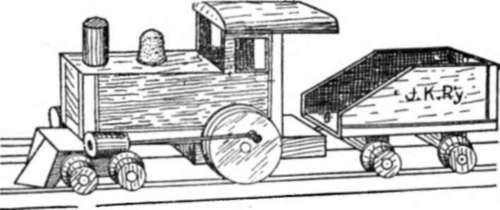


Complete Train of Cigar-box Railway
Continue to:


My Books

