


How To Make A Hydraulic Elevator
Description
This section is from the book "The Boy's Book Of Mechanical Models", by William Bushnell Stout. Also available from Amazon: The Boy's Book Of Mechanical Models.
How To Make A Hydraulic Elevator
Another elevator just like this as to guide strings and general mechanism can be made to work by water power, so that you will not need to turn a crank or do anything but work levers to make the car go up and down as much as you want, so long as you keep the box at the top full of "fuel."
This "fuel" is ordinary water, which, by acting as a counterweight, makes the elevator run up and down along its guide wires.
Figure p shows this type of elevator in use at the back of a flat building, with two boys at work, while the third is looking on.
Figure 10 shows the mechanism of the elevator, while Figures n and 12 show details on the counterbalance can.
The box at the top is an ordinary starch box of wood, painted inside to make it waterproof. From the small nails on the front face at d strings run down as guides to the elevator, as in the toy we made previously. Similar strings off to the other side from nails b take the guide strings for the counterweight can C.

Fig. 9.
Water elevator at work.
Two pulleys J made of sawed-off sections of curtain pole, with "V" grooves filed around the rim, are fastened to the front of the box halfway between the guide wires for the elevator and the can, so that the string L, passing around these pulleys, will run down centrally between the guide strings d and b. These pulleys should work loosely on the screws on which they pivot. A brake lever B is fixed over the pulley shown, so that when one pulls on the string which runs down from the outer end to the ring R at the bottom, a brake is set, and the elevator thus stopped at any floor. This brake lever is cut to fit the groove of the pulley J and has a rubber band r fitted between two nails shown, to hold the brake lever away from the pulley when not in use.
On the one end of the string I is fastened the elevator E, made as in the drawing of the former elevator, with a cigar box as the carrier.
On the other end of the string between the two guide strings or wires b is the tin can shown in Figure II, which will need a little separate description.
In the bottom of this can is soldered a short piece of tubing T, as shown in Figure 12 in detail, this tubing being from the handle of an umbrella or bicycle pump and about half an inch long


After this is soldered in place, an ordinary wood screw is taken with small notches n filed as its slanting face, as in the small sketch in Figure 12. Put this in the tube, as at S and rotate with a screwdriver while pressing down heavily on the screw. This will cut the edge of the tube at the same angle as the screw head, so that when a new screw without the notches is put into the tube, we have a water-tight valve. The weight of the screw will keep this tube from allowing any water to go through, but by lifting the screw from its seat, the water will run out of the can. At the top a loop d for the main string I is formed of a piece of wire, while the ends or arms from this run out through holes in the side of the can near its upper edge and opposite each other, terminating in little loops p which act as guides for the strings W to run through, as shown. The string I is of such a length that when the elevator E is within half an inch, say, of the baseboard, the can is at the top, with its upper edge resting on the bottom of the box containing the water.
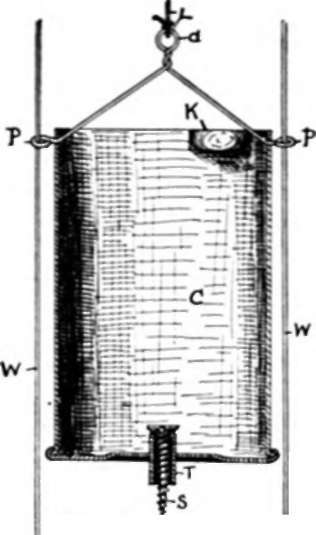
Fig. 11. The balance can.

Fig.12. Making the valve.
When in this position a hole which comes out into the top of this can, is bored through the bottom of the wooden box and into this hole is forced tightly another valve tube T with a valve screw S in it just like the one in the bottom of the can, while a small wooden block K is nailed to the inside of the can at its upper edge, so placed that when the can comes up to the top, this block K will hit the lower end of the screw valve in the bottom of the wooden box and open it. Supposing the box to be full of water, you can now see how the toy works.
The elevator is naturally heavier than the water can C, so that if left alone, the elevator drops to the ground, and the can goes up, the elevator being stopped wherever desired by the operator by pulling on the brake string previously described. As the elevator gets to the bottom, the can gets to the top, and the block K lifts the valve in the box, thus allowing the water to run out of the box into the tin can. This water will run until the can gets heavier than the elevator. The can will then start to descend, pulling up the elevator, and whatever load is in it. As the tin can descends, the elevator will be stopped at the different floors by means of the brake string. As the elevator gets to the top, the can gets to the bottom; the screw S hits the trough or a stick arranged at the bottom, and the valve T in the can is opened, thus allowing the water in the can to run onto the ground until the can becomes light enough so that the elevator starts down and the can starts up.

From this description you see that as long as you keep the box upstairs full of water, the elevator will keep traveling up and down, and can only be stopped by the use of the brakes for different floors. Be careful about the location of the tube in the box so that the block K will always hit it at the end of the up trip.
This elevator is not nearly so hard to make as it may sound at first, and the only job which may puzzle you is soldering the tube T into the bottom of the can C. If you punch the hole in the bottom of the can with the handle end of a file and have the tube all cut, any tinsmith will solder this for you for nothing, or for a few cents at least.
Figure 9 shows this toy working up four flights, but if desired it can be run to almost unlimited height so long as the weight of the string on the one side does not overbalance the weight of the can of water, or the difference in weight between the elevator and the can. If you do not want to use water, by a little ingenuity you can work with sand as power.
No toy elevator ever devised will give you more fun than this one.
Continue to:


My Books

