


How To Make The Tendulum Of Galileo
Description
This section is from the book "The Boy's Book Of Mechanical Models", by William Bushnell Stout. Also available from Amazon: The Boy's Book Of Mechanical Models.
How To Make The Tendulum Of Galileo
AWAY back in the year 1564 a coy was born in Pisa, Italy, who could do almost anything he started out to do. He had gifts, it seemed, in all directions, and he could practically choose in which line he wished to be great.
In the first place he was a fine musician and wrote a book on the theory and practice of music. He was very skilled as a player of the lute, - one of the musical instruments common in those days, - and it was as a player that we first hear of his genius.
Finally this boy, who came of a fine family, was put to school and showed that he was a brilliant scholar. His father wanted him to be a doctor, so finally he studied medicine and would have made a famous doctor if something else hadn't interested him.
In while he was standing in the cathedral at Pisa, - you have doubtless read the story in school, - he saw a bronze lamp which was suspended from the ceiling by a chain swinging back and forth, and he soon noticed that each swing took the same amount of time, whether the lamp swung through a wide arc or a small one. He immediately applied the idea to a small machine, - somewhat in the nature of a clock, - made to measure pulse beats. He had no knowledge of arithmetic or mathematics, or he might have gone farther with this invention at this time.
But suddenly he lost his interest in medicine and took up mathematics. One day he overheard one Ostilio Ricci, a teacher, giving lessons in mathematics to some of the pages in the court of the duke then living at Pisa. Immediately the youth became intensely interested and studied so hard that a short time later, when Ricci went on to another town, he took this boy Galileo with him to show off his knowledge.
Next we hear of him as the famous inventor of a piece of scientific apparatus,-the "hydrostatic balance." And so he went on, writing and inventing and growing more famous every day. He didn't use much tact, though, so he made some enemies, and that was a dangerous thing in those days.

For instance, the professors of a certain college said, all of them, that a body fell with a speed according to its size; that is, a cannon ball would fall twice as fast as one half as large. When they all said it, - and it was considered a law of science in those days,-Galileo took them out on the leaning tower of Pisa and by actual experiment proved they were wrong. Of course they didn't like this, and as a result the young man lost his job.
Then he invented the thermometer and some say the telescope also. At least, he was the first to really use one in astronomy.
I saw a model of his pendulum in the South Kensington Museum in London, and his own drawing that it was lt,| made from was there too. When I got home I made a little model of it, and it worked perfectly and ticked away as merrily as a real clock. Figure I shows the pendulum.
First the spool S is fixed to turn by a weight below. Six nails N are driven in one end of the spool at equal distances around the edge, while on the other end of the spool the flange, or edge, is cut with six notches opposite the nails.
Over it is the pawl B that drops down into the notches and keeps the spool from turning. There is a piece D at the side with the pendulum hanging from it. From this piece D a wire c runs out so it can swing up and hit the nail b that sticks out from B and lift B up out of the notch. Then the spool can turn.
Another wire d runs out from the stick D under one of the nails on the end of the spool, Figure I. When the spool S starts to turn, the nail N pushes down on this wire d, and this swings the pendulum to the right. This movement lets the wire c down, and the pawl B catches the next notch on the spool and holds it so it cannot turn any more till the pendulum swings back again. When it swings back the wire c will lift B again. So long as the weight turns the spool, the pendulum will swing back and forth, once for every notch, six times for every turn of the spool.
Now about making the model.
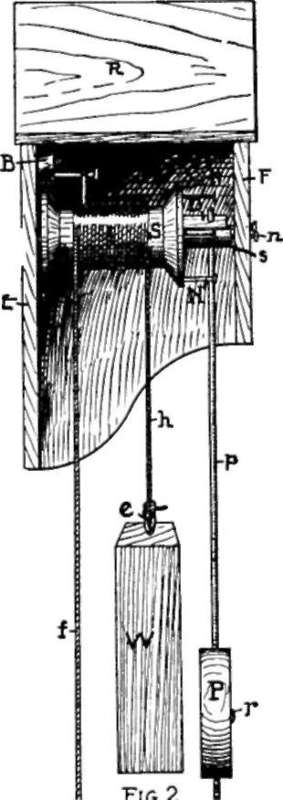
The spool S is mounted on a tight wooden axle s with needles or brads on the ends to turn on, as at n. The brads N are nailed in place, as you see in Figure I, and the axle s sticks out enough so that when the spool is mounted in a frame, as in Figure 2, the nails have plenty of room without hitting the frame.
The frame can be made as in the separate drawings, Figures 3 and 4, -3 being the pattern for the ends, which are cut of thin cigar-box wood with a keyhole saw, and 4 giving a pic-ture of the finished frame from the front.
Of course, you needn't make the frame just like this. For instance, instead of the wooden axle s, you could use a large screw and hold up the outer end of D by a wire bracket. Then all your machinery would be in sight. If you want to inclose it, this form shown by Figures 3 and 4 is good, and you can fasten a hand to the outer end of n to turn like the second hand of a watch, - only faster.
If you like, instead of a spool, you could cut a larger wheel with little pegs in the rim and with sixty little brads in the face. Then you could lengthen the pendulum to beat once a second, and your wheel would turn once a minute (60 seconds), just like the second hand of a watch.


The pawl piece B, Figure 1, is cut from a piece of half-inch wood and pivoted on a brad or a small screw. The nail b at its other end may be a shingle nail.
The piece D needs to be only half an inch square, and you can see in the small sketch of Figure 4 how the wires are fastened to it with a small screw g. The holes may be bored so the wires will be a tight fit.
Figure 4 will show also how to hang the pendulum. This is just a round piece of wood Pf weighted with lead, perhaps, that is fitted on a wire p. By sliding the wood up and down on the wire, you can vary the time the pendulum will swing.
The weights are to keep the string on the spool tight and to wind the machine up. The big one does the work, and when it goes down, -the string is wound several times around the spool S, - the little weight goes up. When it gets clear up, you can hold the pendulum off to one side so the nails N won't hit the wire d and pull the little weight down. This will lift the big weight again, and the "clock" will be "wound up."
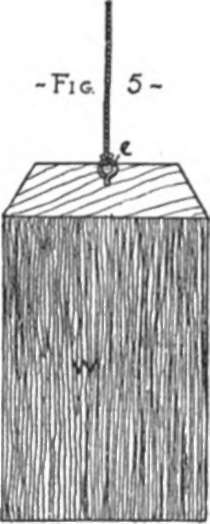
These weights can be made of a piece of wood squared, with a screw eye c in the top; or you can bore a hole in the bottom of them and pour in lead, if you want them heavier.
Continue to:


My Books

