


Office Appliances
Description
This section is from the book "Workshop Receipts For Manufacturers And Scientific Amateurs. Supplement Aluminium To Wireless", by The Chemical Publishing Co.. Also available from Amazon: Workshop Receipts For Manufacturers And Scientific Amateurs.
Office Appliances
Other than the typewriter, the above include such devices as duplicators, letter copiers, and addressing machines, and few modern offices are without some or all of them.
Duplicators
The purpose of these being generally to furnish a number of similar typed letters, the usual method is to cut a waxed sheet or " stencil " by a typewriter, the ribbon being put out of action, while the stencil is being impressed or " cut." The typewriter is operated in the usual way as though ordinary typing was being done, but without a ribbon. The lower priced and slowest type of these duplicators have a flat framework , supporting a fine wire mesh sheet, the stencil is placed on the under side of this, and the frame is brought down until the two are in contact, an inked roller is then passed over the top surface of the wire mesh, ink passes through the mesh on to the stencil, and holds it on to the mesh. A clean sheet being placed under the mesh frame and stencil, the inked roller is passed over again and the ink passing through the impressions in the stencil make a copy on the sheet of paper. This being continually repeated results in a number of duplicate copies being made. From time to time the roller is reinked by passing it over (generally) a slab of slate having a supply of ink thereon. The number of copies obtained per one stencil in this way is about 200, and depends rather much upon when the wax begins to spread and distort under the roller pressure, and also upon the care of the operator. The speed of operator is controlled by the operator's quickness in taking off the copies and putting on the blank sheets, also by the time taken by the rolling on of the ink, etc. It will readily be seen that this is not a high speed method of obtaining copies, but may easily suit some requirements. If the time taken to change the sheets, to raise and lower the framed mesh, and to use the inked roller can be practically cut out, then clearly the speed of production of the copies increases considerably.
This has been done in a rotary letter duplicator, of which Fig. 128 shows one of the best known makes, which by turning the handle will produce 100 perfect copies per minute, which is a speed much in advance of that of the type first described. The stencil used on this rotary machine is cut exactly in the same manner as before described. It is then fixed securely around the cylinder, avoiding any fullness or wrinkles anvwhere. The machine has inside the main cylinder an ink reservior which will hold enough ink for thousands of copies. Before the new stencil is put on the lever of the ink reservoir is operated, which brings an inked roller inside the main cylinder into con-tact with the ink in the reservoir, and thus re-inks it. From 21)0 to 300 copies can be obtained from one inking, after which the ink lever is again operated. A pile of paper about 3/4in. thick is taken, the top edge flipped to overcome any tendency for the paper to stick together, and placed as shown in Fig. 128, a few other simple points are observed and the printing then commenced. It is important that the first one or two copies should be taken slowly in order to get a good impression, but afterwards good copies can be obtained as quickly as the handle can be turned. The action of the machine is entirely automatic, it taking in one sheet at a time, printing it, and delivering it unto the other side of the machine, where it is blotted. For the duplication of handwriting and drawing, etc., proceed as follows :-
Autographic Work-Handwriting
This may be done by any of the following three methods :
1. ;By means of a sharp-pointed Stylus pen and Stylus plate.
2. ;By means of a wheel pen on a zinc writing plate.
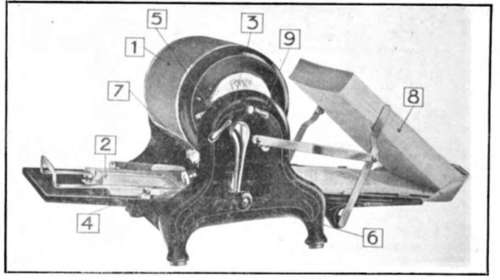
Fig. 128.
3. By means of a blunt-pointed Stylus pen and file plate.
1. For the first method, Stylus stencil paper is used (but Typo stencil paper can also be used if the protecting tissue is removed). The Stylus plate is laid between the wax sheet and the backing sheet, and the stencil made by writing on the wax sheet with the Stylus pen.
This method will not produce the fine, sharp work obtained by other methods, but it is to be recommended on account of it being possible to use the same ink as for Typo work, whereas the other methods require "Autographic " ink. Autographic ink is of a different nature to Typo ink, and before changing the ink, the machine must be thoroughly cleaned and a new-pad put on. Also, the self-inking reservoir cannot be used with Autographic ink, the ink having to be applied with a brush. When, therefore, the machine is wanted for reproducing both typewriting and handwritten work, " Typo " stencil, sharp stylus, and typo ink are recommended.
2. In the second method, Autographic stencil and Autographic ink are used. The zinc writing plate is laid between the backing and the wax sheet and the stencil is made by writing with the wheel pen. A stretching board is very useful, especially if any ruling is to be done.
The wheel pen should be frequently cleaned with a little oil. Apply this by means of a splinter of wood dipped in oil, and run the pen to and fro over the palm of the hand.
After each stencil has been made the zinc writing plate should be rubbed over with a piece of fine emery paper fill all traces of the writing have been removed.
Should an error occur when making a stencil, the error should be brushed over with " Correctine " (which dries in a few moments) and the correct lines can then be written in.
3. The third method also requires the use of Autographic stencil and Autographic ink, but the stencil is made by placing the wax sheet over a file plate and writing on it with a blunt Stylus.
Continue to:


My Books

