


Pneumatic Tools. Continued
Description
This section is from the book "Workshop Receipts For Manufacturers And Scientific Amateurs. Supplement Aluminium To Wireless", by The Chemical Publishing Co.. Also available from Amazon: Workshop Receipts For Manufacturers And Scientific Amateurs.
Pneumatic Tools. Continued
It is very essential that the coupling between the cylinder and handle of the hammer should always be kept quite tight, and this point requires particular attention with a new tool. For the Boyer and B.-K. chipping hammers a special spanner is provided for this purpose.
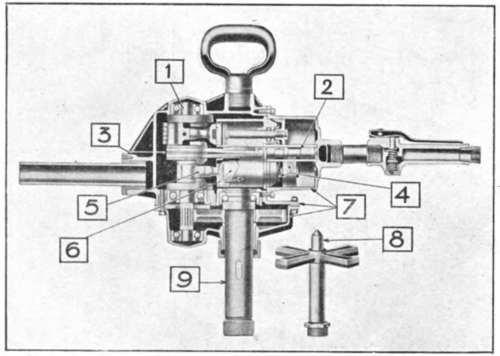
Fig. 171.

Fig. 172.

Fig. 173.
Keep the air mains and receiver well drained : the arrangement of the piping has some influence on the disposal of water; makers will be pleased to advise users on the best arrangement to suit any conditions.
After use, a pneumatic hammer shoultl have a charge of oil blown through it to remove moisture which might otherwise be left in after the day's work.
Use the best possible quality of light oil for the hammers, and a good grade of heavier oil for the drills. Great care should be taken to adhere to maker's instructions re use of any special oil or grease.
The working parts of Pneumatic Tools must never be ground or otherwise altered. Makers employ special care to ensure all parts being as near as possible to the dimensions they have found necessary, and it is only natural that their working cannot be subsequently improved by rubbing them with emery cloth, or altering them on a grindstone or emery wheel, by hand.
It is essential that the shanks of the chipping and caulking tools, or snaps, should be exactly to the proper dimensions. Chisels or snaps with defective shanks must not be used, otherwise the piston, which is an expensive part, will be ruined.
New parts to replace those worn or broken, are kept in stock, and as a separate symbol number is assigned to each part, it is only necessary to quote that number and the number stamped on the machine, when ordering.
Do not allow drilling machines to be run light with an open throttle.
See that air mains are drained to prevent moisture being carried to the tools and carefully blow out all hose pipes to remove any dirt before connecting them to the hammer.
See that the right kind of lubricating oil is used on the tools. For hammers, a light mineral oil is best. A thick oil tends to clog the working parts and a vegetable oil causes working parts to stick.
See that the hammers are properly lubricated. If they are being used continuously, it may be necessary to pour a little oil into the tool through the air inlet (before connecting the hose) during the working shift. It is preferable to have the hammers returned to the Store Room every night so as to make sure that they are clean and lubricated. To clean the tool, paraffin should be run through, or it should be left suspended over night in a bath containing a mixture of half paraffin and half hammer lubricating oil. It is important to note that after cleaning with paraffin, the tool must be thoroughly blown out and lubricated, as paraffin is not a lubricant.
See that handle and other parts are kept tight. On every pneumatic hammer, the effect of the vibration may cause a little slackening here and there and unless parts are kept tight, there may be serious loss of efficiency.
See that the shanks of chisels are of the correct diameter and length and that the striking face is flat and square. The chisel sleeve in the nose of the hammer cylinder is bound to wear in the course of time, and this part should be replaced when the chisel shank is too slack.
The fits of working parts on a pneumatic hammer are necessarily very close. The greatest care should therefore be taken to see that the fits of the parts are not destroyed by emery cloth, etc., when tools are being cleaned and repaired.
Continue to:


My Books

