


Roller Bearings
Description
This section is from the book "Workshop Receipts For Manufacturers And Scientific Amateurs. Supplement Aluminium To Wireless", by The Chemical Publishing Co.. Also available from Amazon: Workshop Receipts For Manufacturers And Scientific Amateurs.
Roller Bearings
These may be divided into two main classes, i.e., those in which the rollers make contact with the shaft or axle, and those which run on an inner roller race, which race is fast on the shaft or axle. The first mentioned class require that the shaft be true, and in good order along the whole of the bearing length, otherwise the best results cannot be obtained. Some types of this class of roller bearing have no means provided to separate the rollers from one another, this is distinctly not good, as rollers bearing on the outer race, also on the shaft, and rubbing on one another at the same time must increase the bearing friction. Another type of this class provides for a pin to pass through the centre of each roller, the pin being rivetted at both ends into annular rings, in order to hold the rollers free from each other, and also to cause them to lay parallel with the bearing. In the Hyatt roller-bearing the rollers are made of chrome vanadium steel strip, closely wound like a helical spring. They are wound alternately right and left-handed, are heat-treated, and accurately ground. Steel rods acting as distance pieces pass between the rollers, and are rivetted into steel rings at each end, so forming an effective, simple, and rigid cage. It is claimed that the spiral construction of the Hyatt rollers ensures resiliency, and long life, and also the rollers being arranged alternately right and left handed cause the lubricating oil to be passed continuously over the whole bearing. These Hyatt roller-bearings are made in two different types, one has a slit outer race with no inner race, and with relatively long rollers, while the other has solid steel inner and outer races, and shorter rollers. The former may be used where space is available, and the speed is low, while the latter type is suited for more confined spaces, also for higher speeds, in addition it has an approximate 50% greater capacity than that of a single row radial ballbearing of equal dimensions. Fig. 6 shows the solid race type, and Fig. 7 the slit race type. If the slit race type be used in a wheel or bearing of say aluminium or hard rubber or soft material, it is advisable to fit a cylindrical steel tube or ring in which the slit race is fitted, so that this race is prevented from opening out under pressure.
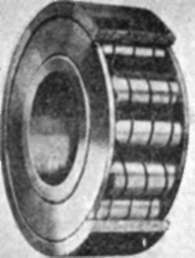
Hyatt Solid Race Roller Bearing
Fig. 6.
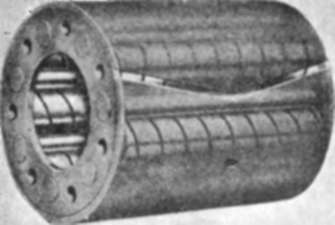
Hyatt Slit Race Roller Bearing.
Fig. 7.

Fig. 8.
In other makes of roller bearings having solid rollers which are short in length, the design generally follows that of ball-bearings in several respects. Fig. 8 shows a radical type single row roller-bearing, having both inner and outer roller races. Fig. 9 gives a section through such a bearing, the method of holding the rollers is clearly seen. Fig. 10 shows a two row self aligning roller-bearing of the Shefko Ball Bearing Co. manufacture, and Fig. 11 shows how the curvature of the outer roller race allows the whole interior including the rollers to be tilted so that the rollers can be easily got at, and also allows the bearing to adjust itself to any want of alignment. Fig. 12 shows the application of such a bearing to an axle box. To obtain the best results from roller-bearings they should be properly protected from dirt and dust, supplied with the correct amount and quality of grease, and given proper mechanical attention when fitted to the job. Generally it may be taken that their use is possible where conditions of heavy loads or high speeds, or both, are against the use of ballbearings.
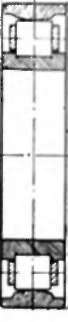
Fig. 9.
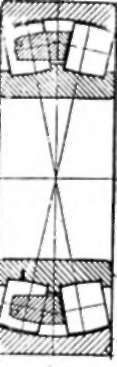
Fig. 10.
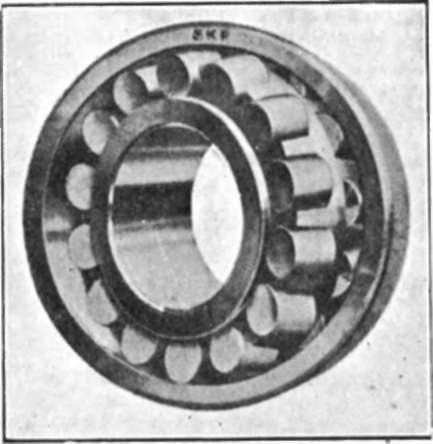
Fig. 11.
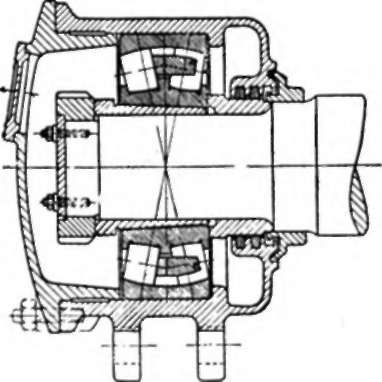
Fig. 12.
Opinions seem to be divided on the question of whether roller bearings should be provided with means of adjustment or not. The bearings dealt with above have no such means of adjustment provided, this being agreeable to those who maintain that if such was provided it would be certain to make for trouble, as the adjustment would be badly handled. Others do not agree, maintaining that the adjustment is perfectly simple, and should be provided, as its advantages are great.
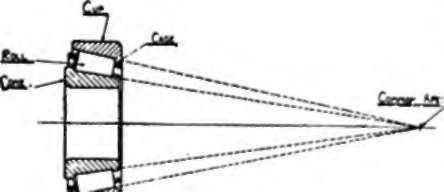
Fig. 13.
Continue to:


My Books

