


The Ewart Detachable Or Pinless Chain. Continued
Description
This section is from the book "Workshop Receipts For Manufacturers And Scientific Amateurs. Supplement Aluminium To Wireless", by The Chemical Publishing Co.. Also available from Amazon: Workshop Receipts For Manufacturers And Scientific Amateurs.
The Ewart Detachable Or Pinless Chain. Continued
The Gray Pin Chain
In this Chain (Figs. 34 and 35) the body of the link is made of malleable iron, and the connecting pin of steel containing about 0.4 per cent, of carbon. The pins are fitted tightly into the side bars, but not rivetted over, and are readily renewable. The bearing area of metal in contact with the pin is made specially large to increase the durability.

Fig. 34.
Chains of the Gray type are not made in very small sizes, the shortest pitch being two and a quarter inches and the longest pitch twelve inches. They are intended to work on wheels made for Ewart chains of corresponding numbers. Thus No. 567 chain will work on wheels made for No. 67 Ewart chain ; while No. 503 chain of three inches pitch will work on sprocket wheels made for No. 103 Ewart chain. Thus it is easy to replace an existing Ewart chain with a stronger type capable of working on the same wheels, a great practical convenience. Gray chains are much stronger than Ewart chains, and the pin is more protected against corrosion and abrasion than the tail-bar of the Ewart chain. Although more expensive than the Ewart chain, the Gray chain is still economical in first cost, and has a wide application in connection with package conveyors ; also for elevators and conveyors handling coal, ashes and sugar. Table II. gives the sizes of Gray chain that are regularly stocked and should preferably be selected for conveyor work.
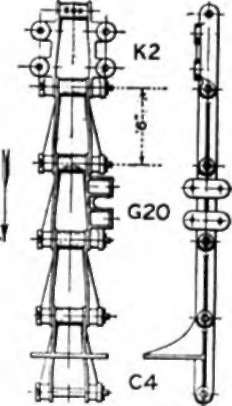
Fig. 35.
The Ley Bushed Chain
Fig. 36 is a considerable improvement on the Gray pin chain, especially for an elevator handling hard gritty materials, such as cement and .stone. It was designed and patented by the late Sir Francis Ley, Bart., a pioneer in conveying machinery. The special feature is the renewable hardened steel bush, which receives both the wear internally due to contact with the pin, and also the external wear due to the abrasion of the sprocket wheel teeth (see Fig 36). These I bushes can be readily replaced when badly worn ; and if the renewals are taken in hand in time, this feature adds greatly to the life of the chain. When new pins and bushes are fitted to an old chain, the original pitch is restored, and the chain takes on a new lease of life. Rut this refitting of the chain must not be delayed too long ; otherwise the whole of the chain will be ruined, and both new chain and new wheels will be required. For specially severe duty the pin and bushes are often made of manganese steel, on account of the great hardness and durability of this material.
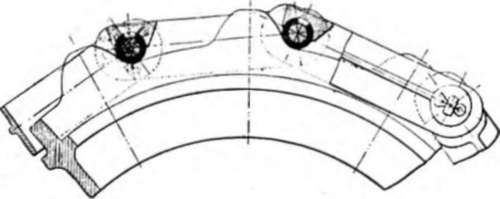
Fig. 36.
Table II. Short List Of Gray Conveyor Chains
| ; | Approximate | ; | ||
Nominal | Pin | ; | W'ght. | Test Load |
Pitch | dia. | Width | of 10 ft. | ; |
in. | in. | in. | lb. | lb. |
21/4 | 3/8 | 3.2 | 33 | 2500 |
25/8 | 7/16 | 3.4 | 35 | 3000 |
3 | 9/16 | 4.4 | 62 | 4000 |
4 | 5/8 | 5.7 | 85 | 5500 |
6 | 5/8 | 5.6 | 60 | 5500 |
12 | 5/8 | 5.6 | 62 | 6000 |
The lightest pattern of Ley Bushed chain made is of three inches pitch, and the heaviest pattern commonly made is of twelve inches pitch. The six-inch pitch chains are utilised to an enormous extent in gas and cement works.
In Table III. are listed the sizes of Ley chain which are commonly stocked, and in regular request.
The Ewart Roller Chain. Fig. 37 is much employed in connection with sugar mills, cane carriers and megasse carriers. The malleable iron roller is of fairly large diameter and travels on angle runways, which form a convenient method of supporting the chain. The rollers are a very free fit on the bosses of the side bars. Two strands of chain are often run in parallel, and occasionally three strands. This chain is not made for very light duty, the usual pitches being 4-inches and 6-inches. The heaviest chain made of this type is No. 9063, with pins 1-inch diameter. It is well adapted for use in glass bottle continuous annealing lehrs, and for other furnace work where the temperature does not exceed a dull red.
Table III. Short List Of Ley Bushed Chains
Nominal Pitch | Approxim | ate | Test Load | |
Pin dia. | Width Width | W'ght of 10 ft. | ||
in. | in. | in. | lb. | lb. |
3 | 9/16 | 4.4 | 74 | 4000 |
4 | 5/8 | 5.7 | 96 | 5500 |
6 | 11/16 | 6.1 | 104 | 6000 |
6 | 7/8 | 7.4 | 180 | 8500 |
12 | 11/16 | 6.1 | 9 | 6000 |
12 | 7/8 | 7.4 | 145 | 8500 |

Ewart Roller Chain.
Fig. 37.

De Brouwer Type of Chain.
Fig. 38.
The sizes of Ewart roller chain commonly stocked are given in Table IV.
Table IV. Short List Of Ewart Roller Chains
Nominal Pitch | Ap | proximate | Test Load | |
Pin Dia. | Width | W'ght of 10ft. | ||
in. | in. | in. | lb. | lb. |
4 | ; | 3.5 | 74 | 4000 |
6 | i | 3.7 | 86 | 6000 |
6 | i | 4.1 | 100 | 8000 |
6 | 1 | 4.5 | 145 | 10000 |
The De Brouwer type of chain is shown in Fig. 38. It was originally brought out by a Belgian engineer of that name, and has been used in gas works for handling hot coke more extensively than any other type of conveyor chain ; while it has also a limited application for other purposes. It will be noticed that the bosses of the side links are extended in order to be encircled by the wide middle links, and are tied together by rivets, which latter do not take the load in the same way that the pins do in an ordinary pin chain.
The De Brouwer chain is commonly built up of steel drop forgings and alternatively of malleable cast iron with steel crossbars rivetted on ; thus chains of different widths can be conveniently built up by varying the lengths of the crossbars.
Continue to:


My Books

