


219. The Chief Irregular Verbs
Description
This section is from the book "Lessons In English", by Chestine Gowdy, Lora M. Dexheimer. Also available from Amazon: Lessons in English.
219. The Chief Irregular Verbs
The verb be is a very irregular verb of the old conjugation. Its forms are from three different roots. Be, being, and been are from one; was and were from another; and am, is, and are from another. The verb be has more different forms than any other English verb.
Must has but one form.
May, can, and shall have but one other form each, might, could, and should.
Will is occasionally conjugated like a new conjugation verb, but it has also a very common form, would.
Go has for its principal parts go, went, and gone. They are from two roots. The old past tense form has been lost, and went, a form of the verb wend, has been substituted.
Many weak verbs are irregular. See list, pages 333-335.
Exercise 260
Give the principal parts of these verbs. Classify them as verbs of the old or the new conjugation. If you are not sure of the classification, consult lists on pages 330-335.
drop, ring, annoy, talk, fall, keep, put, catch.
Exercise 261
Conjugate these verbs in the indicative mode, present and past tenses: begin, attack, drown, light, take.
Exercise 262
Learn the principal parts of the verbs given below and use each form correctly in a sentence. Remember that most participles may be used in verb phrases, but past tense forms must be used as verbs.
knit, steal, fly, flow, flee, choose, dare, write, learn, throw, see, speak, come, take, go, cut, lead, break, do, ride, run, begin.
Which belong to the new and which to the old conjugation?
Exercise 263
Fill blanks with the correct forms of verbs in parenthesis.
1. Such excitement was never ----- before. (see)
2. He has ----- to school. He ----- an hour ago. (go)
3. Have you ----- your composition? I ----- it yesterday. (write)
4. Her composition was carefully -----. (write)
5. Has she-----? Yes, she ----- yesterday. (come)
6. She has ----- her doll. (break)
7. The dish was ----- yesterday. (break)
8. Has she ----- the work carefully? Yes, she ----- it with great care. (do)
9. He has ----- away. (ride)
10. He ----- away yesterday. (run)
11. I ----- an oriole yesterday. (see)
12. She has often ----- of the matter. (speak)
13. The tramp has ----- a gun. (steal)
14. She ----- to speak too soon. (begin)
15. She ----- the work well. (do)
16. The boy has ----- his knife. (break)
17. Have you ----- her? (see)
18. I have often ----- her. (see)
19. I ----- her yesterday. (see)
20. The little boy then ----- in and sat down by the window. (come)
Exercise 264
Learn the principal parts of the intransitive verbs sit, lie, and rise, and of the transitive verbs set, lay, and raise.
Which of these verbs belong to the new conjugation? Which to the old? The transitive verbs are sometimes called causative verbs. Can you see why? Use the principal parts of these six verbs and also their present participle in sentences. In some of your sentences use participles in verb phrases, and in others use them as direct adjuncts.
Exercise 265
Fill each blank in the following sentences with a form of sit or set.
1. ------ the lamp on the table.
2. Then she ------ down to rest.
3. I have ------ here a long time.
4. Please ------ still.
5. I will ------ the cup here.
6. The woman ------ by the window is Mrs. White.
7. She often ------ the breakfast table at night.
8. She often ------ down to rest.
9. ------ the work basket on the table, she rose and left the room.
10. I have ----- the pail by the door. It is still ------ there.
11. Just ------ down a minute.
12. She ------ the chair against the wall.
Exercise 266
Fill each blank in the following sentences with a form of lie or lay.
1. Deep shadows now ------ on the grass.
2. The child ----- on the bed an hour.
3. ------ the bundle here.
4. I am sure I ------ the bundle there.
5. I have ------ your books on the shelf.
6. The child ------ on the cot is sick.
7. ----- still.
8. I have ------ still a long time.
9. He came in and ------ his books on a chair.
10. They are still ------ there.
11. He ------ down every afternoon.
12. The land - well.
13. I will ------ down to rest.
Exercise 267
Fill blanks with forms of rise or raise.
1. ------ the window.
2. The sun ------ at six o'clock.
3. ----- at once.
4. The chairman ----- his hand, asked for quiet.
5. He ----- his hand when the noise began.
6. The bread ----- slowly to-day.
7. Don't ----- so abruptly.
8. The wind has ----- since the sun went down.
9. The price of corn has ----- recently.
10. The sick man ----- himself in bed.
11. ----- hurriedly, she dropped her work.
12. I want the bread to ----- early to-day.
Exercise 268. Review
Fill the blanks in these sentences with correct forms of verbs used in the last three exercises. Be sure every one is correct, then read the sentences aloud several times.
1. I found the book ----- on the grass last night, and 1 believe it had ----- there for days.
2. We were ----- under the trees.
3. She ----- her work on the table and ----- down to rest for a few minutes.
4. Have you ever ----- on pine needles and looked up through pine branches?
5. Where is it -----? Where you ----- it yesterday.
6. The hen had been ----- a week.
7. Has he ----- any money by?
8. Was the baby ----- still?
9. Show me how the land -----.
10. The price of wheat ----- five cents a bushel last week.
11. After ----- quiet for a time, she felt rested.
12. The river has ----- five inches to-day.
13. Wages have ----- this fall.
14. Has she ----- down?
Exercise 269. Composition
Write a connected story, using as many forms of each of these verbs as you can: sit, set, lie, lay, rise, and raise. Make your story connected and sensible.
Exercise 270. A Description
Read the following description of the "dropping song" of a mocking bird. Try to see and hear the bird as you read the description.
"Dropping Song" Of The Mocking Bird
Whoever has closely observed the mocking bird has noted its mounting song," a very frequent performance, wherein the songster begins on the lowest branch of a tree and appears to mount on its music from bough to bough, until the highest spray is reached, where it will sit for many minutes flinging upon the air an ecstatic stream of song. But he who has never heard the " dropping song " has not discovered the last possibility of the mocking bird's voice. It is, in a measure, the reverse of the "mounting song," beginning where the other leaves off; but it is very much rarer. I have heard it but four times during all my rambles: once in Georgia, twice in the immediate vicinity of Tallahassee, Florida, and once near the St. Mark's River. My attention was first called to this interesting performance by an aged negro who was with me on a camping trip. One morning, as a burst of music rang out from a haw thicket near our extemporized camp, he cried out, "Lis'n, mars, lis'n, dar, he's a droppin', sho's yo bo'n!" I could not see the bird, and before I could get my attention fixed upon the song it had ended. However, Uncle Joe gave me a graphic description of the bird's song and actions, and after that I was on the outlook for an opportunity to verify his statements.
I have not kept the exact date of my first actual observation, but it was late in April, or very early in May; for the crab-apple trees, growing wild in the Georgian hills, were in full bloom, and spring had come to stay. I had been out since the first sparkle of daylight. The sun was rising, and I had been standing quite still for some minutes, watching a mocking bird that was singing in a snatchy broken way, as it fluttered about in a thick-topped crab-apple tree thirty yards distant from us. Suddenly the bird leaped like a flash to the highest spray of the tree and began to flutter in a trembling, peculiar-way, with its wings half spread and its feathers puffed out. Almost immediately there came a strange gurgling series of notes, liquid and sweet, that seemed to express utter rapture. Then the bird dropped, with a backward motion, from the spray, and began to fall slowly and somewhat spirally down through the bloom-covered boughs. Its progress was quite like that of a bird wounded to death by a shot, clinging here and there to a twig, quivering and weakly striking with its wings as it fell; but all the time it was pouring forth the most exquisite gushes and thrills of song, not at all like its usual medley of imitations, but strikingly unique. The bird appeared to be dying of an ecstasy of song. The lower it fell, the louder and more rapturous became its voice, until the song ended on the ground in a burst of incomparable vocal power. It remained for a short time, after its song was ended, crouching where it had fallen, with its wings outspread, and quivering and panting as if utterly exhausted; then it leaped boldly into the air and flew away into an adjacent thicket. Maurice Thompson. Adapted.
Exercise 271. Word Studies
Read again the description given in Exercise 270, and make the following lists of words: (1) verbs used to express actions of the bird, (2) verbals used for the same purpose, (3) well-chosen adjectives. Make a list of groups of words used to name the different songs of the mocking bird.
What words in your lists have you never used in talking? What ones have you never used in writing? Are there any that you have never before heard or seen?
Topics For Oral Composition
Give especial attention to your choice of words. Select such as will make your picture vivid. Perhaps you will use some that you have never used before.
Be very careful not to misuse verb and verbal forms.
1. Some animal in a city park.
2. A visit to a park.
3. An animal story by Kipling, Ernest Thompson Seton, Burroughs, Long, or Harold Baynes.
4. A quiet spot.
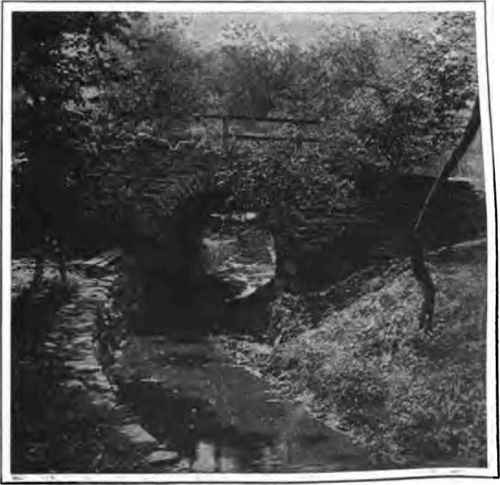
A Quiet Spot. A.J.Swanson.
5. Describe a bird or some other wild animal as you would describe it if you merely wished to enable some one to recognize it. See if your classmates can tell from your description what you were thinking of.
6. Describe the same animal as it lives in its favorite haunts. Tell about its actions, its home, its food, and all the other things that go to make it interesting.
7. Ten minutes on a street corner.
8. Scene on a crowded street car.
9. A character in some book you have read. 10. The song of some particular bird.
Continue to:


My Books

