


Disjoined Affixes
Description
This section is from the book "The Manual of Phonography", by Benn Pitman And Jerome B. Howard. Also available from Amazon: The Manual of Phonography.
Disjoined Affixes
187. Disjoined Affixes
Certain frequently-recurring affixes are conveniently represented by special signs which are disjoined from the outline of the main word or "stem." Disjoined suffixes are placed near the end of the stem-outline and disjoined prefixes near its beginning.
188. Disjoined Suffixes.
A
ing. When the stem ends with involute motion the stroke
 is generally the best form, as also it is after the strokes

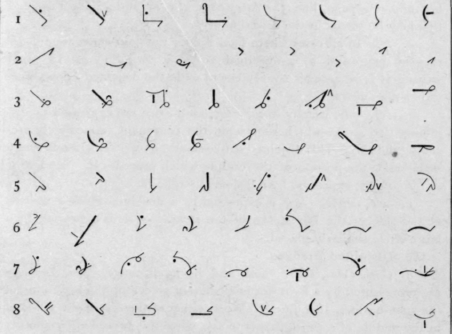
 . After evolute motion and after all other straight strokes use a small dot immediately following the stem-outline. See page 91, line 1.
B
ings. When -ing is represented by a dot, the plural should be represented by a small circle placed in the position of the dot. See page 91, line 2.
R
ing-the. When the follows a word ending with the dot-ing,
Exercise on the Tick-the.
Exercise on the Tick A-an-and.
Disjoined Affixes
Concluded.
-ing-the may be expressed by writing the tick in the position of the dot. See opposite page, line 3. After ch,j, s, z, sh, and zh the disjoined tick may be struck in the direction of p.
D
ly. In all cases where final / does not join conveniently, -ly may be expressed by a disjoined stroke-/. See line 4. In rapid writing it is sometimes convenient to write the disjoined / downward rather than upward.
E
l-ty, -r-ty, usually -ility, -ality, and -arity, are expressed by disjoining that stroke which represents the consonant immediately preceding the affix. This disjoined stroke should be written close to and a little below the portion of the outline which precedes it. See line 5.
f. ship is expressed by a disjoined stroke sh.
G
self, -selves, -self is expressed by a disjoined circle-.s written at the side of the last stroke of the stem, -selves is expressed by a large circle similarly placed.
189. Disjoined Prefixes.
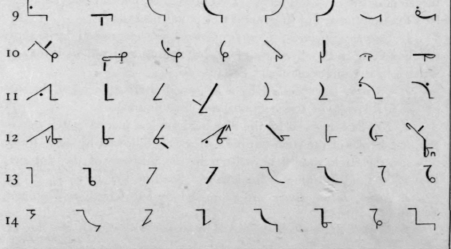
a. Con-, Com-, Cog-. Con- and its modifications com- and cog-are represented by a light dot immediately preceding the beginning of the stem-outline. See line 8. When either of these syllables is found in the middle of a word, that is to say, when it is preceded by another prefix, the con, com, or cog is expressed by its omission, the portion of the word which precedes it being written near the beginning of the stem-outline. See line 9. This preceding portion may be vocalized for exactness, but in general this is not necessary.
b. Counter-, Contra-, Contri-, Contro- are expressed by a short tick generally in the direction of ch, but before ray and m it may be written in the direction of P.. See line 10.
c. Circum- is expressed by a disjoined circle-s placed at the side of the first stroke of the stem-outline. See line II.
d. Self is expressed by the disjoined circle-.s placed at the side of the first stroke of the stem-outline. If self- is followed by -con-, -com-, or -cog-, the circle should be written in- the position of the dot con; that is, at the beginning of the stroke. See line 12.
e. Inter-, Intro-, Enter- are expressed by half-length n disjoined. See line 13.
f. Magni-, Magna- are expressed by stroke-m disjoined. See line 14.
Exercise on Disjoined Suffixes.

Exercise on Disjoined Prefixes.

Continue to:


My Books

