


The Halving Principle
Description
This section is from the book "The Manual of Phonography", by Benn Pitman And Jerome B. Howard. Also available from Amazon: The Manual of Phonography.
The Halving Principle
158. Vocal Affinity
A strong affinity exists, in the English and in other languages, between sounds of a like nature with respect to vocality - that is to say, a voiced sound is much more likely to be immediately followed by a voiced than by a whispered sound; conversely, a whispered sound is more likely to be immediately followed by a whispered than by a voiced sound. This is observed in plurals, which are regularly formed by adding s (a whispered sound) to the form of the singular when that ends with a whispered sound, as lock, locks; and z (a voiced sound) when the singular ends with a voiced sound, as log, logs (=logz). Vocal affinity has an equally strong illustration in the formation of the past tenses of weak verbs - those of which the past tense is usually represented by ed in the ordinary spelling. The sound which forms these past tenses is t (whispered) whenever the present tense ends with a whispered sound, as, pluck, plucked (=pluckt), and d (voiced) whenever the present tense ends with a voiced sound, as plug, plugged (=plugd).
159. The Halving Principle
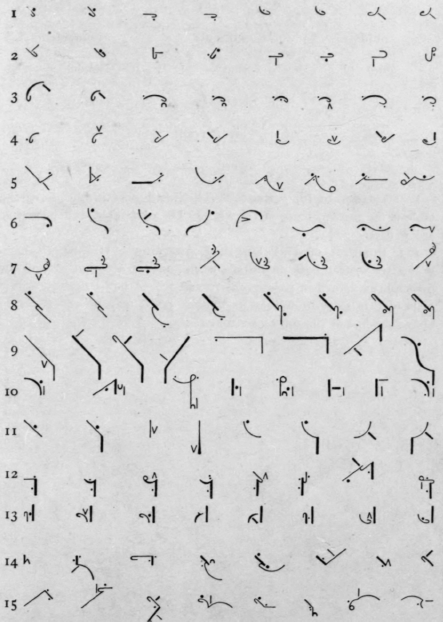
The frequent occurrence of t and d in past tenses, as well as in other cases, is provided for in phonography by what is called the "halving principle." By halving a consonant stroke, t or d is added according as the stroke is light or heavy - t being added to a light stroke and d to a heavy stroke. See lines 1 to 3.
160. Vocalization Of Half-Lengths
a. A vowel before a half-length stroke is read first. See line 4. b. A vowel after a half-length stroke is read next after the primary letter but before the added or d. See line 5.
161. Halving of L, R, M, N. - The rule for writing given in par. 159 would agree exactly with the phonetic principle stated in par. 158 if it were not for the fact that /, r, m, and n, although voiced sounds, are represented by light lines, contrary to the general method of representation explained in par. 6. When these strokes are halved t is added because they are light. See line 6. But as these strokes represent voiced sounds it is desirable to add the voiced sound d; and this is done by shading the strokes when halved for that purpose. See line 7. This necessitates that y, w, nip and ng never be halved. Half-length Id should always be written down.
162. Tick-H On Halved Strokes
The tick-h is attached to half-length exactly as it is to full-length strokes. See line 8.
163. Circles And Loops On Halved Strokes
The circles and loops are attached to half-length exactly as they are to full-length strokes. See lines 9 to 12.
164. Halved Double And Triple Consonants
The l and r-hook strokes, as also the large w-hook strokes, are halved like simple strokes. See lines 13 to 15.
Exercise on the Halving Principle.

The Halving Principle
Concluded.
165. Halved Final-Hook Strokes
The final-hook strokes-may be halved to add either t or d. See lines 1 to 3. To distinctly indicate the added d the hook may be thickened, but this is seldom necessary in practise. Although w, y, mp and ng cannot be halved when simple, they may be when followed by a final hook. See line 3.
166. Halved W-Hook Strokes
When a small w-hook stroke is halved, the addition of either t or d is indicated. When d is added the stroke is not shaded. See line 4.
167. Halved Ray
Ray may be halved whenever it is joined to some other stroke (see line 5) but it must not be halved when it would be the only stroke in the word. Words like rate, and write must be written in full.


168. Half-Lengths Joined At A Tangent
A half-length stroke cannot generally be used unless it makes a distinct angle with its adjacent stroke, as half-lengths joined at a tangent (cp. par. 25 c) produce indistinct outlines. If, however, the half-length stroke is a heavy curve and the stroke to which it is joined is light, the tangent joining will be sufficiently distinct. See line 6.
169. Half-Length S
When a half-length s ends an outline it may be written either upward or downward according to convenience. See line 7.
170. Rules For Writing Past Tenses
a. When the present tense ends with a full-length stroke (simple or compound) halve that stroke to form the past tense. See page 77, lines 1 to 3. b. Light double consonants may be halved to add d in forming past tenses. See page 79, line 8. c. When the final full-length stroke in the present tense forms no angle with its preceding stroke the halving principle cannot be used (cp. par. 168) and a stroke t or d must be added (see line 9); except (d) when such final full-length stroke making no angle with its preceding stroke is t, in which case the t should be halved and disjoined to form the past tense, as shown in line 10. e. When the present tense ends with a vowel preceded by a full-length light simple stroke, the halving principle should not be used, but the stroke-d should be added to form the past tense. See line 11. f. When the present tense ends with a half-length stroke add the stroke-d to form the past tense (see line 12), but (g) if the stroke-d forms no angle with the preceding half-length stroke or cannot be coveniently joined to it, it must be disjoined as shown in line 13.
171. Free Use Of The Halving Principle
In certain outlines, especially in those of two or more strokes, some license may be taken in using the halving principle to indicate d after light strokes and / after heavy strokes. This, however, should be done with caution, and only when a decided practical advantage and no ambiguity results therefrom. See lines 14 and 15.
Exercise on the Halving Principle-II.
Continue to:


My Books

