


Final Hook For Tion
Description
This section is from the book "Phonetic Shorthand", by William W. Osgoodby. Also available from Amazon: Phonetic Shorthand.
Final Hook For Tion
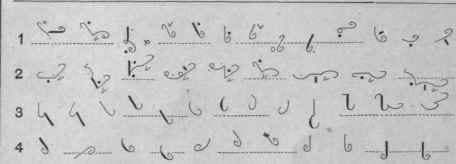
Sec. 22, The syllables Tion, Sion, etc., are expressed by a small circle and back-hook similar to the expedient for Sn. (See Sec. 8, g, h). A small circle may be written within the back-hook to add S. The syllable Tion may be added to an N-hook, on a straight stem, by changing that hook to a circle and continuing the stroke to form a back-hook; and another circle for S may be written within the back-hook. {Lines 6-12.) a. Tion may be indicated after the D-stem and an F-hook, by a small hook outside of .the F-hook; but when two vowels immediately precede this syllable, in such cases, Ish with the N-hook is used for Tion. {Line 12.) b. In such words as dictionary, stationer, national, the back-hook is omitted. {Lines 13,14.) c. The past tense of verbs ending with Tion, is indicated by halving the stem immediately preceding that syllable. In words ending with -ate following Tion, a half-length N is used after the circle, instead of the back-hook. {See Section (Line 15.)
M-Hook Contractions
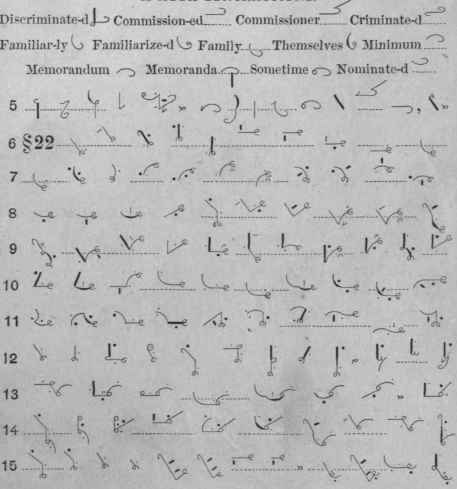
d. The termination S-tion, in such words as position, physician, is indicated by a large circle and back-hook; and a final circle may be written within the back-hook. (Line 1.) e. S-tion is added to an N-hook, by changing the hook to a large circle and adding a back-hook; and a final circle may be written within the back-hook. (Line 2.) f. In words ending with -est or -ist, following Tion, the syllable may be indicated by a small loop added after the circle, or by using a half-length S. [Line 2.)
Write Exercise XX. of the Speed-book.
Halving To Add T Or D. Sec. 23. Making any stem half-length, except as stated in this section, adds to it the sound of T or D. The added sound is read after the stem, and after all vowels and hooks, but before a final circle or loop. {Lines 3-9.) a. Words containing a second-place vowel, with no other stem than L, R, M or N, when halved to add the sound of D, are written through the line, to distinguish them from similar words ending with the sound of T; but when such words end with a hook, the sound of D may be indicated by shading the hook.
b. Half-length stems are written below the line, for the third position.
c. A half-length stem must not be joined to another stem, except where its length can be readily distinguished.
d. Ray is seldom halved to add D, except when hooked, or when preceded by F, V, M or L. (Line 10.) e. The syllable -tive is usually indicated by a V-stem following a half-length. (Line 11.) f. Phrasing. - Halving any word-sign, or the last stem of an outline, adds the word It or The, and occasionally the word
To. [Lines 12, 13.)
Key to Lines 12,13. - Take-it-away. Did-it-mean. If-it-had-not-been. For-which-it-was. Can-it-be. If-it-were. Is-it-not. After-it-was. Shall-it-be-said. Where-it-was. May-it-not-be. Whether-it-is-or-not.
Upon-the-occasion. About-the-same. At-the-time. Charge-the-amount. For-the-sum. Of-the. With-the-details. From-the-time. What-were-the-means. Go-to-him.
Note. - A dot at the beginning of a stem indicates the prefix Com or or Con. See (*) on page 35. A dot at the end of a stem, indicates Ing.

Tion-Hook Contractions
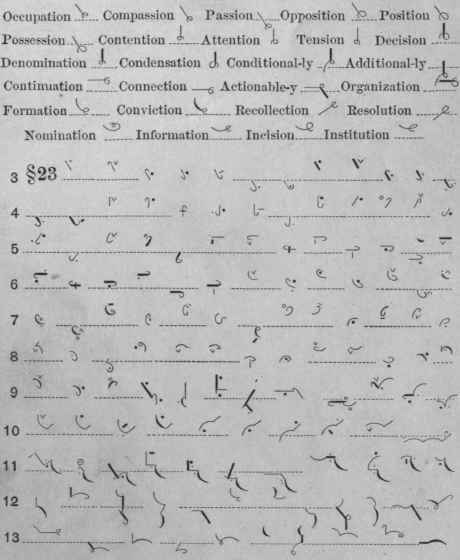
g. Halving a pronoun or adverb, adds the word Did. Halving- any preposition which is written with a curved stem, adds the word What. {Line 1.)
Key to Line 1. - What-did-you-mean. Which-did-you-get. When-did-you-go. We-did. You-did. If-they-did. He-did-not. She-did-not say-that. Whether-he-did-or-not. Where-did-you-see-him. From-what-time.
Write Exercises XXL and XXII. of the Speed-book.
Continue to:


My Books

