


Phonetic Shorthand
Description
This section is from the book "Phonetic Shorthand", by William W. Osgoodby. Also available from Amazon: Phonetic Shorthand.
Phonetic Shorthand
Sec. I. Introductory. - a. In Phonetic Shorthand words are spelled as they are pronounced, and no silent letters are used. In the English alphabet the sounds of Ch as in chain, Th in thin, Sh in show, and Ng in sing, are not provided with distinct letters, though they are really simple sounds. The same letter often indicates different sounds, in different words, as the letter G, in the words gun, gem; the use of two or more letters to indicate a sound for which a single character is provided, is also very frequent, as the sound of F in the word trough, triumph; and a single, simple sound is often indicated by letters to which entirely different values are usually assigned, as in the words pleasure, azure, the letters S and Z are used to indicate a sound which has no precise representative in the language. Similar inconsistencies exist with respect to vowel sounds. In Phonetic Shorthand, however, each distinct vocal sound is provided with a distinct letter.
b. The alphabet should be carefully studied, and the names of the letters should be learned in connection with their sounds. The letters Chay and Gay, for instance, which represent the sound of Ch and the '"hard" sound of G, should not be called see-aitch and jee There is probably no better way to commit the letters to memory, than to trace them repeatedly with a penholder, pointed like a pencil, the sound of each letter being pronounced aloud as it is traced; varying the exercise by frequently writing the letters with particular attention to form and to the proper angle with the line of writing.
c. It is only by careful and persistent practice, not only in writing but in reading his shorthand notes, that a legible style can be acquired by the student: and an illegible style is worthless, even though written at high rate of speed. Every character should be made with precision, and no attempt should be made to write rapidly; speed will come when practice has given the necessary facility for smooth and graceful writing.
d. The different principles should be taken in order, and each thoroughly understood before the next one is taken up. These principles do not apply to single words alone - they apply to classes of words and phrases; and if any one of them be misunderstood or misapplied, the error is far-reaching, involving all the words or phrases in the language to which the rule is applicable.
e. The student should not be satisfied with once reading the engraved exercises; they should be read and copied in shorthand many times, until each word-form can be recognized instantly. The same care should be taken in the use of the writing exercises, which begin on page 73. The value of one's knowledge in this study, depends not only upon his perfect familiarity with every principle, but upon his ability to apply each of those principles readily and correctly; and this ability can only be attained by earnest and painstaking effort.
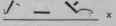
f. The proper use of punctuation will very much aid the student in reading his written exercises. The following marks are used in shorthand:

Period;

Semicolon;

Hyphen;

Dash;

Interrogation;

Exclamation;

Paragraph. Excepting these, the ordinary marks of punctuation are used. The dot of the comma should be distinctly made. "Stet." written in the margin of the notes, indicates that an erasure has been made by mistake. Particular emphasis to a word or phrase is indicated by underscoring it with a waved line. If more than one outline is to be underscored, a light, straight line is used. Two inclined ticks are placed under a word to indicate that it should be written with a capital in transcribing notes; as,

When Envy cannot deny Merit, it ignores it. A proper name, consisting of two or more words may be underscored with a light, straight line; as,
Continue to:


My Books

