


Chapter XI. The Fingers In General
Description
This section is from the book "The Laws Of Scientific Hand Reading", by William G. Benham. Also available from Amazon: The Laws of Scientific Hand Reading.
Chapter XI. The Fingers In General
AFTER viewing the hand as a whole, and separating it into the three worlds, the next observation should be of the fingers in general. This will lead to a classification of the fingers as either long or short, as belonging to the smooth or knotty class, and will cause you to look at the tips to see whether they are square, spatulate, conic, or pointed. Do not try to class any set of fingers in a groups but consider each one, and judge it by itself. Every finger is named for, and partakes of, the qualities of the Mount under it. The first finger is the finger of Jupiter, the second, Saturn, the third, Apollo, the fourth, Mercury. The thumb we do not consider as a finger, but in a class by itself. In examining the fingers first note their length. If they seem unreasonably long, apply the measurements given in a subsequent chapter on long fingers, to determine whether they are long fingers or normal length. If the fingers appear unusually short, apply measurements given in a subsequent chapter, being careful not to class as short fingers those which belong to a normally short hand. Observe the joints to see if they are developed or smooth, using great care in judging the degree of development for each joint, and looking to see if the first or second joints alone are prominent.
If you find very knotty joints, apply knotty qualities; if entirely smooth, give the subject smooth-finger attributes. Examine the flexibility of each finger by itself; if one finger is more flexible than the others, then the qualities of the Mount type it represents are more pronounced in this subject. See if the fingers are straight or twisted. See if the bending is lateral or if the finger seems to twist around on its own axis. Fingers bent laterally (35) increase the shrewdness of the qualities of the Mount on which they are placed, while a twisting on the axis shows a liability to moral or physical defects in the Mount qualities. To determine which, use the nails, the lines on the Mount, the Life line, and the line of the Mount itself. You can easily separate moral from physical defects in this way.
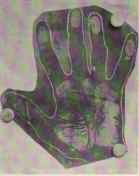
No. 36. FINGERS BENT LATERALLY.
Note carefully the tip of each finger, and apply the square, spatulate, conic, or pointed qualities to the individual finger and its Mount. Note whether any finger seems to stand more erect than the others, with one or more fingers inclined toward it (36). Tliis will show you the strongest finger on the hand. Every finger leaning toward another gives up some of its strength to the finger toward which it leans. This applies if the leaning finger be only straight and merely appears drawn toward another. If the leaning finger is bent it accentuates the strength of its own Mount and you will generally find other fingers leaning toward it. A straight, leaning finger and a bent finger must not be confounded. Fingers to be well balanced should set evenly on the palm (37); one finger should not be placed lower down or higher up than the others. Any finger set lower than the normal line (38, IWO illustrations) reduces the strength of the Mount under it.
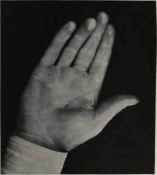
No. 34 ONE FINGER ERECT. OTHERS LEANING TOWARD IT.
And Any finger set higher than the normal line (39), iucreeses the force of the Mount under it. The best development is the evenly set, normally placed finger. At some part of your examination get at the normal way in which the subject carries his fingers, in order to find out which are bound together and which are widely separated. In this examination it is indispensable that the fingers should be held naturally. Any strained position would defeat the object. Various ways can be devised to accomplish this. You can ask that he place his hand in a perfectly natural manner on a piece of white paper as though you were to draw an outline of it. By asking that he lift the hand up and place it on the paper several times in succession, you will get the natural pose accurately. Another way is to ask him to hold the hand up, clear of every support, and extend the palm toward you. When this is done, the fingers assume their natural pose. When the hand thus held shows the space between the thumb and side of the hand to be very wide (40), your subject is generous, loves freedom and independence, and is intolerant of restraint, these being the qualities belonging to the low-set thumb.
If the fingers of Jupiter and Saturn separate widely (41), the subject has great independence in thought, is not bound down by the views of others, hut forms his own opinions. When the fingers of Saturn and Apollo widely separate (42), the subject is careless of the future, Bohemian in ideas, and is entirely devoid of stiffness and love of formality. When the fingers of Apollo and Mercury widely separate (43), the subject is independent in action. He does what he wishes without caring what others may think. These separations of the fingers will be very useful and very accurate in their results. You will find the separations variously combined. Oftenest you find freedom in thought combined with freedom of action, with Saturn and Apollo close together, showing care for the future. You may find freedom of thought with the other fingers close together. Then your subject is a free thinker, but one careful in actions and of the future. When all the fingers separate widely (44) you have free thought, Bohe-mianism, and freedom of action. This subject will be easy to get acquainted with, entirely lacking in conventionality, and not tied down to rules of etiquette. If the separation is very wide, he will be a "nail fellow well met"; if only moderauly wide, the person will be easy of approach.
If all the fingers are held tightly together (45), the subject will be hard to get acquainted with, stiff, and lack independence in either thought or action. He is a slave to formality, and to make his acquaintance one must approach in a respectful manner. He is also stingy, for he is self-centred and constantly looking out for the future. You must compare the fingers with each other as to length, tips, and thickness. Saturn should be the longest finger always, for it is the balance-wheel of the character. The fingers of Jupiter and Apollo should be of equal length to be in balance; the one which is the longer of the two will have its qualities dominant over the other. Tips must be considered, for spatulate or square tips are stronger and more practical than conic or pointed. The fingers of Jupiter and Apollo being of equal length, the one having a square or spatulate tip will be stronger in a practical way than the one having a conic or pointed tip, which, however, is likely to indicate greater keenness. Consider carefully both length and tips of the fingers, in estimating which finger is the strongest. Mercury is naturally the smallest finger. The Mercurian is the smallest of the seven types, Saturn is the tallest, the fingers following the respective height of their types.
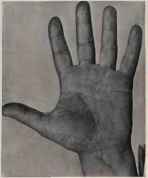
No. 37. Fingers Set Even.
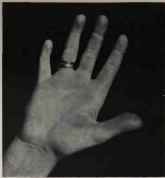
No. 38.MERCURY LOW SET.
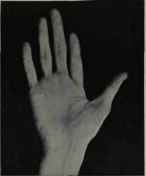
No. 38.JUPITER LOW SET.
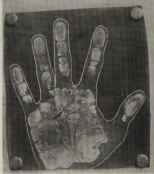
No. 39. SATURN HIGH SET.
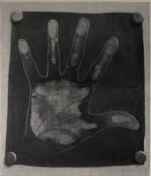
No. 40.SPACE BETWEEN THUMB AND JUPITER WIDE.
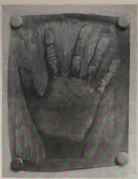
No. 41. SPACE BETWEEN JUPITER AND SATURN WIDE.
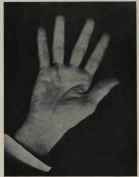
No. 42. SPACE BETWEEN SATURN AND APOLLO WIDE.
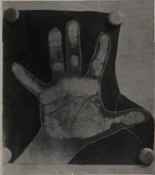
No. 43 Space between Apollo and Mercury wide.
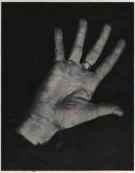
No. 44. ALL FINGERS SEPARATED WIDELY.
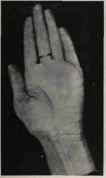
No. 45. ALL FINGERS CLOSE TOGETHER.
Continue to:


My Books

