


Chapter XVIII. Mounts And Fingers - How To Judge Them
Description
This section is from the book "The Laws Of Scientific Hand Reading", by William G. Benham. Also available from Amazon: The Laws of Scientific Hand Reading.
Chapter XVIII. Mounts And Fingers - How To Judge Them
OF the seven Mounts in the hand, four are located at the bases of the fingers, two along the side of the hand which has been called the Percussion, and one at the base of the thumb, being, as before stated, the third phalanx of that member. The Mount of Mars is divided into the upper and lower Mounts, and the Plain of Mars. The plate which accompanies Chapter I. gives the geography of these Mounts. It will be necessary to become familiar with their exact positions and boundaries, in order to tell whether a Mount is in its proper place or is pulled to one side by the greater strength of one of the other Mounts.
As the great difficulty with beginners lies in classifying subjects under their proper types, especially when the type is not markedly prominent, great care has been taken with this chapter to make it very explicit. While, at the first reading, it will seem hard to fully digest, it will grow clearer as you put one after the other of its rulings into practice. It will be a most useful chapter of reference while gaining from experience the ability to classify your subjects under their proper types.
As each Mount represents one of the original types in the plan of creation, it is from the development of a certain one or more of these Mounts, that you can tell to which type the subject belongs. Each finger is named for the Mount to which it is attached, and partakes of the qualities of its Mount. Physiologically these Mounts are the balls or pads of flesh which bulge up from the palm at the base of the fingers, and at other points in the hands. In some hands they form little hills (86), in others they are perfectly flat (87), and, where the Mounts should be. in some cases there are actual holes or depressions (88). Mounts which are very prominent are considered strong Mounts, the flat ones are ordinary, and depressions show weakness and absence of the qualities of the Mount. In your examination, first try to discover which is the strongest Mount. Whichever one it may be, will show that the qualities of that type are leading ones in the subject. If one Mount is found to be very large, and the others normal, it will be a strong indication that the subject belongs to the type of the strong Mount. If on this Mount is found a single deep, vertical line, it will confirm this opinion.
If in addition the finger of this Mount is very long and well developed, being appreciably larger than the other fingers, it is certain that the subject represents practically a pure specimen of this Mount type. Highly developed Mounts, that is, those which rise high, are the strongest in operation. A well-marked vertical line on a Mount, deep and uncut by cross-lines, must be considered, even on what appears to be a flat Mount, as giving the Mount almost equal prominence with the higher development. Two vertical lines add strength, but not as much as one, three lines less, and so on until you find a Mount full of vertical and cross-lines, so mixed that they form a grille (89), which degenerates into the defects belonging to the Mount.
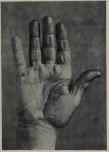
No. 86. HIGH MOUNTS.
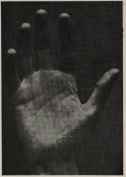
No. 87. FLAT MOUNTS.
Each Mount type has a good and a bad side, a weak and a strong side. The Mount which is well developed and well Mounts and Fingers - How to Judge Them 187 placed, shows the good development: grilled and cross-lined, or with cross-bars or crosses, it shows defects of the type. Hard consistency and red color shows strength of the Mount: fiabbiness and whiteness, even though the Mount be prominent, show weakness and lack of energy. When a strong Mount is found, with a good line on it and a large finger, next see whether the Mount is hard or dabby, and also note its color. If in addition to the strong signs above enumerated you find hard consistency and red or pink color your subject is surely a specimen of this type. In some hands you will find one Mount harder than the others; this, even though the Mount may not be over-well-developed, will add energy and vigor to it. Color also plays a strong part, for all the qualities which it indicates will belong to the Mount on which you may see it. In sensitive hands and those with very fine-textured skin yon will find some of the Mounts pink, others white. In that case apply pink and white qualities to the Mounts having them. In a band having two Mounts equally developed the subject will be a combination of the two types.
If, in this case, one Mount has a good vertical line, or if it should be harder or redder in color than the other, you will know that, while your subject is a combination of the two types, the Mount which either has a vertical line, or is harder, or redder, is somewhat stronger than the other. If you cannot tell by these methods which is the leading type, note the finger carefully, for the Mount with the strongest finger will be the leading one.
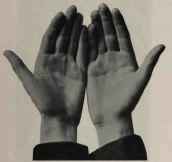
No. 88. DEFICIENT MOUNTS.
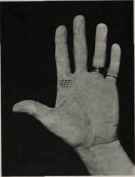
No. 89. GRILLE ON A MOUNT.
Mounts and Fingers - How to Judge Them 189
In judging the ability of fingers to add strength to a Mount, compare their lengths with each other and with the finger of Saturn. A normal finger of Jupiter should reach the middle of the first phalanx of Saturn (90). Saturn should always tower above the other fingers, if the subject is to have a good balance to bis character, for Saturn represents wisdom and sobriety. The finger of Apollo should reach the middle of the first phalanx of Saturu (see 90). Longer than this will show strong Apollonian qualities; shorter than this is deficiency. The normal finger of Mercury reaches the first knot on the finger of Apollo (see 90). If it is pronouncedly longer than this, the subject has strong Mercurian qualities; shorter than this is deficiency. In judging the length of fingers, as regards each other, note whether their seeming length is due to their own increased size, or to the other fingers being under size. By this means you can determine whether the seeming long finger may not be only normal size for the hand, and the other fingers much under-sized. In examining individual fingers note the separate phalanges, for these represent the three worlds - mind, material qualities, and baser - as indicated by the first, second, and third phalanges respectively.
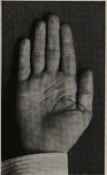
No. 90. FINGERS NORMAL IN LENGTH.
Continue to:


My Books

