


The Line Of Head. Part 2
Description
This section is from the book "The Laws Of Scientific Hand Reading", by William G. Benham. Also available from Amazon: The Laws of Scientific Hand Reading.
The Line Of Head. Part 2
In this examination for the length of the line, proportion must always be kept in mind. If the Head line extends across the entire hand in a straight line (88), with a Heart line normal, it will show the preponderance of head and the subject will be out of balance in this respect. He will be avaricious, will view all things from the mental standpoint, sentiment will be subservient to interest, he will be practical in all things, and more interested in whatever is capable of producing direct results than in beautiful things which please the eye or appeal to the heart. If this long, straight Head line has no accompanying Heart line, the subject will be cold, heartless, merciless, miserly, avaricious, extortionate, and demanding his "pound of flesh." The proportionate depth and character of all the lines must be noted. If the Head line be straight and long and also deep, it makes a stronger combination. When the Head line without the Heart line is found also long and it is straight and deep, it makes worldly interests greater and the subject harder and more avaricious. If this line be also red, it makes the subject aggressive in his avarice, and if yellow he will be doubly mean and hard.
If the Head line be long, but thinner and smaller than the other lines, the head will be on a constant strain and must not be overworked or the brain will be wrecked. If the line be short, narrow, and shallow, it will be a pronounced indication of small mentality. If all the other lines are deep and well cut, and the Head line short and thin, it shows a person easily led, weak in mentality, the servant and creature of others, never the leader. So, together with the length of the line, must be estimated its size and proportion to the other lines, and the subject must be placed above or below the normal balance in accordance with the proportion found. In every case use both hands. If the line be short in the left hand and long in the right, the subject has developed his mentality. If the line be long in the left hand and short in the right, he has retrograded mentally, or else there is danger of fatality from the short line. Examine at once Life line, type, and all health indications to discover which. If the line be narrow and thin in the left hand and deep and well cut in the right, the subject is improving mentally. If this combination is reversed the opposite condition is present.
If the line be long and straight in the left hand and shows the same formation in the right, but with the Heart line absent in the right hand, the subject is naturally grasping and self-interested, and these qualities in him have been tremendously increased until he has become intensely selfish and avaricious. By noting in this way the two hands and their changed condition of lines, you will be able to read changes from the past to a present mental attitude, and can tell the subject how he formerly regarded certain matters and how he views them at present.
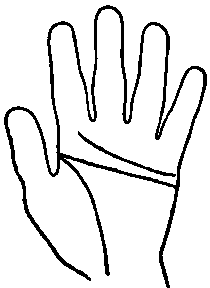
No. 88.
One of the first things to do in reading the Head line is to distinguish disease from character of the mentality. To do this it will be necessary to use not only defects in the line arising from breaks, dots, islands, and similar causes, but also the narrowness and thinness of the line, as well as its proportion to other lines. Inasmuch as the Head line indicates both the extent and character of the mentality and also diseases, it will be necessary at times when a defective line is seen, to distinguish between the two and to estimate whether your subject is lacking in character directions, or whether brain illness or insanity are indicated. Any defect seen on the Head line will indicate mental disturbance, which may be the result of illness, or it may be an indication of the unsteady character of the mentality. In making a distinction between character and diseases the Life line should be examined to see if it is also defective at about the same period as the defect appears on the Head line. Anything abnormal found on the Life line will fix the defect on the Head line as an illness. The nails must also be consulted in connection with the Head line, for if badly fluted they tell of great nervous disturbance, which is emanating from the centre of nerve force, the brain.
If in addition to a defective Head line, fluted and brittle nails are found you are warned that the subject is using up his nervous vitality faster than it can be generated and is in danger of paralysis. This is further confirmed if the subject be either a Saturnian, Mer-curian, or Lunarian. The color of the hand and particularly of the lines is exceedingly important in this investigation. If too white, the anaemic condition furnishes little blood, and the operation of the brain will be weakened. On the other hand, extreme redness will show that blood in excessive quantity and in too great strength is being forced to the brain. Either of these indications show an abnormal condition and indicate disease, whiteness predisposing to weakness and insufficiency, and redness indicating liability to fevers or apoplexy. The latter condition is to be read from the presence of stars, crosses, dots, or deep cutting of the line, red color being also present with these markings.
When a defective Head line is noted, use the Life line as indicated above, the Mercury line in the same way as the Life line, together with nails and color, for all these must be consulted along with the type of the subject, and from this combined point of view you will be able to distinguish health defects from mental defects.
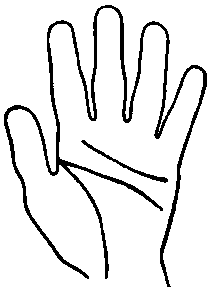
No. 89.
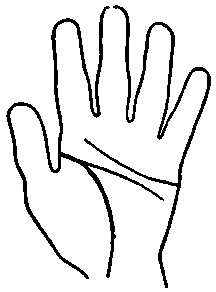
No. 90.
The starting-point or source of the Head line must be noted. In the greater number of hands the line rises from the line of Life, to which it is slightly attached at the start (89), and branches away from the Life line, sometimes near the beginning of that line, sometimes farther along (90). At this point the Head line registers the early years of life, and the sooner the line separates from the Life line, the younger was the subject when he began to think for himself. The longer the Head line is tied to the Life line the less self-confidence has the subject and the more he relies upon the advice of others. The longer the period covered by this union of the two lines, the later in life did the subject begin to rely upon himself. The Head line is not often bound to the Life line longer than the twelfth year, and many Head lines are seen which only touch the Life line at its beginning, showing that as a mere child the subject was self-reliant.
Continue to:


My Books

