


Advaita Defined
Description
This section is from the book "Studies In Saiva-Siddhanta", by J. M. Nallasvami Pillai. Also available from Amazon: Studies In Saiva-Siddhanta.
Advaita Defined
We now come to the definition of Advaita. And we may say at once, all the Saiva Siddhanta writers describe their system as 'Advaita' pure and simple, yet people who hear it casually described call it Visishtadvaita and fail to note its special features. Advaita is defined by St. Meykandari as meaning Anyo nasti or Ananya* or inseparable; and his disciple calls the relation 'as neither one nor two.' Advaita † literally meaning not two, simply denies the separability or duality of God and soul and matter, but does not postulate Oneness by denying the existence of one or other Padartha or by postulating their mutual convertibility as in causation etc. Mind (unextended) is not matter (the extended); yet they are ever inseparable and found as one; how the unextended is present in the extended is the puzzle and the contradiction as stated by Doctor Alexander Bain. And the illustrations of mind and body, vowels and consonants ‡ are used to denote their Advaita relation of God to the Universe of nature and of man.
God is the Soul, whose body (Sarira) is the Universe of nature and man, as so well and forcibly put in the Brihad-aranya Upanishat texts referred to above, beginning from Earth to Atma.
* See pp. 244 - 272 ante.
'He who dwells in the earth, other than the earth, whom the earth does not know, whose Sarira (body) the earth is, who rules the earth within, He is thy Atma, the puller within, the immortal.'
"He who dwells in Atma (Vijnana), other than Atma, whom
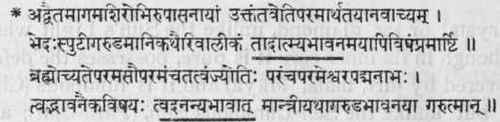
(Haradatta).

(Bhagavad Gita).
M. N. Dvivedi in his 'Monism or Advaitism' points out also that advaita does not mean Eka or Abhinna or Abhinna but Ananya and that this is the view of the Sutrakara.
† Vide Srikantha's Bashya on Vedanta Sutras II, i. and 22.
‡ Dr. Bain complains that there is not even an analogy to illustrate this unique union of mind and body, but Saiva Siddhantins have this analogy of vowels and consonants to illustrate this union from the very beginning of their letters.
Atma does not know, whose sarlra the Atma is, who rules Atma within, He is thy Atma, the ruler within, immortal." (III. vii. 22).
Here 'He is thy Atma', simply means'He is the Soul's Soul.'
And the analogy of vowel and consonant explains this relation fully. In Tamil Grammar, the words used to denote vowels and consonants are the same as the words meaning mind and body. And we find the following text to our surprise in the Taittiriya Upamshat (II. iv. 1).
' Its consonants form its body; its vowel, the soul (Atma).'
The .vowels are those that can be sounded by themselves but the consonants cannot be pronounced without the aid of the vowel.* The consonants cannot be brought into being unless the vowel supports it; and in union, the two are inseparable; and One is the word used in the oldest Tamil Grammar to denote the union of the two. A vowel short has one matrai, a consonant (pure) half a matrai; and yet a vowel-consonant has only one matrai, instead of one and a half. But the vowel is not the consonant nor the consonant the vowel. God is not one with the soul and the Universe, and yet without God, where is the Universe?
"Thou art not aught in the universe, yet naught is there save Thou."
He is not one, nor different from the Universe, and this relation is called Ananya, Advaita. The Sutrakara brings out the nature of this relation which is neither one nor different in II. i. 15 and 22. The Saiva Advaita Siddhanta accordingly postulates that God is neither Ab-hftda with the world, nor Bheda, nor Bhedabheda, as these terms are ordinarily under-stood, and yet He is one with the world, and different from the world, and Bheda-bheda.

Siva is situate with reference to all, as the letter A stands with reference to the letters.
(Sivajnanabodham Sutra 2, Siva-jTianasiddhiyar II. 1). And St. Meykandan declares accordingly: "You can indeed say God is One, without a Second, as when you say without the vowel 'A' no other letters exist." This is a view of Advaitam or Monism, which is not ordinarily met with, which must appeal to the hearts and intelligence of the people of every nation and every religion and which I commend to your earnest consideration.
Continue to:


My Books

