


Its Antiquity
Description
This section is from the book "Studies In Saiva-Siddhanta", by J. M. Nallasvami Pillai. Also available from Amazon: Studies In Saiva-Siddhanta.
Its Antiquity
The Supreme polity of the Veda is Sacrifice. Various Gods, Indra, Vayu, Varuna, Agni, Hiranyagarbha, Soma, the Sun, the Moon, Vishnu and Rudra, are worshipped. Each is addressed as a most powerful deity, and his aid is invoked for all kinds of earthly blessing and freedom from evil. They are all supposed to represent various powers of nature, and to idealize man's aspiration after the Supreme. Then we meet the text, "Ekam Sat Vipra Bahudha Vadanti"; and who is this one? Was any one God recognised, above all others, as the Chief, as the

God of Sacrifices, as the Pati? And we have the following texts from the Rig Veda.
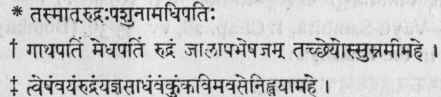
"Tasmat Rudrah Pasunamadhipatih" * (Rig Veda).
"Gathapatim Medhapatim Rudram Jalasha bheshajam Tat Samyoh Sumnamimahe." † (Rig.I Ashta, I Mand, 26 Anu).
"We seek from Rudra, the Lord of Songs, the Lord of Sacrifices, who possesses healing remedies, his auspicious favour (Rig Veda I. 43. 4).
As the Pati of all sacrifices, He is the fulfiller of sacrifices, "Yajna Sadham" ‡ (I. 114 - 4) and 'Rudram yajnanam sadhad-ishtim abasam' (111-2-5). As the God of gods, He is said to "derive His renown from Himself" 'Rudraya Svayasase'. His glory is said to be inherent, independent, or self-dependant God, 'Svadhavane' (Rig. VII. 46 - 1). He is also called Svapivata, which is variously explained as meaning 'readily understanding' 'accessible,' 'gracious,' ' He by whom life is conquered,' 'He whose command cannot be transgressed,' 'Thou by whom prayers (words) are readily received.' He is called the ' father of the worlds,' 'Bhuvanasya Pitaram,' § VI 49 - 10, and the Rik story of His becoming the Father of the fatherless Maruts can be recalled in many a Puranic story, local legend, and common folklore.
He is referred to in the text "anter ichchanti" - (VIII. 61 - 3). Hi) form as described in the Rig Veda is almost the same as the Image of later days. He is called the Kapardin, with 'spirally braided hair.' He is of ' Hiranya' 'golden formed' and 'brilliant like the sun,' and 'shining like gold' 'Yahsukra iva Suryo hiranyam ivarochati' (1-43-5). And in Rig Veda, X. 136-1 to 7, He is the 'long-haired being who sustains the fire, water and the two worlds; who is, to the view, the entire sky; and who is called this 'Light.' He is Wind-clad (naked) and drinks Visha (water or poison) and a Muni is identified with Rudra in this aspect.
- Rig, 1 Ashtaka, 1 Mandala, 16 Anuvaka.

- Rig, 4 Ashtaka, 6 Mandala, 4 Anuvaka.
Rudra is derived by Sayana from the roots, Rut dravayita,* meaning 'he who drives away sorrow.' And consistent with this derivation, Rudra is called in the Rig Veda itself, as the 'bountiful' and the 'Healer' possessed of various remedies (the later Vaidyanath) 'benign' and 'gracious.' And the term Siva clearly appears in the following text of the Rig Veda (X. 92-9): "Stoman va adya Rudraya sikvase kshyad-viraya namasa didishtana yebhih Sivah † svavan evayavabhir divah Sikshati svayasah nikamabhih."
(With reverence present your Hymn to-day to the mighty Rudra, the ruler of heroes, (and to the Maruts) those rapid and ardent deities with whom the gracious (Sivah) and opulent (Rudra) who derives his renown from himself, protects us from the sky).
If the Gods, Indra, etc., personified individually the different powers of nature, in the supreme Personality of Rudra will be found combined all these different powers. He is a thunderer and storm-God, the father of the Maruts. He is Agni. He is Vayu. He is Varuna. He is Soma. He is the Sun and Moon. We have the high authority of Sayana that Soma means Sa-Uma. He deduces the story of Tripuradahana

- -Vayu-Samhita, I. Chap. 28, vv. 35-36, (Bombay Ed). Srikantha says in the Bhashya:

Haradatta says:

† Sayana in his great Bhashya takes Sivah as a noun and not as an adjective as translated by most oriental Scholars, and Vishapana from two texts in the Rig Veda. We have in the Rig Veda also the germ of the later Hindu Cosmology, in the famous Nasadasaya suktam; and this is also the central text of Siva Sakti worship.
"In the beginning there was neither sat nor asat; Then there was neither sky nor atmosphere above. What then enshrouded all this teeming universe? In the receptacle of what, was it contained? Was it enveloped in the gulf profound of water?
Then was there neither death nor immortality; Then there was neither day, nor night, nor light,
Nor darkness, only the Existent One breathed without breath self-contained. Nought else but he there was, nought else above, beyond. Then first came darkness, hid in darkness, gloom in gloom; Next all was water, all a chaos indiscrete. In which the one lay void, shrouded in nothingness. Then turning inwards, he, by self-developed force Of inner fervour and intense abstraction, grew. First in his mind was formed Desire, (Ichcha-sakti) the primal germ, Productive, which, the Wise profoundly searching say, Is the first subtle bond, connecting Sat with Asat."
. In the Rig Veda also, we find the famous text which is repeated in the Atharva Veda and subsequently in the Sveta-Svatara Upanishat and also in the Katha and Mundaka Upanishats, and which forms the chief stronghold of Indian Theism against Idealism. "Two birds, inseparable friends cling to the same tree. One of them eats the sweet fruits, the other 'Anya' looks on without eating".
Continue to:


My Books

