


Mahavakya Texts
Description
This section is from the book "Studies In Saiva-Siddhanta", by J. M. Nallasvami Pillai. Also available from Amazon: Studies In Saiva-Siddhanta.
Mahavakya Texts
But what are we to do with the Mahavakya texts 'That Thou art,' ' I become that,' I am that' etc? It will be noted that these texts are not discussed by the Sutrakara Badarayana in the First Adhyaya relating to Pramana or Proof of the nature of the Padarthas, where he distinctly postulated the difference, but they are in the chapter on Sadana relating to the means of salvation. The Teacher tells the pupil to practise the Sadana, telling him that he is God (Tattvamasi), and the pupil accordingly practises Soham bhavana or Sivohambhavana, by repeating the mantra 'Aham Brahmasmi'; there is consciousness, and consciousness of duality, of two Padarthas - Aham and Brahma. This is Dvaitam, the Yoga or Upanishat or Vedanta Pada. When by this practice of Sivoham, the consciousness can disappear then the soul can become One with God, Jnathru, Jnana and Jneya all disappearing (the Jnana or Siddhanta Pada). And the question arises how can this oneness be reached, how can the two become one? This becomes possible on account of the peculiar nature of the soul and its relation to God. This peculiar nature of the soul is alone discussed in the Yoga Sutras and in Saiva Siddhanta Text-books. And the peculiar relation between God and the Soul is called Advaita.
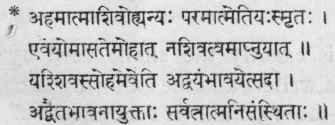
(Sarvajnanottaragama).
Nature Of The Soul
This nature of the soul consists in its becoming one with whatever it is united to, losing its own individuality, and its not being able to exist independently, except in union with one or the other. It can only be united to the world or to God. It can reach God only when it leaves the world. It cannot serve God and Mammon at the same time. It is the caterpillar of the Upanishats, which leaves one leaf-stalk to gain another. And when it is united to one thing or the other like the mimicking caterpillar again, it is indistinguishable from the one or the other. It is the shadow of the one (Maya) or the light of the other (God) that completely hides its (Soul's) individuality. So when in union with matter, with the body, it is so lost in the nerve-centres and so on, that the Scientific Agnostic fails to discover the soul, by the closest analysis. In union with God, the Pure Idealist finds no soul there. The soul identifies itself absolutely with the body or God, and its individuality or identity disappears but not its personality or being (Sat),
This law of the Human mind called The Law of Garuda-dhyana is stated in the terms that we become like what we are associated with, and may be called the Law of Association or Identity, and Professor Henry Drummond calls it the Law of Reflection and of Assimilation, and likens man to a mirror or a crystal. "All men are mirrors. That is the first law on which ' . this formula (of sanctification or corruption) is based. One of the aptest description of a human being is that he is a mirror."
And we will find this is exactly the simile used by the Upanishats and the Siddhanta writers and the following extracts contain the illustration and the formula of sanctification.
Continue to:


My Books

