


Maya Defined
Description
This section is from the book "Studies In Saiva-Siddhanta", by J. M. Nallasvami Pillai. Also available from Amazon: Studies In Saiva-Siddhanta.
Maya Defined
"Indestructible, formless One, seed of all the worlds, Achit, all-pervasive, a Sakti of the Perfect One, cause of the souls, bodies, senses and worlds, one of the three Malas (impurities,) cause also of delusion, is Maya."
Composed Of Thirty-Six Tattvas
This Maya or Prakriti, or Pradhana of most Indian Schools comprise the 24 tattvas from earth to Buddhi or 25 with Mula-prakriti, but the Saiva School † postulates 11 more tattvas above this 25; which are Kalam (Time), Niyati (order), Kala, Vidya, Raga or Ichcha, Asuddha-Maya, Suddha-Vidya, Sadak-yam, Isvaram, Bindu or Sakti, and Nada or Siva (Suddha Maya).
text Badarayana Sutra I. 4, 27 and, Srikantha Sivacharya in his Bhashya distinguishes it from the ordinary conception of Parinama by calling it 'Apurva Parinama.'

By the will of the Lord (Siva) Parasakti became one with Siva-tattva (a nonsentient primordial substance), and thence, in the original creation is produced all as oil from sesamum.
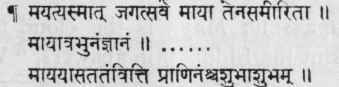
All beings always know good and bad by means of Maya.
† See for a full discussion of the 36 tattvas, Sri Kasivasi Sentinatha Aiyar' 'Saiva Siddhanta Tattva Prakasa Catechism', published in the Siddhanta Dipika, Vol III, p. 205 et seq. Vide Authorities for 36 Tattvas.
 Svet. Up.
 Svet. Up.
This Suddha Maya is the Kutila or Kundalini Sakti of the Yogis, of which Mulaprakriti called also Kundalini is the grossest form. These higher tattvas, and their Powers can alone be perceived and realized by the Highest Siva Raja Yogis; and they are so subtle as to be mistaken for the Light of the Mother Herself, as they reflect Her Light most perfectly.
Maya Distinguished From Avidya
This Maya is again to be distinguished from Anava Mala (the technical * term in the Agamas for Ahankara, or Avidya or Ajnana or ignorance), and the definition and distinction are stated in the following verses by St. Arunandi:
Avidya Or Anava Mala Defined
"Anava Mala, with its many Saktis, is One, pervading through the numberless Jivas, as the dirt in copper‡; it binds them from jnana and kriya. It also affords them the capacity for experience and is ever the source of ignorance." distinction.
"Do you say ' there is no other entity as Mala (Anava); it is only the effect of Maya'? Understand well, that Maya causes Ichcha, Jnana and Kriya to arise in the Jivas, but Anava causes the same to disappear. Anava is inherent in Jivas, but Maya is separate from them (as one's ignorance and body can be called inseparable and separate), and besides manifesting itself as the Universe, forms the body, senses, worlds and enjoyments."
Continue to:


My Books

