


The Nature Of The Divine Personality. Part 3
Description
This section is from the book "Studies In Saiva-Siddhanta", by J. M. Nallasvami Pillai. Also available from Amazon: Studies In Saiva-Siddhanta.
The Nature Of The Divine Personality. Part 3
The Infinite and Limitless God whom the Brahmavadin pourtrays in such glowing colours to mislead the credulous few, whose throne is Space, and whose queen is Time, and who is limitless and infinite as space and time are limitless, must also share a similar ignoble fate. We never thought that we would have to correct our learned brother in regard to such a simple thing, as that, the very notion of time and space implies both limitation and finiteness. We have no need to turn over big treatises to find authorities for this statement. There is lying before us, a small and well written pamphlet of Dr. Peebles of America, entitled 'The Soul'. In the very opening paragraph, we find the following lines, we quote it only to what a trite notion it has now become. "All beginnings in show, time and space necessarily have their endings. A creature which has its beginning in time is incapable of perpetuating itself or of being perpetuated through eternity. A line projected from a point in space has a further limit which no logic can carry to infinity." We have, on another occasion, pointed out that Infinite space and limitless time are contradictions in words. The absolute can never involve itself in space and time. If it does, there is no use of calling it the absolute and unconditioned.
And our brother is quite right in saying that Knowledge of This Brahman is onty a misnomer (a myth we should say). Then again (in the same page 587), our brother says that 'the Brahman (It) is formless, for all forms imply a boundary'.
Vainest of delusions! But, does formlessness imply no boundary? So many things in nature are invisible and have no form. If, by formless is meant unextended, such as mind etc., we know mind as a product of Maya is also limited. But by formless, they generally mean 'Arupi,' 'invisible'; and invisibility is no great attribute after all, as matter can also be formless and invisible. We have elsewhere pointed out the mistake of taking Form and formless as being respectively equivalent to Personal and Impersonal. To deny to God that he can take form is to deny his Omnipotence and limit his nature. The distinction is from our standpoint. When we begin to identify him with anything we know, from the lowest tattva to ourselves (Atma), then this is Anthropomorphic. The distinction does not rest on calling the supreme, as 'Siva', or 'Sivah or 'Sivam.' 'He ,' 'She' or 'It.' God has form. The Srutis declare so. God is formless, so also the Srutis say. He has form and has no form. This is because, His body is not formed of matter, but is pure Chit, or Intelligence. It is when we make God enter a material body, and say that he is born and dies, then it is we blaspheme Him and humanize Him and our conception becomes Anthropomorphic. Some of the so-called Vedantists who are unable to distinguish between what constitutes God's real nature and Anthropomorphism and Hindu symbolism mistake the ideal of God according to Saiva Siddhanta. Do they care to understand why when describing God, they say He is neither male nor female nor neuter, neither he, she nor it, neither Rupi, Arupi nor Ruparupi, and yet when thay address God,, He is called Siva, Sivah or Sivam, 'Rupam Krishna Pingalam,' and worshipped as the invisible air and Akas. Professor Max Muller points out how with bewildering perplexity the gender varies frequently from the masculine to the neuter in the Svetasvatara. Well, in the passage 'it has feet and hands everywhere,'if the neuter Brahman can have feet, why could not the Being with the feet etc. be described as He also.
We describe all inanimate creation as it, and when we proceed to call the Supreme as It also, we transcend from
Saguna to Nirguna!!! We have already cautioned against mistaking the Sakti of Saiva-Siddhanta to be Maya. It is this mistake that has been the fruitful source of all the degradation and vice of the northern Vamachara. This Sakti is called most frequently in Tamil 'Arul Sakti' (God's manifestation as Love or Grace) and the greatness of this 'Arul is thus beautifully described by Tirumular. -
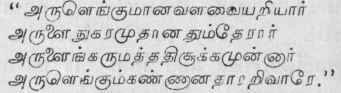
"Who knows the Power of this Arul by which Omnipresence is secured?
Who understands that this Love transmuted Herself into tasteful ambrosia?
Who thinks that this Love - permeates subtly the five great operations (Panchakritya)?
Who knows that this Love has eyes on all sides (is Omniscient).?"
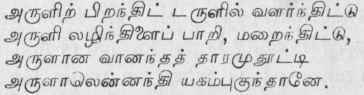
Born in Love, Bred up in Love, Changing, and resting in Love, Fed in the Supreme ambrosia like Love, The Nandi entered me as Love."
He says elsewhere that none knows that Love and God are the same. To go and identify this Supreme Love of God, which, like the emerald, covers everything with Her own Love, and imparts to each and every one its own peculiar beauty and power and grace and will, to Maya which, like darkness, plunges everything into ignorance and death, is real blasphemy and prostitution indeed. We will stop here the discussion so far as Saguna and Nirguna is concerned, and glance at the controversy as regards Personal and Impersonal God, It is not very easy to get at the precise definition of these terms, and the quarrel seems to be more often a quarrel over words. One author for instance says that by Personality is implied and involved mortality, corporeality (material,) human volitionality. Another says that personality involves limitation. Is this so, and is this the proper connotation and denotation of the word? If so, nobody need pause that God cannot be personal. But eminent men like Emerson and others say that it does not mean any such thing.
To quote again Dr. Peebles, "Personality in its common and outward acceptation is usually associated with appearance and outward character; but to such writers as Emerson, James Freeman Clarke, Frohschammer, Elisha Mulford, Lotze etc., Personality has a far deeper meaning. The Latins used persona to signify personating, counterfeiting or wearing a mask. But personality in the sense in which Emerson employes it, signifies true Being, both concrete and spiritual. It alone is original Being. It is not limited. Personality is that universal element that pervades every human soul and which is at once its continent and fount of Being. Distinction from others and Limitation by them results from Individuality, not Personality.
Personality therefore pertains to the substance of the soul and individuality to its form. And the Rev. J. Iverach also controverts very ably in his work, 'Is God knowable' the idea of personality as at first stated, and argues that to say that the absolute and the unconditioned Being is personal, is not a contradiction in terms, such as a round square, but that it will be true, as when we say, a white oricrimson square. "When we speak of the absolute, we speak of it as a predicate of pure Being, and what we mean simply is that the absolute is complete in itself, it has no conditions save the conditions contained in itself. When we speak of personality, we ascribe to it, Being, regarded as pure spiritual Being; and we simply mean that absolute personal being is and must be self-conscious, rational and ethical; must answer to the idea of spirit. Why may not the absolute Being be self-conscious? To deny this to Him would be to deny to Him, one of the perfections which even finite beings may have?" And Saint Meykanda Deva asked the same question several centuries before. (Sivajnana-both-am, XI. Sutra I b). And our Saint Tirumular also staets the question in similar terms.
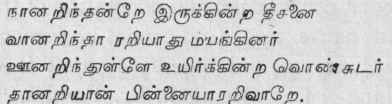
"That day I knew my God; the same was not understood by the Devas. The Bright Effulgence, lighting inside my body and soul, it is said, does not know. Who else can know them?"
We will stop here for the present. We accept the view of personality as set forth by Emerson and others, in which case we must reject the notion of an impersonal, unintelligent and unconscious, unknown, unknowable, unloveable, and unloving nothing. The Christians and Mahomedans (there are some
Sagunavatis among them also) have no need to fall shy of the
Nirguna conception, though the Ramanujas and the Madhwas whose God being identified with Prakriti itself (Vasudeva Para
Prakriti) never rise above the Saguna Sattvic conception. Some of the Vedantists halting between two stools contrive to fall most miserably, and their view of a God, both Nirguna and Saguna,
Personal and Impersonal is what, we have no good language to describe. None need be ashamed to proclaim truth, if it is truth. Why undertake the trouble of praising Krishna and his teaching to the skies, to say, after all, that Krishna (the late
Mr. T. Subba Rao stated more plainly that he cannot be the incarnation of the absolute) is only for such who wish to be born again and again, and who consider the service of God as their Highest Felicity, and Brahman is for those whose goal is perfect rest in freedom. These very people will raise a howl, if the Saiva were to state the same truth, which by the way was stated long ago by Sri-Krishna himself that worship of Siva or
Sivam alone would secure Sayujya (Moksha) and the worship of other gods (Isvara, Brahma, Vishnu, Rudra, etc), would only secure their respective worlds (Pada). There are some more questions which arise out of this discussion, and we reserve them for a future occasion.
Continue to:


My Books

