


The Two Gems. Sat And Sat-Asat. Part 2
Description
This section is from the book "Studies In Saiva-Siddhanta", by J. M. Nallasvami Pillai. Also available from Amazon: Studies In Saiva-Siddhanta.
The Two Gems. Sat And Sat-Asat. Part 2

 'The sex follows the more predominating organs present,' and so a hermaphrodite person will always be called either he or she and not it. The life of the individual soul is, as such, passed either as Asat or as Sat, and it has no life of its own. That is, it cannot exist by itself, independent of its relation with either Padartha. If either God or the world did not exist, the existence of the soul would be an impossibility. Saint Meykandan uses two analogies to illustrate the position. The soul is campared to an object suspended in air, and a flood of water. We cannot imagine an object suspended in air without a support. If the support is removed, the object falls to the ground. Saint Meykandan had as such distinctly before him the question "why does an apple fall to the ground." The actual example he had before him was a swing attached by a rope to a tree. The tree holds up the object by its own force. When this force is weakened and loosened, another force is brought into place, the force of the earth, gravity. The object was in fact held in between these two forces. The object must either be attached to the tree or to the earth.
In spite of the enormous power of gravitation exerted by the earth, the tree was able to hold up the object for a time. Only for a time, for when the fruit matures, the tree cannot hold it up, however it may will to do so. The same act accomplishes the severence from the tree, and the bringing it to the earth. Just so, in the case of the soul. It is bound to Maya and Mala, so long the soul is not ripe. Before it is ripe, we do not perceive its brightness and sweetness. When the soul perfects itself, fed by the juices from the earth (the Grace of God) it finds its resting place in God. When it so finds itself, united, it becomes one with God, as the fruit itself when left alone becomes one with the earth. The flood again cannot stand still, unless it is held up by an embankment. When this embankment is breached, it will run on and on, till it finds its resting place in the broad arms of the ocean. Without either of these means of support, it will be difficult to restrain the fleeting soul. The embankment or the flood gates are the Maya support of the soul.
The ocean is God. This support is called in Tamil a support, a bond of attachment, a rest, desire, love. It is this peculiarity which Saint Tiruvalluvar expresses in the following couplet, which again is the mere echo of our Saint Manikkavachakar's words.


This peculiarity of the soul we have been discussing above, has a tremendous bearing in connection with various philosophical schools. The ancient Buddha and the modern Agnostic would not postulate this other support and resting place of the soul. And we find they are landed in Nihilism accordingly. The moment of perfection is the moment of annihilation to the Buddhist. Nay, with his modern Apostles, Mrs. Annie Besant for example, the cry of the Vedas, 'whence there is no return, there is no return" is merely a vain cry. There is no such thing as final perfection, beatitude or Moksha. The soul must roll on ever and anon, subject to the never-ceasing and ever-recurring evolution due to "the moral necessity connected with the central and most precious doctrine of the exoteric Vedanta, the doctrine of Samsara." Here of course we see the phenomenon of extremes meeting. The Vedantist could not deny the possibility of the soul, attaining the so-called moksha, recurring back into the cycle of evolution, as the orginal retrogression of Brahman into Gods and men, brutes and worms is itself not explicable by him.
The Agnostic not believing in God, examines into the nature of the mind or soul and perceiving how intimately it is connected with matter, denies of course, its separate personality and independent existence; and hence his denial of the soul's immortality and future existence, when once its mortal coil is broken. In the .case of the Vedantist, however, this peculiarity of the soul will alone furnish the excuse for his theory. And we ha\e heard honest Vedantists admit this as the only explanation of Sri Sankara's otherwise untenable position. When in union with God, the soul has lost not merely the consciousness of the world, the Asat, it loses also its self-consciousness, (not be it remarked its self-being) it loses also its consciousness of difference from God etc, and the only perception that remains is the bare perception, the bare enjoyment of God, - the full manifestation and Presence of God, as Love and Bliss, alone is felt; and in such a condition, Sankara could say there is no second thing.

Sankara's experience will therefore by only one-sided one, and the statement cannot stand as a matter of proof. The state of union with God is called Turiya or Para-Avasta, and in this condition, though the conscious perception of the world and soul may not be possible there, be-ness (existence) is not gone. And it is this condition, Saint Tirumular expounds in his next verse.
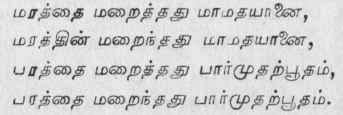
The tree was concealed in the mad elephant; The tree concealed the mad elephant. The world concealed the Supreme, In the Supreme was concealed the world.
Continue to:


My Books

