


The Union Of Indian Philosophies. Part 4
Description
This section is from the book "Studies In Saiva-Siddhanta", by J. M. Nallasvami Pillai. Also available from Amazon: Studies In Saiva-Siddhanta.
The Union Of Indian Philosophies. Part 4
One and all, the objects in the whole universe, good, bad, sat, asat, high and low, animate, inanimate are all named in succession and God is identified with all these and it is pointed out that He is not all these and above all these, "the soul of all things, the creator of all things, the pervader of all things" (Visvatmane Visva srije visvam avritiya tishthate). This Sataritdriyam* ought to be known to every Brahman more or less and it is the portion of the Vedas which is recited in the temples every day. The praise of the Satarudri-yam occurs throughout the Mahabharata, and most in Drona and Anusasana Parvas, and these parvas dealing as they do with various visions of God (Visvasvarupa Darsana) as granted to Rishis, Upamanyu, Vyasa, Narada, Kabila, and Krishna himself on other occasions, contain the similar reproductions of the Satarudriya as in chapters 9 to 11 of the Gita. What is more important to be noted is that in the case of Krishna, he had got the teaching from Upamanyu Maharishi, and after initiation (Diksha) into this mystery teaching and performance of tapas, he gets to see the vision himself, and he describes it as follows (vide page 87 to 91 Anusasanaparva. P. C. Roy's translation).
* We knew a Tamil Scholar who would gossip for hours together, the whole conversation interlarded with quotations from Kural and Naladiyar and an ordinary listener could not recognize that he was quoting at all.
"The hair on my head, O son of Kunti, stood on its end, and my eyes expanded with wonder upon beholding Hara, the refuge of all the deities and the dispeller of all their griefs.
........................... Before me that Lord of all the Gods, viz.,
Sarva, appeared seated in all his glory. Seeing that lsana had showed Himself to me by being seated in glory before my eyes, the whole universe, with Prajapati to Indra, looked at me. I, however, had not the power to look at Mahadeva. The great Deity then addressed me saying, "Behold, O Krishna and speak to me. Thou hast adored me hundreds and thousands of times.
* Sri Krishna himself says " Hear from me, O King, the Satarudriya, which, when risen in the morning, I repeat with joined hands. The great devotee, Prajapati created that prayer at the end of his austerity." Anusasana Parva, chapter V,
There is no one in the three worlds that is dearer to me than thou." And the praise by Krishna which follows is almost what Arjuna himself hymned about Krishna. Vyasa meeting Asvaththama after his final defeat tells him also that Krishna and Arjuna had worshipped the Lord hundreds and thousands of times. And does not this explain Krishna's own words in the Gita that he and Arjuna had innumerable births (iv. 5).
What we wish to point out is that this trasfiguration scene with its gruesome description which Mr. Jhonstone wants to trace to Puranic legends preserved from South Indian aborigines is, by express text and by the authority of Krishna himself traced to the second Veda; and to say that the Yajur Veda, the Central portion* of this Veda, should copy the holiest portion of the whole Vedas, as believed by the contemporaries and predecessors of Krishna, from the demonology of the South Indians, could only be a parody of truth; and if this be true, this demonology of the South Indians, instead of a thing being repugnant must have been glorious indeed, to be copied by the Brahmavadins of Yajur Veda days. Western Scholars have only misread and misunderstood the nature of this transfiguration and Visvarupa mystery, as they have misread the mystic Personality of Rudra or Siva Himself, whose ideal these scholars say, was also copied from the aborigines. To the credit of Mrs. Besant, be it said, she has understood both these mysteries better than any other European. Siva's whole personality, with his eight forms, Ashtamuhurtams (see page 220 of the Siddhanta of. The whole satarudriya passage quoted in sec.
II. chap III. vol. vi, Muir's Sanskrit texts.
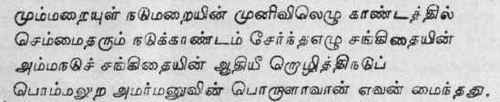
* It is believed and it is a fact that the Panchatchara Mantra of the modern Hinduism is found in the very middle of the three Vedas, Rig, Yajur and Saman, which fact is set forth in the following Tamil verse.
Dipika Vol. I, for full description) earth, fire, air etc., and his three eyes, as Soma, Surya and Agni, and His Head as Akasa, and his eight arms as the eight cardinal points, his feet as Padala, and the sky as his garment, Digambara, and himself, a Nirvani and living in cemeteries and yet with his Sakti, Uma, a Yogi yet a Bhogi, all these give a conception of the supreme Majesty of the Supreme Being which, no doubt, nobody can look up in the face. Does any ordinary person dare to look up nature's secrets and nature's ways in the process of destruction and creation and sustentation? If so, he will be a bold man, a great man. Strip nature of its outside smooth and fragrant cloak and what do you see inside? The picture is ugly, dirty and gruesome. Yet the scientist perceives all this with perfect equanimity, nay with very great pleasure. A small drop of water discloses to the microscopic examination multitudes of living germs, and these fight with one another, devour each other with great avidity. We drink the water. Plants drink up the water. Animals eat the plants, insects and animals devour one another. Man, the greatest monster, devours all. There is thus constant struggle of life and death going on in nature.
And when this nature is, as thus, exposed to view in the transfiguration, and Arjuna sees before him this havoc, in the Person of the Supreme as the Destroyer, ('Devourer' of Katha Upanishat) (and be it remembered that this Visvasvarupa Darsan is more gruesome in Gita no doubt, than similar ones presented in the Anusasana Parva, as Krishna's whole burden of advice in the Gita is simply to force Arjuna to fight and kill his foes, and to conquer his repugnance), a remark that it is derived from Puranic legends and aboriginal practices is altogether out of place. We hope to pursue this subject on a future occasion.
Continue to:


My Books

