


Tree Of Knowledge Of Good And Evil. Part 3
Description
This section is from the book "Studies In Saiva-Siddhanta", by J. M. Nallasvami Pillai. Also available from Amazon: Studies In Saiva-Siddhanta.
Tree Of Knowledge Of Good And Evil. Part 3
It will not require much thought to see that this story of man's first disobedience, and of his tasting the fruit of that Forbidden tree is nothing more than the Doctrine of Karma as told by all the Indian schools of Philoso-phy, including the Buddhists.
The knowledge of good and evil is good and bad Karma,
 and the fruits thereof are the pleasures and pains derived from such acts. There is no harm in performing good and bad acts, but these acts should not be performed for the sake of the fruits, out of selfish desire or dislike. And the moment these are performed with such desire, the thirst
 Trishna-Tanha) after such enjoyment increases, and the bonds of wordly existence are more and more made fast. The fruits of both are bad, and are compared to gold and iron-fetters and St. Tiruvalluvar calls them its
 i.e., "the two kinds of Karma, darkness covered." It is significant how in the Indian Philosophic Schools the phrase
 meaning eating the fruits of Karma is the commonest expression and one which exactly corresponds to the eating of the Forbidden fruit of good and evil in the Biblical accounts. More than this, the tree of good and evil fruits, one tree out of which both fruits are produced, is a common figure in the Upanishats and in the Tamil Siddhanta works.
The following passages in Mundaka Upanishat iii. 1 to 4 which are repeated in the Katha and Svetasvatra Upanishats and are derived from the Rigveda, explain the whole fully.
1. Two birds, inseparable friends, cling to the same tree; one of them eats the sweet fruit, and the other looks on without eating,
2. On the same tree, man (anisa) sits grieving, immersed by his own impotence. But when he sees the other Lord (Isa) contented and knows His glory, then his grief passes away,
3. When the seer sees the brilliant Maker and Lord of the world, and himself as in the womb of God then he is wise, and shaking off good and evil, he reaches the Highest oneness, free from passions.
4. Life sure is He who flames through all creation. The wise man knowing Him reaches of naught else. He sports in God, in God finds his delight, yet he doth acts perform (truthfulness, penance, meditation &c), best of God's universe, he.
5. This God is to be reached by truth alone, and meditation, by knowledge, pure and constant discipline. He is in body's midst, made all of Light, translucent; whom practised men, sins washed away, behold.
6. That heavenly-bright, of thought-transcending nature, shines out both vast and rarer than the rare; far farther than the far, here close at hand that too, just here in all that see nestling within the heart.
7. By eye He is not grasped, nor yet by speech, nor by the other powers, nor by mere meditation, or even holy deeds. By wisdom calm, in essence pure, then not till then does one in ecstacy, Him free from parts, behold.
The second mantra is thus commented on by Srikantha-charya (vide Dipika Vol. 2, p. 74). The traditional interpretation of this Siddhanta passage is given as follows:
"The Jiva, bound by the shackles of beginningless Karma, having entered into many a body made of Maya (Physical matter) - each suited to the enjoying of a particular fruit - is subjected to a lot of incurable misery; and unable to ward it off on account of his impotence, he does not know what to do and grieves. He is thus immersed in the ocean of grief, caused by his great delusion. When, however, by the Lord's grace, he intuitively sees Him, who as the Impeller dwells within Himself, who is gracious to all who is ever associated with Uma (Love and Light), then he attains to the unsurpassed greatness of the Lord, free from all grief. Therefore though Siva, who is independent and who has been free from samsara from time without beginning, is in contact with the body, he is not subject to its evils, as the Jiva is. Wherefore it is, that Jiva and Paramesvara are said to be in the cave of the heart."
St. Tirumular has the following stanza :


There is a fruit maturing from flowers of vanity. One bird partakes of it and another does not. If aimed with an arrow and driven away, Sure one can reach the golden seat of Siva.
St. Manickavachakar calls the tree exactly in the following beautiful passage
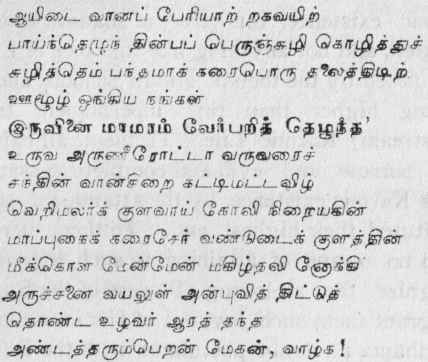
Meanwhile, the heavenly mighty stream Rises and rushes, crowned with bubbles of delight, Eddies around, dashes against the bank of our 'embodiment,' And twofold deeds of ours growing frcm age to age, - Those mighty trees, - roots up and bears away. It rushes through the cleft of the high hills, Is imprisoned in the encircling lake, Where grow the expanded fragrant flowers, - In tank, where rises smoke of the agil where beetles hum ; And as it swells with ever-rising joy, The ploughmen-devotees in the field of worship Sow in rich abundance seed of love! Hail, Cloud Like God,* hard in this universe to reach!
- From Dr. Pope's translation.
* God, 'like clouds is gentle and fierce too,' nourishing both the wicked and good, and in time rooting up the wicked.
and St. Pattinattar has a much more elaborate passage, in regard to the uprooting of this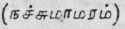
Continue to:


My Books

