


Tree Of Knowledge Of Good And Evil. Part 5
Description
This section is from the book "Studies In Saiva-Siddhanta", by J. M. Nallasvami Pillai. Also available from Amazon: Studies In Saiva-Siddhanta.
Tree Of Knowledge Of Good And Evil. Part 5
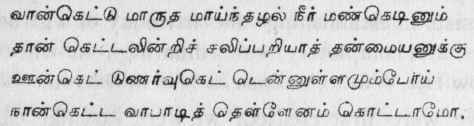
While earth and air, water and sky and fire May change their nature, He changes and wearies not, In him, I lost my body and sense, my life and mind I lost my-self, I sing Tellenam.
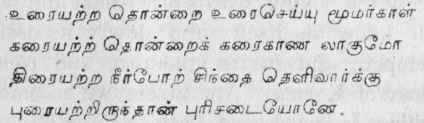
Ye fools ! that speak of the unspeakable, Can ye find the limits of the limitless one? When as the waveless sea one gains clearness, To him, will appeal" the Lord with braided hair.
Compare also,
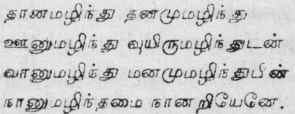
When deeds perished, and with it wealth, When flesh perished, and with it life, When mind perished, and its cause Akas, Then my 'I' perished, I did not know.
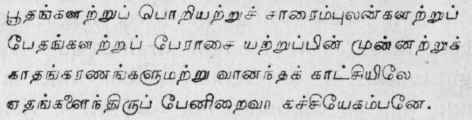
O, my Lord of Kanchi, when the elements, senses and sensations, The differing gunas and desires, and sense of time and space, When all these are lost in the blissful vision, Then am I freed from all evil and rest in peace.
The original fall was brought about by disobeying God's Law, by opposing our will to his Will, and the only way of salvation consists in establishing the harmony of will between His and ours, and completely subordinating our will to His own, and allow His Will to be done as it is in heaven.
When we were first created, we were just like children, fresh and innocent, fully trusting and depending on our loving-parents, without caring for the morrow, fully obeying their dictates, and never asserting ourselves nor becoming self-willed. But the child preserves this condition only for a short time; it would not abide by the loving words of wisdom and warning given to it, would know for itself; and slowty its desire and self-will are developed, and in its ignorance and conceit, it accumulates the load of Karma. And unless we become again like children abiding in trust and faith completely on our Beloved Father, we cannot get rid of this sin and sorrow. And unless we become born again, we cannot see the Kingdom of heaven as declared by the same Jesus Christ, whom the world thought he was beside himself i. e., mad. And our St. Tayumanavar likens the nature of the saintly
 to the babies, and lunatics and men possessed.
Karma or simply means an act, and this act may give pleasure or pain and if it gives pleasure, it is called good and if it produces pain, it is called evil. Every good act is right and every evil act is wrong, or Punyam or papam, Virtue or sin.
Sivajnana Siddhiyar defines puny am and papam as
 doing good to all sensient creatures and
 doing evil to all creatures in the largest and broadest sense of the term, in the same way as any modern utilitarian philosopher would define these terms, and we have no doubt that the definition is quite correct from any point of view. When we interpose conscience in the middle as a judge of good and evil, right and wrong, it is seen how varying the consciences of men are, and so we must necessarily seek a higher authority or test.
Karma therefore signifies acts or series of acts or the aggregate of human experience, acting and reacting on each other ; and Law of Karma means the invariable order or Niyati which results, pain or pleasure attaches itself to a doer in accordance with the kind of acts performed by him, in accordance wilh the maxim
 "He who sows must reap accordingly".
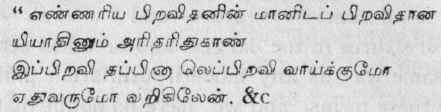
One result of this law is, that the respective fruits have to be enjoyed in a suitable body and this body is determined by the Karma performed by each, (Vide Sivajnanabotha II. 2. ab) and if his previous Karma is good, he will get a good body, and if it is bad, he will get a bad body. And this accounts for the myriads of physical bodies in every stage of development to the highest, from that of the amoebae to that of a Christ or Manickavachakar, possessed of every varying mental and spiritual characteristics. The more good a man performs, the better and more developed body does he get, with the accompanying development of mind and heart, and the result of this privilege is, that he is enabled to get a purer and purer body, which, the more it becomes pure, will reflect the Light and Glory of God; so that when man reaches his physical and mental perfection, he reaches the spiritual perfection of complete merger in the supreme Light. And of all bodies, the human body is the one in which a man can work out his salvation, and therefore is he enjoined to take time by the forelock and do good while this body lasts, if not to secure salvation in this birth, atleast to secure a better body in which he can carry on the good work.
Continue to:


My Books

