


Vowels And Consonants. Mind And Body. Part 3
Description
This section is from the book "Studies In Saiva-Siddhanta", by J. M. Nallasvami Pillai. Also available from Amazon: Studies In Saiva-Siddhanta.
Vowels And Consonants. Mind And Body. Part 3
But mind can ascend to pure subjectivity, and it does not imply the presence of objects, as the object does the subject; and in such a pure subjective state, where is the object? It has become also non-apparent (Sunyam). Regarding the possibility, however, of matter being the primary element, there is this fact. Matter is found both as organic and inorganic, and what a world of difference is there between these conditions of matter? Is the peculiar organization given to it by the presence for the time being of mind in it or is it derived solely by its inherent power. We have admitted that the so-called dead matter might possess potentialities without number. Still, is there any sort of similarity between the inorganic properties exhibited by matter, and the organic or vital properties? However this be, we will now proceed to state our analogy. It is the analogy of vowels and consonants. We have quoted the Gita verse, but we look in vain even in Sankara's commentary for the meaning we have tried to give it. Possibly Sankara would not give such an explanation, as it would conflict with his preconceived theory. So, if there was truth in it, it remained locked, and the key, altogether, remained with the Siddhanta writers.
The most familiar example of the analogy occurs in the sacred Kural, in the very first verse of it.

"As 'A' is the first of all letters, So the ancient Bagavan is the first in this world."
We might fancy an alphabet, in which the letter "A" is not the first, and if the point of comparison is merely to denote God's order in place as the first, so many other analogies might be thought of. And Parimelalagar accordingly notes that the order is not order in place, but order in its orgin. It is the most primary and first sound that the human voice can utter, and it is also the one sound which is present in every other sound, vowel or consonant. All other vowels are formed by modifications of this sound. And what are vowels and consonants pray? A vowel is defined as a sound that can be pronounced of itself, without the aid of any other sound. And a consonant is one which cannot be sounded, except with the aid of the vowel. Let us look more carefully into the nature of these sounds. We every day utter these sounds, and yet we fail to recognize the mystery in their connection, solely on account of their familiarity. We try to utter 'A.' It comes pure and simple, by the mere opening of the mouth, without any modification whatever, and requires no other aid.
But let us pronounce say 'K.' It is 'Ke in English, in Tamil it is 'Ka', or 'Ik',
 There is a vowel sound present in it, 'e' or 'a' 'i.'
Let us eliminate this vowel sound, and try to pronounce the consonant. Well, the task is impossible, you don't get any consonant sound at all. In the consonant, therefore, there is always a vowel sound present, though we never consciously recognize its presence; though in Tamil, the symbolism is so highly philosophical, that we invariably mark its presence, even when we write purely consonants. We dot all our consonants as
 etc. and the dot or circle represents in Hindu symbolism the letter
 This dot or circle begins almost every one of the twelve vowels in the Tamil alphabet, and as to what the other curved and horizontal and perpendicular lines mean we will take another opportunity to explain. When we write
 therefore, the framers of the alphabet meant to represent how the vowel sound underlies the consonant, and supports it, and gives it its very being and existence. Such a mark is unneceesary when we write the vowel-consonant 'Ka',
 as we are fuly aware of its presence. In the pure consonant therefore, the vowel is implied and understood, though for the time being its presence is not detected, and it is completely identified with the consonant itself. We have been considering, at learned length, the nature of the union between mind and body, but have we ever paused to consider the nature of the union of the vowel and consonant? Is there any such unique conjunction anywhere else in nature, where one subsists not, except in conjunction with the other. Except the inseparable conjunction, as above stated, we see that the consonant (pure) is no more derived from the vowel than the vowel from the consonant. There is much wider contrast between these, than between any two things in the world. The place of origin is distinct. 'A' is pronounced by the mere opening of the month. The tongue has to be brought into contact with the palate to pronounce 'k' and this same act cannot produce the vowel. So the vowel cannot be said to cause the consonant, nor the consonant the vowel. Nor can we call the consonant and the connection themselves as false, and as a mere illusion or delusion. So neither the principle of Pari-nama nor Vivartana can apply to this connection.
All that we can say of it is, that they are so connected and inseparable, and that no language can be possible, by vowels alone nor by consonants alone, and every consonant is at the same time a vowel-consonant, in which the vowel is apparent or non-apparent; and though we can conceive of the vowels standing alone, to think of consonants as existing by itself is an utter impossibility. Now apply all this to the case of mind and body. Mind is the vowel, and the body (matter) is the consonant. Mind and body are as widely contrasted as vowel and consonants are. One cannot be derived from the other by Parinama or Vivartana. . Yet both are inseparably united, and though the mind occupies an independent position, can be pure subject at times, the body cannot subsist unless it be in conjunction with mind. Mind is always implied in body ; mind underlies it, supports it and sustains it, (if all this language derived from material cognition is permissible). When the mind is pure mind, the body is not, it is asat(Sunyam). When it is pure body, mind is present but non-apparent, it has become one with the body. The mind is there, but it conceals its very self, its very identity, and it is as good as absent.
And except at rare intervals, our whole existence is passed in pure objectivity, without recognizing the presence of the true self, the mind. The whole truth of these two analogous cases, the only two, are brought out in Tamil, in the most beautiful manner, by the same words being used to donote vowel and consonant as also mind and body. See what a light bursts when we name The word
 means both a vowel and mind (soul); and
 both body and consonant. Dr. Bain observes that the sense of similarity is the sense of invention and true discovery. The greatest discoveries in science have been made by catching such resemblances at rare intervals. And when the very first Tamil man called his vowels and consonants
 was he not a born philosopher and had he not comprehended the true nature of the union between mind and body, and vowels and consonants. The simile recieves its best exposition for the first time in the hands of Saint Meykanda Deva, (vide Sivajnana-botham, II. I. b. and notes pp. 12, 19 and 20), and his followers (vide Light of Grace pp. 7 and 8); and Saint Meykandan gives a name in the same verse for denoting this connection. This one word is Advaita. This word has been a real puzzle to many; and so many renderings of it have been given. The Tamil, Philosopher, however, explains it as meaning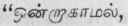
 (neither one nor two nor neither), and which fully and beautifully brings out, therefore, the meaning of Dr. Bain's words that the connection is both a paradox and a contradiction. Very few outside the circle of Siddhanta School could be made to comprehend the truth of this paradox; more so, when their mind is prepossessed with the truth of their own views. But we have always used the analogy of vowels and consonants with very great effect, and it has tended to make the subject much clearer than many a more learned argument. We have confined ourselves in this article to deal with the last two sets of phenomena in Nature, Mind and Matter; and we will reserve to a future article, the Nature of the Higher powers we postulate, and their connection with the lower ones; and a further amplification of the subject, together with the history of the question, in Indian systems of thought.
Continue to:


My Books

