


Chapter Twenty-Five. Appreciating Movies
Description
This section is from the book "Time Out for Living", by Ernest DeAlton Partridge and Catherine Mooney. Also available from Amazon: Time Out for Living.
Chapter Twenty-Five. Appreciating Movies
Why? Two men were walking along a crowded street of a large city. One was a naturalist who had come into the city to visit his friend for a few days. As they walked along, the man from the country suddenly stopped and said, "Listen to that cricket! He must be in one of the buildings there."
His friend looked at him in astonishment. "A cricket?" he asked. "Do you mean to tell me that you can hear a cricket chirp in all this noise?"
The man with the sharp ears took his friend by the arm and led him over toward an old building on the corner. Sure enough, there was the cheerful chirp of a cricket barely loud enough to be heard above all the hurly-burly of the busy street.
"I am amazed, Phil, that you could hear that thing so far away."
"Nothing to it, Al, it is all a matter of knowing what to listen for. My ear is trained to hear the slightest noise made by insect or bird. You, and most of these people on the street, have learned to listen for something else. Look what happens when I drop this thin dime on the sidewalk."
So saying, he reached over and dropped his ten-cent piece to the sidewalk. At the faint tinkle of the coin several people looked around quickly.
"You see," he went on, picking up his money, "it is all a matter of what you listen for!"
And so it is with any part of life, including the movies. Unless you learn to look for the interesting little things in a picture, much of it is likely to pass you by. You will not get your money's worth. By increasing your understanding of how movies are produced and the way they tell their story you can multiply your enjoyment, and get more out of them. Much of the interesting action of a movie is small and unimportant to most people, but to those who have learned how to appreciate these little things they are valuable.
A Difficult Job
Producing a movie is a tremendous job. Those who have not seen one in the making have no idea of how much hard work goes into the one and a half hours of flicker on the screen. Hundreds of people and thousands of dollars are used in preparing the story, choosing the actors, making the sets, taking the shots, and editing the final film. One of the most difficult jobs, however, for the director, is to produce a film that is not only new and different, but one that the public will accept. If all people who saw movies were trained to appreciate the finer points of the production, the director would have a much easier life. It is a fact that people like to see things done in the same old way. They very often resist new ideas, and, if the director is not careful, his work will go to naught because the public will not pay to see the film and it will be a financial loss. For example, happy endings are often tacked on to films even though the original stories did not have them because those who pay to see the movie like to come away with a happy solution of the story in their minds. So it is with many other parts of movie production.
If you learn to appreciate artistic productions on the screen, you will then do your part to improve American movies. Whenever you buy a ticket to a movie, you are voting for that production. It is the number of admissions that tell the producer how well his picture was received.
Watching The Plot Unwind
It seems that man just naturally loves a good story. Your pioneer forefathers used to enjoy spinning yarns around the campfire. The old scout who had been out into the mountains of the West could always get an attentive audience when he told of his experiences among the crags and peaks. You yourself would have enjoyed listening to him unravel his story step by step. Perhaps you have had the thrill of gazing into an open fire while some person has told of his adventures.
This interest in stories on the part of people in general has caused the producers of motion pictures to weave their scenes together with plots of various kinds. Just as storytellers differ in their ability to relate an experience, so do directors and actors differ in their ability to tell a story on the screen. Much of the success of a picture, nevertheless, depends upon the value of the original story. By learning the various things that go to make up a good story and the way it is produced you can enlarge your appreciation of the movies you see.
Get Acquainted Before The Show
Very often your appreciation for a certain movie can be greatly improved if you know about the writer of the scenario or the writer of the original story. Usually an author has something definitely in mind when he writes a story. You are apt to sec much more in the picture if you have some idea of what the writer had in mind.
Obviously it will not be possible for you to talk with the author personally about his plot, but there arc other ways by which you can gather the necessary information. One way is to read other stories that the author has written. If the author is well known, you will not have any trouble in finding such tales, and the chances are that you will be able to detect a certain philosophy in the stories. For example, Edna Ferber, who is joint author of several successful movies and plays, likes to deal with characters who are having a struggle to establish themselves in life. Usually her stories are of this type.
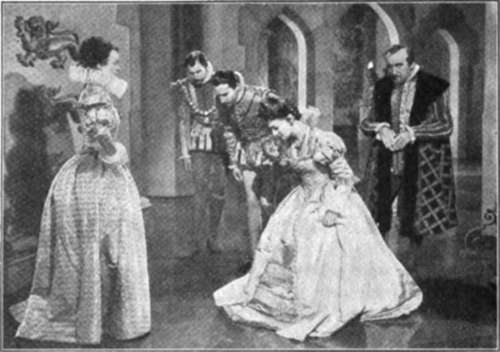
History lives again when Bctte Davis acts as Queen Elizabeth.
When two or more authors have worked together (collaborated) in preparing a story for the screen, it is interesting to try to figure out just which part each author has contributed to the finished product. If you know the philosophy of each one and the previous stories he or she has written, it will not be difficult to judge what part each has contributed to the story. Often a person who alone could not write a successful movie can do remarkably well by collaborating with another person. For example, a "gag writer," one who furnishes the laughs and clever conversation, may not be good at developing a story. By collaborating with someone who is a clever storyteller, the two of them can produce something to be proud of.
It is sometimes worth while to read a short sketch of the author's life before seeing a movie. Often this will give you an excellent background for appreciating the picture. You might look him up in Who's Who in America for the bare essentials of his life, at least.
If the movie is based on a novel, whether historical or modern, it sometimes pays to read the book before seeing the show. It is especially good to read historical novels, since it is usually necessary for the writers of the screen play to cut a good deal of the original story in order to make it fit into the time on the screen they have at their disposal. By reading the story in its original form you have a better appreciation of the scenes and you also have a basis for understanding why the characters act as they do. Some people prefer to have the story unravel before them without knowing what the ending will be, but this preference is usually just habit. None of the thrill of the movie is lost if you are familiar with the complete story. If you will recall your enjoyment of historical movies, you will see how true this is.
Continue to:


My Books

