


Chapter Fourteen. Producing A Movie
Description
This section is from the book "Time Out for Living", by Ernest DeAlton Partridge and Catherine Mooney. Also available from Amazon: Time Out for Living.
Chapter Fourteen. Producing A Movie
In general, there are two kinds of home movies: those that tell a definite story and those that report a trip or some other series of events. The difference between these two kinds of movies is the difference that one sees between the main feature at the theater and the newsreel. The main feature is usually some story that has been written carefully in advance with every scene planned in its proper place. The newsreel, on the other hand, shows actual occurrences which have been organized into the proper sequence. Naturally, one goes about producing a story picture in a different way from making a newsreel.
Preparing A Scenario
The first real job in producing the story type of movie is to prepare a scenario. The nature of the scenario depends upon the story to be told. If a detective tale is to be unfolded, it will be one kind of scenario. If it is a historical portrayal of how the home town was settled, it will be quite another. Regardless of the kind of movie, however, there are certain suggestions that are valuable to a person new at the game.
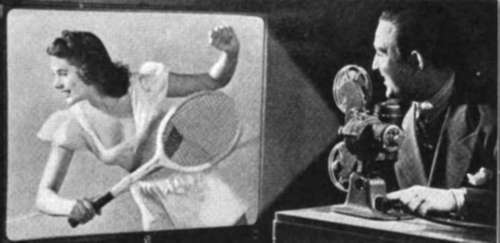
Action on the screen.
One should not be frightened by the mention of a scenario. It is simply a list of the scenes to be taken, in the order in which they are to appear. To the amateur who is new at moviemaking a scenario is essential. As his experience develops, he will be able to imagine scenes as they will finally look without writing them out in detail. But it takes time and practice to develop this skill.
The most important thing in any movie is continuity. Without it, a movie is flat and uninteresting. Continuity refers to the proper sequence of scenes. Attention should not shift from one subject to another in rapid succession without any apparent reason. In telling the story of a hike to the top of a mountain, for example, one would not show the weary hikers coming home as the first shot. Rather, it would be good continuity to show the preparations for the hike, the early start, then the series of experiences leading up to the arrival at the summit, and finally the return home. Thus the theme of the movie has a proper development and does not shift from one period of the hike to another without proper preparation.
Some movie directors have people by their sides, at all times, whose job it is to see that characters come back on the same side of the stage from which they went off, and wear the same clothes in scenes that follow closely one after the other, unless there is some reason for a change. This shows how important they consider continuity.
Another important feature of a scenario is variety in the way in which scenes are shown. This variety can be achieved by using different views or by changing the distance between the camera and the subject. In preparing the scenario, it is well to plan different ways of showing similar scenes to bring in variety.
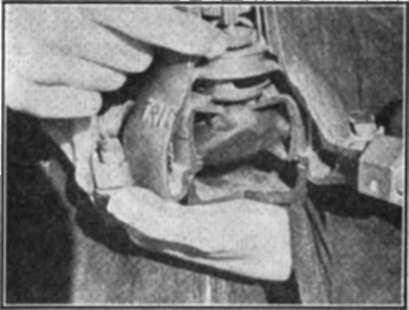
A Close-Up is used to show details of action, signs to be read, and the like.
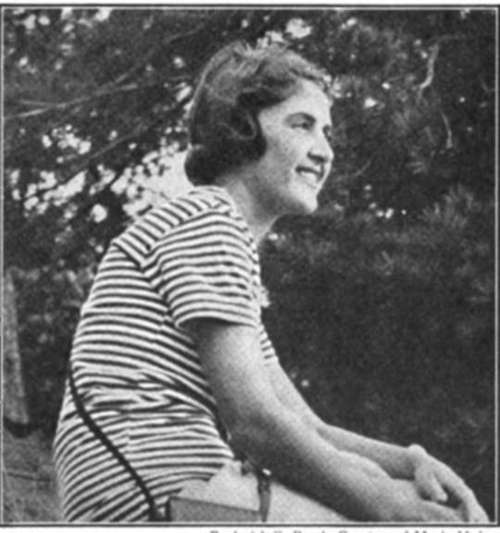
A Medium Shot.
Most pictures of people are medium shots.
Movie-makers have adopted certain terms to describe the different ways of taking a scene. A few of these terms need to be understod if one is to follow a scenario.
A close-up is a shot that shows some small detail of a scene, such as the head and shoulders of an individual, the handwriting of a person, or the print in a book. A close-up is generally used to show facial expression that would be missed in a distant shot. A medium shot is one that may show several people from the hips up and may include some scenic background. A long shot is one that portrays people at a distance with some scenic background. With these terms in mind, it is now possible to discuss the actual preparation of the scenario.
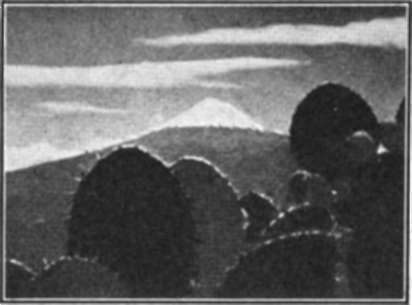
A Long Shot. Notice how much the picture is improved by having a grouping in the foreground.
A Dramatic Scenario
As the name indicates, a dramatic scenario is one that tells a dramatic story. The story usually includes definite characters and some plot. Beautiful scenes and educational values are only incidental to such a movie. The important thing is to tell the story and tell it in such a way that the audience will be interested.
The scenario is prepared as a series of scenes, each one described in sufficient detail so that no important part of the action is left out. In the original scenario, these scenes appear in the same order they will have when presented on the screen. In the actual taking of the scenes, however, it is often necessary to shoot them according to location and the people involved. This way of making a picture saves the trouble of traveling about too much and makes it possible to finish with any of the characters quickly instead of requiring them to be around while the whole filming is being done.
The following part of a dramatic scenario is presented here because it will show how the finished scenario should appear. In preparing a scenario, it is well first to write down a general outline of the action, thinking out the continuity and sequences as this is done, and then to elaborate upon this rough draft for the final scenario.
Watchdogs *
Scene | Camera Position | |
1 | Semi-Close-up | A downward angle showing the edge of a desk on which there is a white paper. A thumb comes into the scene, is pressed on the paper and leaves a black print. The hand withdraws from view. It again enters the scene, this time holding a magnifying glass which is raised up and down as if the unseen operator were focusing it. |
2 | Close | Melvin is seated at the desk, littered with detective equipment ad lib., examining his thumb print through the magnifying glass. He makes another and then another, all of which he seems to admire equally well. Laying down his glass with a sigh, Melvin draws a well-thumbed letter from his pocket and leans back in his chair and reads it. |
3 | Insert | Close-up of the letter which, in part, runs as follows: "So we congratulate you on your graduation from the Griggs Detective School, and under separate cover, we are sending your diploma. We are pleased to hear that you have already opened your office. Sincerely, A. B. Grigg" |
* Permission for the use of the following excerpt from How to Write a Movie has been graciously granted by the author, Mr. Arthur L. Gale, and the publisher, Edmond Byrne Hackett, "The Brick Row Book Shop, Inc.," New York City.
Scene | Camera Position | |
4 | Close | Melvin finishes reading the letter for the hundredth time, as evidenced by its handling, and leans forward, staring despondently off into space. He stirs himself and turns around, calling out: |
Title 1. | "Homer - bring me the mail." | |
5 | Medium Shot | The other end of the office near the door, where there is a much smaller and less pretentious desk - perhaps a plain table. Homer, a small, mild-mannered man, is seated at the desk. He stafts and looks around vacantly. He looks at the desk. |
6 | Medium Shot | Wider view, including both Melvin's and Homer's desks. Homer gets up and shrugs his shoulders, dejectedly saying: |
Title 2. | "Now, you know that the postman didn't leave any letter." | |
7 | Medium Shot | Little nearer than Scene 6. Melvin raps the desk impatiently, gets up and strides away from his desk and generally indicates the strong man held in leash. He paces back to the desk and picks up a newspaper lying on it. Looks at it, snorts and raps with his hand, saying: |
Title 3. | "Not one reply from that ad yet!" | |
8 | Same as 7 | Melvin shakes the paper angrily. Homer comes forward placatingly, saying: |
Title 4. | "Now don't be unreasonable, Melvin; maybe nothing's been swiped. Maybe no murders have been committed under mysterious circumstances." | |
9 | Same as 8 | Homer shakes his head dolefully and Melvin snorts that this is very unlikely. Suddenly, both men change. They hear something - something very startling. |
10 | Close-up | Of a man's face. He is yelling at the top of his lungs. |
11 | Close-up | Of hands beating on an office door. |
12 | Medium Shot | Melvin and Homer in their office as in 8. Homer draws near Melvin. Both men are in consternation. |
Scene | Camera Position | |
13 | Close | The door of the partners' office from the inside. It bursts open and Tobber, an older man of seedy appearance, sticks his head in, crying: |
Title 5. | "I am robbed! I am robbed! They are all gone. . . ." | |
It is not difficult, is it, to become interested in a scenario like this? You can imagine how much fun it would be to help produce a movie of this kind.
Continue to:


My Books

