


Making Movies At Home
Description
This section is from the book "Time Out for Living", by Ernest DeAlton Partridge and Catherine Mooney. Also available from Amazon: Time Out for Living.
Making Movies At Home
Making movies is quite different from taking pictures with a "still camera." Movies usually need more careful planning and more skillful photography. There are a great number of steps in the whole production, such as writing a scenario, making the titles, editing the film, and finally projecting it on the screen. It is all great fun, but the big thrill comes when the pictures you have taken are dancing before your eyes in your own home, and the friends you know walk and smile before you very much as they do in real life.
No doubt, one reason why more people do not make home movies is that they do not know how. They have never learned what fun it is and how to go about it. Another reason is the expense. Movies do cost more than still pictures, there is no denying that, but there are ways of saving money in making movies. You can make some of your own equipment, or several people can club together and buy equipment and pass it around for general use, or work together as a group. A group of boys in San Francisco formed such a club, and although their parents were not well-to-do, they managed to have great fun producing pictures together. Hundreds of people came to see their movies and each one who came paid a littie to help finance new productions.
Selecting A Camera
Home movies used to be much more expensive than they are today. In recent years new inventions and new methods have made it possible for more people to afford movies. One of the most important developments in equipment is a small camera known as the "eight-millimeter." This small machine has reduced the cost of film and brought movie-making into the reach of many families. Now, just a word is necessary about the different sizes of film used in movies.
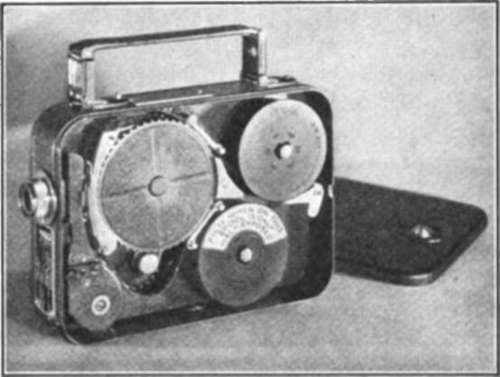
An Inside View of one kind of eight-millimeter camera.
Notice how the film is threaded.
The Hollywood movies are made almost entirely on 35 mm. film. As the name implies, the film is thirty-five millimeters wide. There are approximately 25 millimeters to the inch. There are sprocket holes on each side of the film. These move the film through the camera and projector. The 35 mm. film is quite expensive, and if it were the only size available home movies would be out of the question for many.
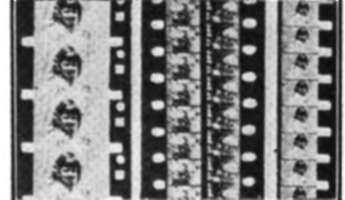
16 Mm. and 8 Mm. Film.
The next size is the 16 mm. film, shown at the left in the accompanying illustration, for comparison. Many amateur movie fans use 16 mm. film and find it very satisfactory. Clear pictures can be had from this film and thrown on a screen as large as six feet high.
The next size is the 8 mm., just half as wide as the sixteen millimeter. (There is a 9 mm. film, but it is not very widely used in America.) The 8 mm. film, really a 16 mm. film split into two strips, has the sprocket holes on one side only after it has been developed and is ready for showing. It costs about half as much as the 16 mm. film. Furthermore, the cost of equipment for use with this film, such as camera and projector, is much less than for larger films. Naturally, the pictures from the 8 mm. film do not produce as large or bright an image as those from the 16 mm., but they are sufficiently clear for use in the home. Thousands of people find real joy in these inexpensive movies.
The selection of the right camera is a very important part of movie-making. As would be expected, movie cameras cost more than cameras for taking still pictures. They usually have a much more complicated mechanism. One can buy a very cheap camera for taking still pictures, or even make a "pinhole" camera that will take snapshots. Movie machines range in price over a wide scale, however, making it possible for almost anyone who wants one badly enough to plan his finances wisely and save enough nickels and dimes to purchase a camera.
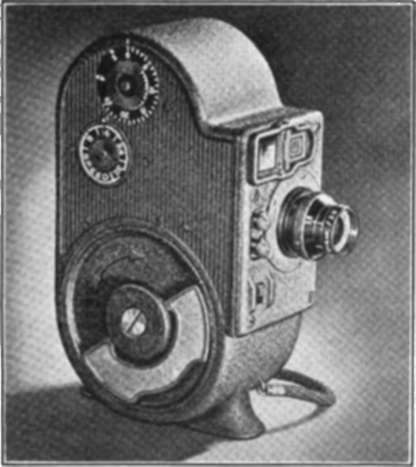
Here is one type of eight-millimeter camera.
Perhaps the most important (and usually the most expensive) part of a movie camera is the lens. The purpose of the lens is to throw the light from the object that is being photographed evenly over the film without distorting any of the images. How well the lens does this depends a great deal upon the skill and workmanship of those who make it. The more expensive lenses make it possible to take pictures in a dull light. The cheaper lenses can take pictures only in the best of light. Because the lenses for a movie camera are so small, they are cheap compared with the lenses of similar quality for a still camera. However, here is an important thing to remember: a cheap camera can make an excellent movie. It is the person who operates the camera that really counts.
Lenses are usually graded on the basis of how much light they permit to come through and focus upon the film. There is usually a scale on the lens with a pointer to show how far open it is. This combination regulates the amount of light, so that you can take pictures in light places or dark places with the same lens.
Now, the reason for going into detail about lenses is to help you judge a good one when you see it. You can tell how much light the lens will let in by reading the scale. It usually looks something like this: f 22, 16, 12, 9, 8, 7, 6.3, 5.6, 4.5, 3.5, 2.5, 1.5, if it is a good lens. Here is the thing to remember - the smaller the number, the larger the opening of the lens! A lens that will open to 5.6 is much better than one that opens to only 6.3, and a lens that opens to 1.5 is unusually fast, as photographers would say- With such a lens one can take pictures in a very dull light.
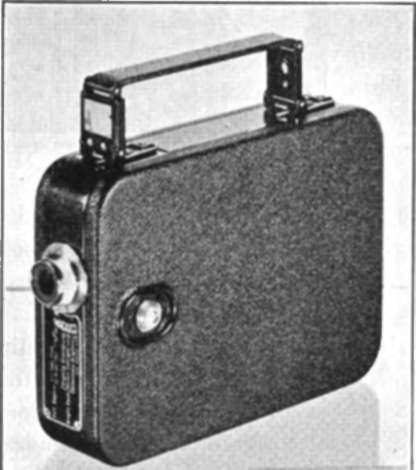
Here is a second type of eight-millimeter camera.
If you ever become an amateur movie-maker you will want to study the matter of lenses rather carefully. You will find it fascinating. There are short-focus lenses, long-focus lenses, wide-angle lenses, telephoto lenses (for bringing distant objects up close), and many others. Before buying a camera, it is well to understand the relative value of different lenses in order to invest wisely.
Another important feature of a movie camera is the action. If the pictures are to be clear, the film must move easily through the opening, and the shutter of the camera must work smoothly. If the action is not smooth, the pictures are jumpy and difficult to observe. The action, too, depends upon skillful workmanship, and this is what determines the cost of the camera. Probably the best thing that a young person can do, if he desires to buy a movie camera, is to talk with several people who have cameras of their own and ask them to point out the advantages of their machines. He should then talk with someone who knows all about different makes of cameras and who will give friendly advice on the best kind to buy with the amount of money available.
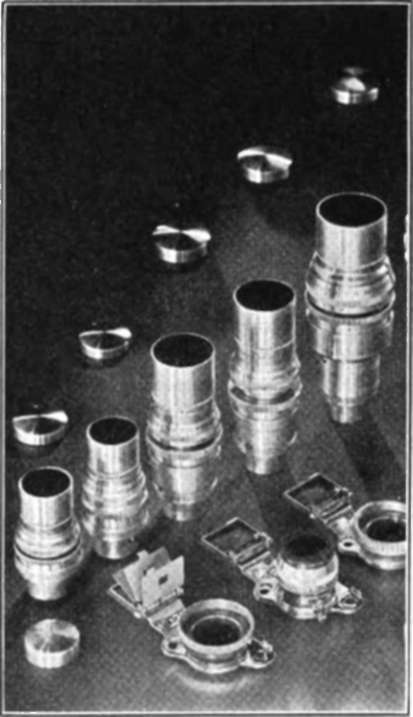
Extra Lenses for one of the popular kinds of movie cameras.
Some Interesting Things To Do
1. Ask your older friends and relatives to show you some daguerreotypes, and tell you about them - how they were made, photographed, and so on. If they cannot visit the class personally to show their collection, perhaps you could relay the message and take good care of the "tintypes."
2. Present a class play for the Parent Teachers Association or some similar group called Family Album. Build a big frame of boxes, have a storyteller, and static human figures posed as they would be in an old album. By use of a curtain or lights, tension on the "human statues" will be relieved.
3. Form a movie club of those interested in making movies. Plan to invest in equipment, set up standards, decide on an interesting project of work, perhaps develop a Photographic Clinic.
4. Act out your impression of Uncle Jack Posing for a Daguerreotype. If it turns -out well, plan to make a movie of it.
5. Find someone who owns a movie camera and have him explain its various advantages.
6. Examine the lenses on several cameras and see if you can tell which lens is the best for taking pictures in poor light.
7. Visit a camera store and look at several different kinds of movie cameras. Find out the price of each.
8. Obtain literature on several different kinds of movie cameras and learn the advantages claimed for each.
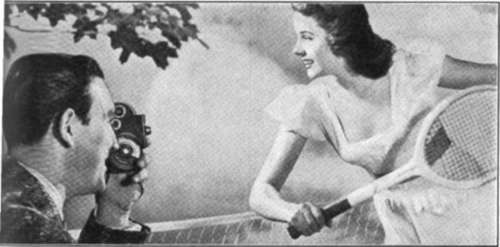
Action ! Camera !
Continue to:


My Books

