


Movies Without A Scenario
Description
This section is from the book "Time Out for Living", by Ernest DeAlton Partridge and Catherine Mooney. Also available from Amazon: Time Out for Living.
Movies Without A Scenario
When one is taking pictures of a camping trip, a visit to the city, or a bicycle expedition, it is not possible to plan the scenes beforehand. Too many interesting things happen on the way that cannot be anticipated. There is a real art, however, in knowing what to take and how to take it, so that the finished product, after it has been edited and titled, will interest those who see it. It is important to recognize good scenes when they appear because they often cannot be duplicated. On the other hand, it is necessary to be thrifty with film since it costs money.
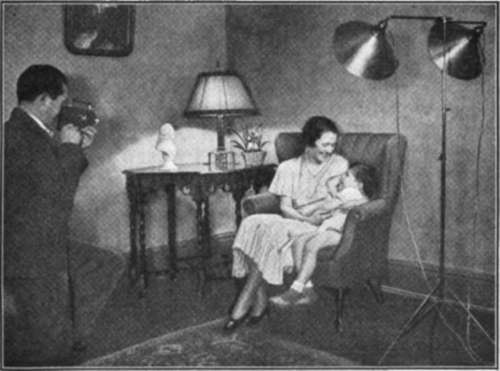
Making home movies is a very popular American hobby.
The following paragraphs illustrate how an ordinary hunting trip can be made more interesting on the screen by knowing how and what to photograph.*
"Anybody can poke a lens into a pal's face and hand him that clook pretty please' stuff. Anybody can see downright beauty in a sunset or landscape or beach scene. But it takes more than that to bring back interesting movies from your trips afield.
"Take a movie shot of your favorite fishing pond, for instance. Stand on the shore edge and point your camera straight ahead. Your resulting shot will show Whopper Lake, all right, but it won't be very interesting. If there are droopy willows along the shore, take a dozen or so paces backward, and line up again. Now you've started to pack meat into your scenic. You've planted a tree, say on the right edge of your picture where branches have cut off the expanse of sky. You've introduced a photographic technique called 'framing' which you're really going to like.
"For 'human interest,' include a canoeist paddling shoreward or a couple of fishermen rowing into the scene. . . . Angling scenes are next in order. Don't ask anybody to hook in a dead fish and 'fake' a landing scene, but have the movie camera ready at all times and snatch that split-second action when the angler is busy trying to stop an old bruiser from ripping out all the line. The excited facial expression, the bent rod, the water-slapping fish will make a peach of a picture.
"Don't just ask the gang to hold up the catch and look bleary-eyed into the lens. Instead, film your leaping fish while he's still splashing water all over the place. Coax the fish to the surface and keep him properly centered as he makes his upward run and wriggles his ears in midair. Filming fish action requires fast thinking and a quick trigger finger. . . .
* From "Hints for Movie-Making Sportsmen," by Ormal I. Sprungman, in Bell & Howell's Filmo Topics, Summer, 1937. Reprinted by permission.
"Fall, with its flutter of leaves, introduces other outdoor sports. Carry your movie outfit in your hunting jacket when you go afield for pheasants, ducks, john-rabbits, and even flicker-tails. *
"Whether he's a full-fledged cocker spaniel or just a run-of-the-alley, bedraggled-looking hound, your hunting pup can furnish some humorous sequences when you're out gunning for birds. It might even be a good stunt to build a film story around the dog, unfolding the action by means of low-angle shots. Open your film with close-ups of the youngster making his first family bow, then swing through the early training periods right up to the moment when the pup goes afield.
"If, contrary to his master's boasting, the pup rushes ahead to flush birds out of range, or plays a catch-me-if-you-can game of retrieving with a bird that's been popped, all the better. This will inject some good comedy into your outdoor piece."
There is much more to taking movies than just pointing the camera and taking the shot. Knowing what to take and how to arrange the scenes after the film is developed are just as important to the movie-maker as knowing what to paint is to the artist. The amateur can pick up many suggestions by noticing how the Hollywood movie artists produce their effects. When you go to the movies, note the length of the scenes, the different angles, and the use of continuity to build up interest.
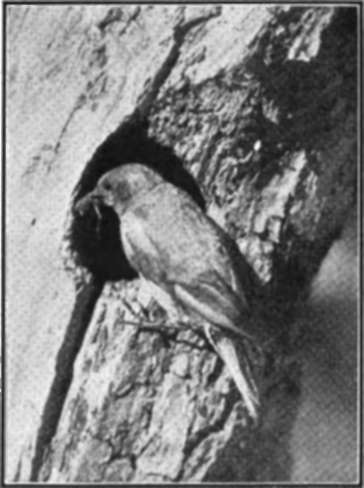
A Good Shot Of A Bird
To take a satisfactory picture of a bird or an animal, you need patience.
* What animal does the writer refer to here?
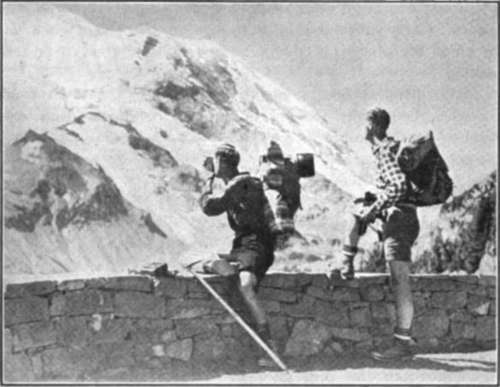
A movie record of a hike lasts for many years.
Continue to:


My Books

