


Chapter Twenty-Six. More About Appriciation
Description
This section is from the book "Time Out for Living", by Ernest DeAlton Partridge and Catherine Mooney. Also available from Amazon: Time Out for Living.
Chapter Twenty-Six. More About Appriciation
Settings And Costumes
Few of us who sit in the audience of a motion picture theater have even a slight idea of how much work there is in preparing the costumes and settings. What we see in a few minutes may have taken months to prepare. Dozens of research workers often labor for weeks preparing drawings and descriptions of the various sets. From these drawings scale models are then made with proper coloring to see how they "take."
Strangely enough, the best settings are the ones that will not be noticed particularly. Costumes and settings are vital parts of the whole picture and must be correct in every detail, but they must be so well done that you do not notice them above the actions of the actors and the plot of the story. If costumes and settings draw your attention away from the main idea of the story, they are not adding to it but rather detracting from it. Stage settings especially are designed to add to the total atmosphere of the photoplay, but they must do it in much the same way as an orchestral accompaniment adds to the beauty of a choir's performance. If the sets are too prominent, they will detract from the effect that the actors are trying to produce.
Perhaps you are beginning to see that the director's job is no easy one. The action of the players is only one detail among many dozens of others that must be correct if the desired result is to be had. Take the matter of lighting, for example. Sometimes it is very difficult to get the right results in a picture because of the problem of lighting. It is especially difficult when there are several actors moving about at once. Each one of them must be considered as to light and shadow before the picture can be taken. So skillfully is this problem handled that you very seldom notice the effect of lighting unless you are trained to look for it.
In the early days of movies, the settings were usually not real but painted scenery. Bookcases, vases of flowers, curtains, and other decorations were painted right on the scenery. In our day this kind of setting is not acceptable. Lighting and cameras have improved so much that such backgrounds would look entirely out of place. Instead, every detail is carefully planned and provided.
Even outdoor scenes are often built to order. Building them saves time and money, for it is then not necessary to transport the entire company and equipment to distant places. Furthermore, California is well suited to the movie industry because there is a wide variety of scenic effects available within short distances. Desert islands, heavy forests, desolate farms, city streets, narrow canyons, and rolling farmlands are near at hand. When the right background is not available, it can be built to order. Jungle scenes are often taken right in the studio lot, and they look as wild as darkest Africa. Since it is the purpose of the setting to make things appear real, these things are permissible as long as they are skillfully done.
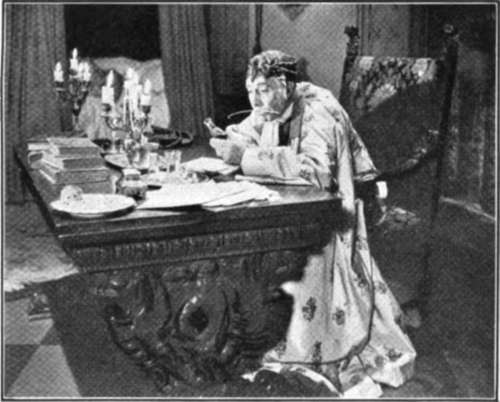
George Arliss has delighted millions with his portrayals of characters famous in history. Here he is shown as Voltaire.
In a historical picture the settings and costumes should by all means be accurate. Usually great care is taken to make sure of accuracy, but occasionally someone slips up and the result is somewhat amusing. Have you ever heard of any of these slips? Since care is taken in making sets and costumes for historical pictures, one can learn a great deal by studying the details and noticing the furniture, the clothing, and the other properties used in the action. Sometimes it is worth while to see a movie through once to enjoy the action, then see it again to note the many details in the settings. Next to an actual trip back into history, watching historical movies is perhaps the best way to learn how people lived in former days.
Continue to:


My Books

