


The Actors
Description
This section is from the book "Time Out for Living", by Ernest DeAlton Partridge and Catherine Mooney. Also available from Amazon: Time Out for Living.
The Actors
Next to the writers, the actors are the most important part of the picture. All other things are designed to aid them in doing their part. Music, lighting, and stage setting are all woven together in an attempt to give the actor a chance to do his part. Therefore a play is often judged good or poor according to the acting alone.
One of the first tasks in producing a play is to choose the right actors for the characters in the play. This procedure is called casting. It is not enough just to see that the hero is good-looking and the leading lady beautiful. The characters should be chosen according to the type of individual they are supposed to represent. A tall, husky lad with bulging muscles is hardly the type to portray the part of a society playboy, and the frail young man who might be a good tap dancer would not look well as the star football player, except in a comedy.
If you have watched your stars closely, you will remember that some of them are good at portraying many different characters. Such actors as the Barrymores, George Arliss, Frederick March, Ruth Chatterton, Charles Laughton, and Mary Astor, for example, have played scores of different roles on the screen, and have done all of them well. Versatile actors are likely to stay in the movies many years, perhaps not always in the first ranks of popularity, but as supporting stars who can ably portray many different assignments. Other actors, who depend almost entirely upon their looks, do not last long in the public fancy. They are unable to adapt themselves to new roles. Their pictures have a tendency to be much alike and so their popularity is shortlived.
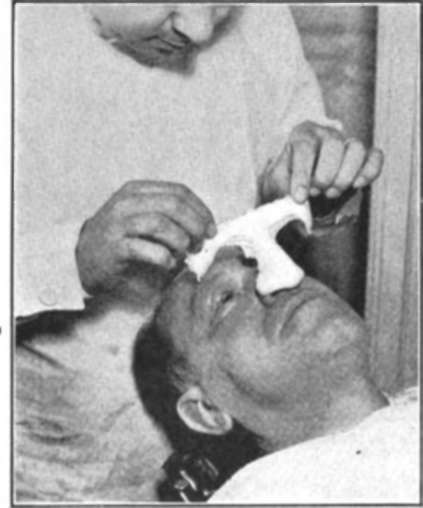
A make-up expert helps an actor achieve a physical likeness to George Washington. A false nose increases the resemblance.
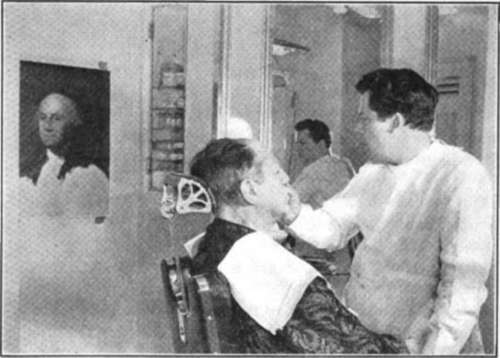
The make-up expert compares the actor's appearance with Gilbert Stuart's picture of Washington.
Acting naturally is one of the best marks of a good actor on the screen. On the stage naturalness is not entirely possible because it is necessary for the actors to speak louder than they ordinarily would in order to be heard in all parts of the theater. With the modern movie this is different. The actor can speak in a whisper and it will be caught by the sensitive microphones. Through close-ups, the slightest facial expressions can be shown to the entire audience. The experienced actor on the screen feels at home, and, in turn, makes the audience feel that the character being represented is true to life. The picture is then more real to those who see it.
If you made a thorough study of acting, you would come to realize that a great deal of good acting depends upon timing. It is not entirely by the spoken word that the actor is able to influence his audience. By knowing just when to raise his eyebrows or change the expression of his features he can tell the audience much. Even the length of the pause between words has great significance. The next time you go to the movies notice the many different ways in which the actors get their messages across. You will soon learn many interesting things about acting that you have perhaps not noticed before. Movies will become more attractive to you.
There are many other things about acting that cannot be mentioned here. Some of the books listed at the end of the chapter will give you more information on this interesting subject.
Continue to:


My Books

