


Garbage And Refuse
Description
This section is from the book "Time Out for Living", by Ernest DeAlton Partridge and Catherine Mooney. Also available from Amazon: Time Out for Living.
Garbage And Refuse
One of the first things an experienced camper learns is how to dispose of garbage and other refuse properly. Some camping authorities advise burying everything of this kind. Burying is not entirely satisfactory, however, because small animals sometimes dig it up at night. After many years of experience it has been found that the most satisfactory way to do away with garbage of all kinds is to burn it, cans and all. Do not allow garbage to accumulate. If it is placed near the edge of the cooking fire as it comes, it will soon dry and burn. After the cans have been burned out they can be mashed and buried in holes dug with sharp sticks.
Dishwater should be poured in a small pit that has been covered with a framework of sticks and grass. The grass catches the grease and other matter and the whole thing can be burned before it takes on an odor. If dishwater is thrown out upon the ground it attracts flies and causes unpleasant odors.
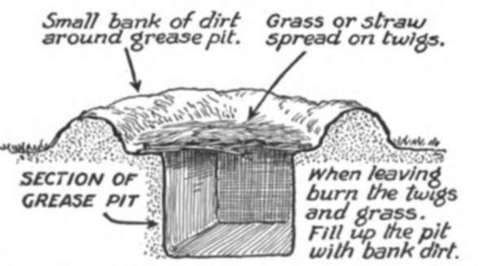
The best way to dispose of dishwater is to pour it in a grease pit.
Human eliminations should be buried well away from trails and camping spots when there are no regular toilet facilities near by. This is an invariable rule of good campers and should always be followed.
Some Interesting Things To Do
1. Make a list of hiking dangers. Include suggestions that would be helpful to hikers in your locality. Include such things as poisonous snakes, plants, water, etc.
2. Write an article on safe hiking for your school paper.
3. You have been assigned the task of producing a movie entitled How to Be Safe While Hiking. Make a list of the scenes you would include in your scenario.
4. Find out if any of the poisonous plants mentioned in this chapter grow in your locality. If they do, learn to identify them by sight.
5. Read a book about snakes and learn to identify those in your locality.
6. Write for some free booklets on camp cooking listed on page 76. Try one or two of the recipes.
7. Demonstrate to the class the proper way to build a campfire, to clean up a camp, and to pitch a tent. 8. With the help of an experienced camper, plan and cook a meal in the outdoors. Tell the class how you did it, how it tasted, and approximately how much it cost.
9. Collect several camp-cooking recipes that appeal especially to you. If possible, try some of these out and sec how your cooking tastes.
10. Discuss with your home-economics teacher the calories and vitamin contents of various foods. Make a list of those mentioned in the chapter and arrange them in the order of value.
11. Plan an overnight hike to a near-by spot. Include a menu for each meal, a food list, and a list of pieces of equipment. Remember that how much you take depends upon how many are going.
12. Plan menus for four people for one day, for two days, and for seven days. Keep the food as light as possible and yet include calorie and vitamin requirements. Figure costs for these menus.
Helpful References
Abercrombie, D. T., Camp Cooking Recipes. (Free, address D. T. Abercrombie, 311 Broadway, New York City. Include a three-cent stamp.)
Alters' Camp Food List and Handy Outdoor Guide. (Free, address Albcrs Bros. Milling Co., Seattle, Washington. Include a three-cent stamp.)
Bends Campers' Manual. (Free, address Bemis Bros. Bag Co., St. Louis, Mo. Include a three-cent stamp.)
Boy Scouts of America, Cooking Merit Badge Pamphlet.
Canadian National Railways, Camp-craft and Woodlore. (Free, address Canadian National Railways, Montreal, Canada.)
Carr, C. F., Complete Hiker and Camper.
Dench, E. A., Cookery in Camp and on the Trail. (A good compilation of sources of information, 10 c. Address American Nature Association, 1214 Sixteenth Street, N. W., Washington, D. C.)
Dried Fruits Jor Camper Cooking. (Address California Dried Fruit Research Institute, 1 Drumm St., San Francisco.)
Girl Scouts of America, When You Hike.
Girl Scouts of America, Kettles and Campfires.
Jessup, E. H., Camp Grub.
Kephart, H., Camping and Woodcraft.
Kephart, H., Camp Cookery.
Sears, G. W., Woodcraft.
Smith, C. F., Camp Fires and Cooking.
Wallace, D., The Campers' Handbook.
Wilder, J. A., Jack-knife Cookery.
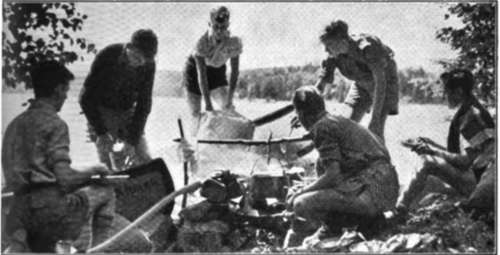
It won't be long now!
Continue to:


My Books

