


Highlights Of Hiking. Part 3
Description
This section is from the book "Time Out for Living", by Ernest DeAlton Partridge and Catherine Mooney. Also available from Amazon: Time Out for Living.
Highlights Of Hiking. Part 3
These clubs have been assisted by local societies and by the guardians of national and state parks. The trails are remarkably well-marked and kept reasonably clear of underbrush and fallen trees. Here and there the clubs have provided lean-tos for shelter in storms and for those who wish to spend the night in the woods. In some places fireplaces have been built to make the cooking of food more convenient. Many hundreds of miles of these trails are maintained through nearly the entire length of the Appalachian Mountain system. When we hike over a forest trail on the very summit of a mountain ridge, we should be thankful that the Appalachian Mountains are so old that the tops have been smoothed away and that they are covered with forests.

The Appalachian Mountains offer splendid hiking opportunities.
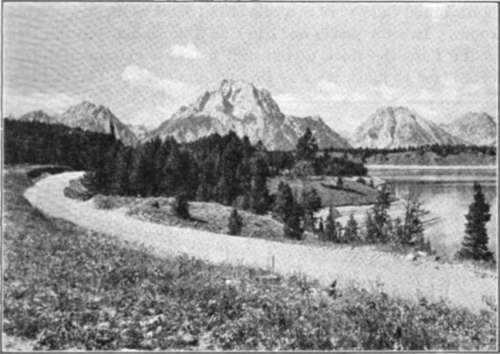
The Rocky Mountains, rugged peaks in western Wyoming.
On account of their elevation, very few of the summits of the Rocky Mountains are covered with trees. Heat, cold, wind, and water have not had time to wear them away to low well-rounded mountains. The Rocky Mountains are jagged and untamed, because they are only about 100 million years old.
The Rockies are grand and beautiful, but much of the hiking must be done on horseback. The distances are enormous. The forests in the valleys are as a rule not so dense as the Appalachian woods. In some places one can ride a horse between the trees. In the East, the thick underbrush makes it extremely difficult for a horse to make his way through the forest. Therefore, for hiking on foot there is probably no place in the world that is superior to the thousands of square miles in the eastern part of America, where there are almost unlimited forests, lakes, streams, and mountains. Also, no other large area of tangled, uninhabited forest contains so many hundreds of miles of trails, marked and maintained entirely for the pleasure of hikers.
The Rocky Mountains reach actually from Mexico to Alaska, and are composed of several different ranges, such as the Wasatch mountains in Utah and the Teton range in Wyoming. In Colorado no less than 46 giant peaks of the Rockies are over 14,000 feet high. California has five famous mountains stretching up beyond the 14,000-foot level: Mt. Whitney, Mt. Shasta, The Palisades, Mt. Tyndall, and Mt. Williamson. Also in California is the only active volcano in the United States - Mt. Lassen. Farther up the west coast of America are Mt. Hood and Mt. Rainier, both famous for their beauty.
While these are some of the more well-known mountains, there are countless others of equal beauty, with good trails surrounding them and numerous lakes nestling in their valleys. The West is truly rich in opportunities for the person who likes to get out of doors on a hike.

Mt. Lassen, the only active volcano in the United States, is a good goal for hikers.
In the East, the Appalachian Mountains reach from Alabama to Maine and cover a strip several hundred miles wide. In this great system there are many ranges: the Great Smokies of North Carolina and Tennessee, the Blue Ridge of Virginia, the Poconos of Pennsylvania and New Jersey, the Adirondacks and the Catskills of New York state, the Green Mountains of Vermont, and the White Mountains of New Hampshire. Mt. Washington, in the White Mountains, is said to be the windiest spot in America.
In spite of the fact that Americans have wasted much of the original forests, there are now millions of acres of woodland in the United States. Millions of trees are being planted every year by the government to replace the great stretches of forest that have been so pitiably diminished.
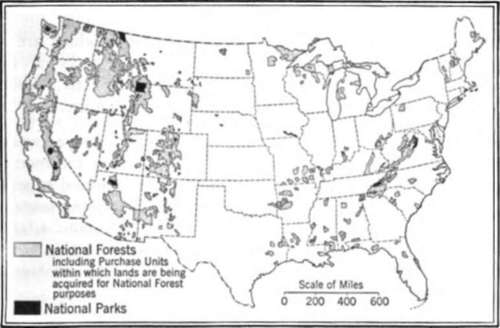
A glance at the accompanying map will show you the distribution of forests in the United States. The trees in the eastern half of the country are almost entirely hardwoods - oak, maple, birch, chestnut, elm, and so on. The western portion, aside from the desert areas, is characterized by softwoods - pine, fir, spruce, hemlock, sequoia, and the like. The largest belt of non-forest area runs from Canada to the Gulf of Mexico through the Dakotas, Nebraska, Kansas, western Oklahoma, and Texas; but even in these states there are woods along the streams.
County Parks
Thanks to the untiring pioneering work of such men as Gifford Pinchot and Theodore Roosevelt, great progress has been made in preserving the existing forests and in planting new ones. Cities, counties, and states have taken up the task, and millions of acres of beautiful wooded land have been set aside for public use. There are now over five hundred county parks in the United States.
Although not so extensive as state and national parks, these county areas are often splendid places to practice hiking and camping. In some instances, where these parks are located in or near cities, camping is not permitted, or if it is permitted one must secure a permit to build a fire or camp overnight. In such cases, of course, the skillful camper is sure to follow the rules set down to preserve the park property.
State Parks
Nearly every state in the Union has now set apart certain areas for the use of the public in addition to the national parks and forests. At the present time there are nearly 750 such state parks and many more are being established.* Besides furnishing beautiful picnicking and camping areas, most of these parks have splendid trail systems, which are a great boon to the hiker. Usually maps of these parks can be secured from the conservation department of the state. Each hiker should have such a map available for his own use.
Continue to:


My Books

