


Classifying Birds
Description
This section is from the book "Time Out for Living", by Ernest DeAlton Partridge and Catherine Mooney. Also available from Amazon: Time Out for Living.
Classifying Birds
Scientists have classified birds according to families. This you will want to do, too, when you become more familiar with them, but for the present it will probably be well to learn the common names and classify them by color, size, and habits.
The following list of common birds classified by their outstanding characteristics will help you in becoming acquainted with some of your feathered neighbors:
Some Bird Identification Helps*. Groups Known By Special Habits. Birds That Are Perpetually On The Wing
Chimney Swift: same size as English sparrow, sooty black, long narrow wings, habitually flying high, with rapid vibratory wing movement, nesting in chimneys.
Purple Martin: larger than English sparrow, glossy blue-black, nesting in birdhouses.
Barn Swallow: same size as English sparrow, blue-black above, chestnut and red below, nesting inside the barn, often seen in flocks on wires.
Birds That Creep on Tree Trunks, but Are Not Woodpeckers Nuthatch: same size as English sparrow, blue-gray back, black cap and back of neck, white under parts. (One species has red on under parts.)
Black-and-White Creeper: smaller than English sparrow, black and gray (or white) streaked (not cross-barred). Brown Creeper: smaller than English sparrow, brown above, lighter below, creeping on trunks.
Woodpeckers
Exploring bark and drilling into wood, black and white cross-barred above.
Downy: same size as English sparrow, clear light under parts. (Hairy : same size as robin, otherwise like downy.) Flicker: larger than robin; brown, breast light, spotted with black, white spot on rump; often on ground. Red-Headed: nearly same size as robin, head, neck, breast red; one broad white band across back and wings.
Birds Often Seen Running on Shores of River, Lake, Sea Sandpiper: midway between robin and sparrow in size, gray and white, long-legged, known by teetering of body when standing.
* Reprinted from Bird Study in Elementary Schools, Bulletin No. 4, by Robert G. Leavitt, published by the National Association of Audubon Societies.
Killdeer: same size as robin but with long legs, dark above, white below with two parallel black bands on breast, upper circling neck; often in fields.
Groups Distinguished By Colors. Birds That Are Black Or Prominently Black Marked
Turkey Buzzard: two or three times the size of a hen, nearly black all over (brownish at near view).
Crow: nearly same size as Leghorn hen, all black.
Grackle: larger than robin, all black (iridescent), end of tail wedge-shaped.
Red-Winged Blackbird: slightly smaller than robin, all black except red front angle of wing. Starling: same size as robin, black, white-flecked, tail short, bill long; as yet mostly in regions not remote from New York. Cowbird: smaller than robin, black except rusty head, neck, throat, breast.
Chewink (Towhee): smaller than robin, black forward and upper parts, dull red on sides of body, white belly, white on tail. Rose-Breasted Grosbeak: nearly same size as robin, black and white, large rose spot on breast. Redstart: much smaller than sparrow, all black except orange spots on sides, wings, tail. Kingbird: smaller than robin, nearly black upper parts, and nearly white under parts; tail white-tipped.
Red Or Prominently Red Marked (Red Including Orange)
Cardinal Grosbeak: nearly same size as robin, all red (black around bill), crest on head. Summer Tanager: between sparrow and robin in size, all over brilliant red, no crest, no black around bill. Scarlet Tanager: between sparrow and robin in size, bright scarlet, black wings, tail.
Baltimore Oriole: between sparrow and robin in size, bright orange body, black head, neck, breast, wings, tail, upper back.
Orchard Oriole: very much like the Baltimore, but with chestnut red in place of bright orange.
Purple Finch: same size as sparrow; looks like a native sparrow, but the forward parts richly suffused with rose-purple, shading to brownish posteriorly.
Blue Or Bluish
Bluejay: same size as robin, bright blue upper and light under parts, white bars on wings, white on tail, head crested.
Bluebird: larger than English sparrow, bright blue, dull red breast.
Indigo Bunting: much smaller than English sparrow, all blue.
Kingfisher: distinctly larger than robin, slaty blue-black, very large head, crest, bill, white collar; generally near water.
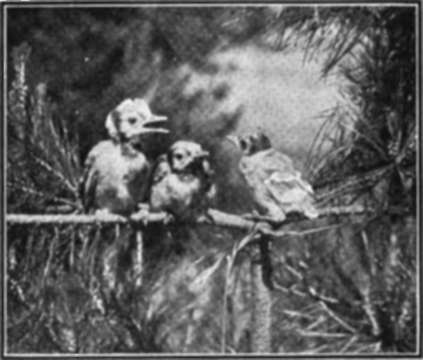
Young Bluejays Hold a Conference.
Yellow And Yellow Marked
Yellow Warbler: smaller than English sparrow, all yellow. Goldfinch: smaller than English sparrow, yellow, black wings, tail. Maryland Yellowthroat: smaller than English sparrow, clear yellow under parts, olive above, black mask across face and eyes. Meadow Lark: same size as robin, brown bird with bright yellow under parts, short tail. Warblers: smaller than English sparrow, many kinds migrating in spring, variously marked with yellow, black, white, gray; slender birds, slender beaks.
Brown With Spotted Breast
Wood Thrush: smaller than robin, breast (and lower) beautifully marked with large dark spots, upper parts cinnamon brown, tail short.
Brown Thrasher: same size as robin, and longer, all upper parts lively red brown, tail noticeably long. (Flicker, song sparrow; the ovenbird, like a miniature wood thrush, is common but shy in woods, saying "teacher, teacher.").
Sparrows
Plump, mostly brown and grayish birds, with stout beaks for cracking seeds. Several species occasional; four species common and easily told.
English Sparrow : black mark on throat and breast ("jabot," "bib," "tie"). Song Sparrow: same size as English sparrow, spotted breast, a large blotch in center.
Chipping Sparrow: decidedly smaller than English sparrow, chestnut crown, unmarked drab breast. Junco: same size as English sparrow, nearly uniform dark slate above, changing abruptly to white under body, outer tail feathers white; winter.
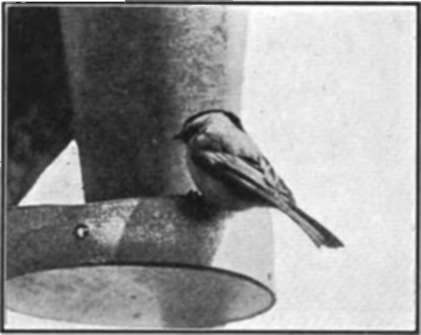
A Blackcapped Chickadee, perched on a feeding pan.
Miscellaneous
Chickadee: much smaller than English sparrow, mouse-gray with black cap and bib. Tufted Titmouse: same size as sparrow, upper parts slaty gray, under parts white and (posteriorly) reddish, crest quite pointed. Wren: very small, brown, up-tilted tail, long slim bill. Waxwing: larger than English sparrow, large pointed crest; very smooth light brown-gray, yellow bar at end of tail. Catbird: smaller than robin, nearly uniform ash-gray all over. Mocking Bird: same size as robin, smooth brownish gray above, white and gray beneath, wings darker barred with white, tail dark edged with white.
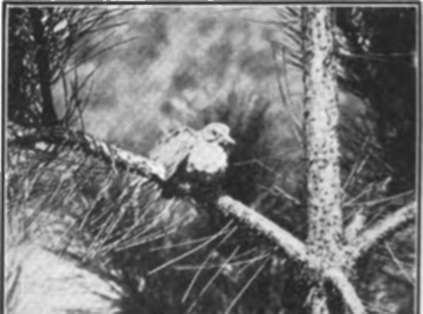
A Young Mourning Dove. Its mate flew away.
Mourning Dove: decidedly larger than robin, slender, bluish gray above, lighter beneath, long tapering tail displaying much white in flight; often walking on ground, in pairs.
Some Interesting Things To Do
1. How many birds can you identify during a week? Classify them as (1) residents; (2) travelers.
2. Keep a list of the birds you see in the spring, making a note of the date on which you see the first one of each species. Save these notes to compare with the next year's notes and see how accurate these travelers are.
3. Make a bird calendar in which observations of migrants will be kept.
4. Can you identify these officers of the bird army?
The Scouting Department (red-winged blackbirds) The Mosquito-Bite Savers (swallows, swifts, etc.) The Hitchhikers The Flycatching Department The Worm Eradicators Collectors of Insect Eggs Clean-up-the-Trees Department Cricket and Grasshopper Destroyers High-flying Bombers Tree Investigators What others can you add?
5. Make a survey of the birds nesting in your vicinity and locate their nests. In no case let the birds know you are an inspector. Be quiet, courteous, and careful.
6. Make a list of the things you see birds eating during one week. See if this list covers most of the insect world.
7. How many birds can you see, during the week, that eat from the trunks of trees? How many of these can you identify? Tell how.
8. If you can, find a place where a woodpecker is digging his hole and watch him. How long do you think it will take him to finish?
9. Find out if anyone in your neighborhood is an expert on birds. If you find an expert, talk with him about bird lore as a hobby.
If possible, go on a hike with him and see birds first-hand.
10. Make colored drawings of five common birds. Tell the habits of each.
11. If you live near a museum, visit it and see some of the birds mounted there.
12. Which one of the books at the end of this chapter dealing with bird lore seems most interesting to you? Read it and report to the class (1) whether the title was misleading or not, (2) new things you learned, (3) your opinion of the book.
13. Draw two cartoons, side by side, contrasting how to go forth to meet birds with gun dog noise checks and plaids excitement field glasses food quiet neutral colors calmness
Helpful References
Allen, A. A., American Bird Biographies. Audubon, J. J., Birds of America. Bailey, F. M., Handbook of Birds of the Western United States. Baynes, E. H., Wild Bird Guests. Brand, A. R., Songs of Wild Birds. Butler, L. L., Birds around the Tear. Chapman, F. M., Bird-Life. Chapman, F. M., Color Key to North American Birds. Chapman, F. M., Handbook of Birds of Eastern North America. Chapman, F. M., What Bird Is That? Coward, T. A., Migration of Birds. Dicken, A. M., Ways of Birds. Doubleday, N. B., Bird Book. Herrick, F. H., Wild Birds at Home.
Mathews, F. S., Field Book of Wild Birds and Their Music. Nice, M. M., The Watcher at the Nest. Peterson, A. M., The ABC of Attracting Birds.
Peterson, R. T., A Field Guide to the Birds. (East) Priestley, M., Book of Birds. Reed, C. A., Bird Guide. (Pocket Nature Library) Reed, C. A., Water and Game Birds.
(Pocket Nature Guide) Robertson and Powell, Bird Watching Days.
Saunders, A. A., A Guide to Bird Songs. Wyman and Burncll, Field Book of Birds of the Southwestern United States.
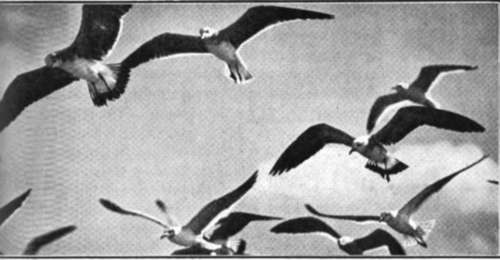
Sea Gulls.
Continue to:


My Books

