


Identifying Birds
Description
This section is from the book "Time Out for Living", by Ernest DeAlton Partridge and Catherine Mooney. Also available from Amazon: Time Out for Living.
Identifying Birds
Learning to identify birds in the field is no simple matter. Very often all you will get is a short glimpse of the bird as it passes by, or you may not see it at all but simply hear its call from far up in a treetop. The experienced bird lover can tell his friends by many different characteristics. The size of the bird, the way it flies, the way it acts when on the ground or in a tree, its coloring, and its voice are all part of the picture.
The size of the bird is reckoned from the tip of his bill to the tip of his tail. For quick comparison, it is customary to speak of a bird as being either larger or smaller than some common bird, such as the English sparrow or the robin. Size is a very important feature of identification and should always be noted when making a list of birds seen.
Often the only way of identifying a bird is by the mannerism it has in flight. Hawks soar in circles looking for prey. Woodpeckers fly in undulating lines (up and down in waves). The goldfinch, a bird that likewise flies in this manner, sings as he goes. Ducks and geese hold their necks out straight, flap their wings very fast, and fly in straight lines. Flycatchers and birds of prey often sit on a perch in the tree and dash out to snap up an insect or other prey when it comes into view. They then return to their perch to watch for another victim.
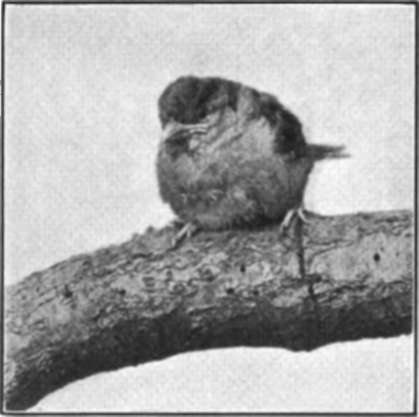
A Young Sparrow in a thoughtful mood.
Small brownish or grayish birds that stay near the ground are apt to be sparrows of one kind or another.
A bird's mannerisms while in trees are interesting as well as instructive to the bird enthusiast. Some small birds belonging to the nuthatch family hang on to the sides of the tree upside down, looking for food on the bark. The brown creeper starts near the bottom of the tree and hitches his way up a little at a time, going around the tree in spirals until he reaches the top; he will then swing down to the bottom of a near-by tree and repeat the process. True woodpeckers are always right-side up on the trunk of a tree. They hang on with their feet and use their stiff tails as a prop while they dig for food.
On the ground, too, birds act differently, according to the family to which they belong. Some birds walk, while others hop. The duck, as everyone knows, waddles because his legs are so far back on his body that it is difficult for him to keep his balance. In the water his build is a great advantage in swimming. Meadow larks walk and flick their tails when they alight. Water thrushes bob up and down on rocks or sticks, as if they had a bad case of hiccoughs. Crows walk about in fields searching for food, quails run fast, and sparrows hop about on both feet.
Birdcalls are very important in identifying birds. Those who are familiar with birds can identify them quickly by either the song or the alarm call. The voice of the bird, it should be remembered, is a means of conveying emotion, that is, of telling the world and especially his friends when he is frightened, angry, or happy. Usually the birds use a different kind of note for each of these emotions. Learning all the different calls is no small task. The wood thrush and the hermit thrush are usually considered the sweetest singers. The brown thrasher, a larger bird than the thrush, has a loud and clear voice that he lifts in song all summer long. He is a good mimic, too, and apes the calls of other birds.
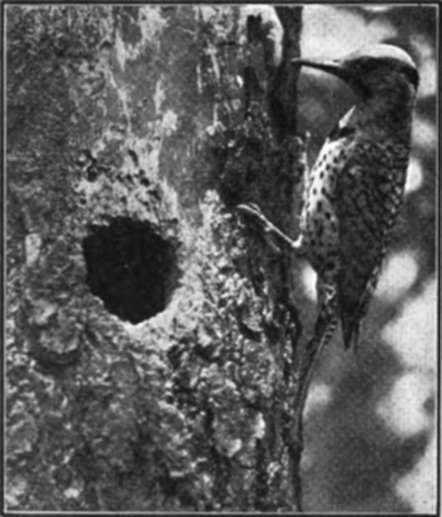
A Flicker, near its nesting hole in a tree trunk. Flickers, found in most parts of North America, belong to the woodpecker family.
Another of the important characteristics of the bird is the coloring - not only the coloring of the bird when it is still, but also the characteristic markings as it flies through the air. The flicker, for example, has a white spot on its rump that does not show until it flies away from you. The robin, too, has its characteristic color for flight. The outer ends of its tail have white spots when it is in flight. The important thing about color, however, is the prevailing color of the bird together with its distinctive markings. The outline given on the following pages will help you to know the different sizes and coloring of common birds and therefore aid you in locating birds in the bird guide.
One thing that should always be remembered in classifying birds by color is the difference between the male and the female. Sometimes this difference is so great that they seem to belong to entirely different species. Usually, though not always, the male bird is much more brightly colored. This may be because he does the courting or because the female usually sits on the nest and is hence less apt to be spied by preying birds.
Continue to:


My Books

