


How To Look For Birds
Description
This section is from the book "Time Out for Living", by Ernest DeAlton Partridge and Catherine Mooney. Also available from Amazon: Time Out for Living.
How To Look For Birds
Looking for birds is just as much an art as skating or swimming. Most people who walk through the woods do not see many birds because the birds know of their coming long before they arrive upon the scene and hence are completely out of sight. Birds depend for their survival to a large extent upon their ability to see small movements and hear small noises. To go swinging through the woods stepping on dry sticks and branches, talking and laughing, is to tell all the birds within a hundred yards that you are coming and that they had better duck out of sight.
If you want to see birds, move slowly and quietly. Do not raise your hands or arms suddenly. Be careful about stepping on dry twigs. Crackling twigs arc the warning to all wild life that a large animal is near. If you see a bird, stop and watch it without moving any part of your body except your eyes. Remember, you look about the size of a huge dinosaur to the average bird. Wear neutral-colored clothes, such as khaki or gray, to be inconspicuous.
Birds, like many other wild creatures, are terribly curious. They will go to great pains to find out what is going on if they think it is safe. You can often bring small birds to you by sitting on a log and making a squeaking noise by sucking with your lips on the back of your hand. It takes time for the birds to come and you must remain as motionless as possible when they appear.
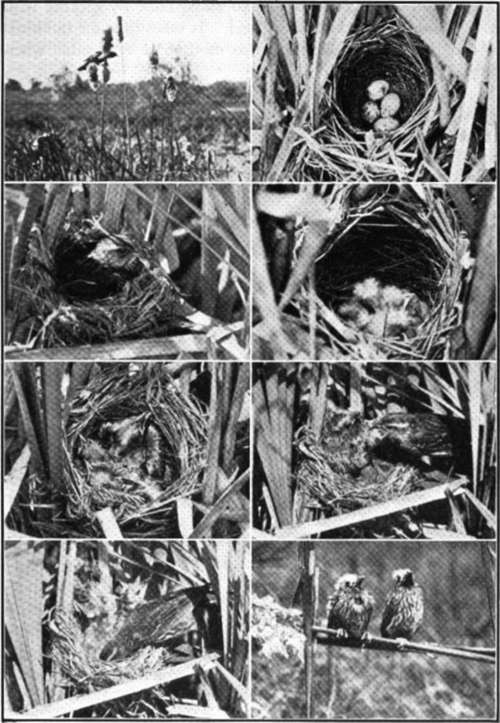
Red-winged Blackbirds from Nesting to Fledgings. The photographer worked many months to get these pictures. Read them from left to right as you would read lines of print: the mother bird building the nest, the eggs, setting, hatched birds, feeding, the fledgings ready to fly.
Continue to:


My Books

