


Chapter Thirty-Two. More About Words
Description
This section is from the book "Time Out for Living", by Ernest DeAlton Partridge and Catherine Mooney. Also available from Amazon: Time Out for Living.
Chapter Thirty-Two. More About Words
Birds As Travelers
There are no living creatures on earth that travel as much as do our feathered friends. True, there are a few men who travel around and around the earth and others who keep on the go constantly in their automobiles. These individuals may cover more ground than a single bird, but millions of birds travel for thousands of miles each year, so that as a group they no doubt are the world's greatest travelers. Consider, for example, the way in which the bobolink travels from its winter home to its summer home each year.
The bobolink arrives from the South about the first week in May. If he carried traveling bags, it might be possible to examine them and see what countries he had passed through by reading the stickers pasted on them. Since this is impossible, we must rely on the studies that have been made of bobolinks' travels.
In the winter these intrepid little travelers spend their time in southern Brazil. When the sun begins to move northward in the sky and bring spring to the Northern Hemisphere, the bobolinks start their travels, but not until they have donned their traveling coats. The birds are heading north for their mating season and the male bird begins to take on his most brilliant colors. The return journey starts sometime in March, while the summer home is still in ice and snow. No one reallv understands how the bobolinks know just when to leave for the North. However, they do, and they promptly vacate their winter home about the same time every year. Early in April the male birds, flying a few days in advance, reach Jamaica and Cuba. About the fifteenth of the same month they are in Florida, where some of them stay until May. In flying from South America to North America, they all cross the Gulf of Mexico, some going by way of Cuba and others by way of Central America.
In many parts of our country the bobolink is called the Maybird because of its arrival in that month. Few people know that the same bird, on his return journey in the fall, with a different traveling coat, is called the ricebird in the South. While in the South, the bobolinks travel in groups and sing in a huge chorus. What a sound it is to hear hundreds of them singing the same tune as they swarm along together.
The traveling schedule of the bobolinks is amazingly accurate. By the last week in April they have usually reached Washington. D. C., at least the advance guard has, and by May first they can be seen around New York and a week later in Boston. You see, these little fellows who spend the summer in northern New England, New Brunswick, and Canada travel four thousand miles twice a year and stay in their summer home only two months.
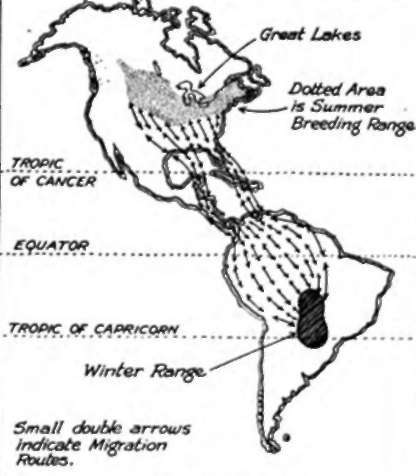
BOBOLIN K MIGRATION.
One would think it would be much easier for the birds to remain in South America or Central America, where it is warm all of the time, than to take this tremendous journey over sea and land. Apparently, the reason for their coming North is to raise a family. Then they return to the South again. All birds that migrate seem to do so for the sake of the family. None of them raise their families in South America or wherever they go for the winter.
Continue to:


My Books

