


Residents And Non-Residents
Description
This section is from the book "Time Out for Living", by Ernest DeAlton Partridge and Catherine Mooney. Also available from Amazon: Time Out for Living.
Residents And Non-Residents
Not all birds travel, of course, at least not to the far South. Generally speaking, there are four types of birds in any one locality during various times of the year. There are the residents who stay all during the year, the migrants who are passing through during spring or fall, the summer residents, and the winter residents. Therefore it is possible for a person, if he watches carefully, to observe many of the birds of North America by studying them the year round. Year-round study makes bird lore a tremendously interesting hobby. The subjects are constantly changing. Watching the movements of birds to keep track of their appearance each year is especially fascinating.
The whole subject of bird migration is interesting. Besides watching the comings and goings of the various species, one can listen and hear them fly overhead at night. Most migrating birds do their flying at night. The reason for night flying appears to be protection against their enemies, the birds of prey. Large birds and birds of prey migrate in the daytime. The little fellows who depend upon dense foliage for protection find it necessary to make their long journeys at a time when the enemy cannot see them. If you will hike out to a hill some night in the spring, when you know birds should be traveling, you can often hear great crowds of them passing overhead. Sometimes they run into lighthouses, airplanes, and electric wires, and are killed.
Try keeping a list of the birds you see in the spring, making a note of the date when you see the first one of each species. Then compare this with next year's entry and see how accurate these travelers are on their schedule.
Some students of birds claim that the humming bird hitchhikes his way to the South in the fall. This little fellow, they say, nestles upon the back of a southbound wild goose and stays under the warm feathers until he arrives at his destination or is dislodged in some way. Hunters claim that they have seen these hitchhikers fly out of the geese when they have been shot, and in some cases the hitchhikers, too, have been killed.
You will, no doubt, be interested in knowing how the travels of birds are studied. Hundreds of people all over the world co-operate in studying them. The birds are caught in especially constructed traps by people who have a permit to do so. These traps are made so carefully that they do not injure the birds. After the bird is caught, a small metal band bearing a number is placed on one of its legs. The government furnishes these bands to those who are permitted to trap birds. The bird is then released and if it is caught again by some other person who is banding birds, the number is sent to Washington. In this way it is possible to trace the bird's travels.
Those who band birds have a very interesting time finding where the birds come from and where they go. You can imagine what a thrill it would be to catch a bird with a band that was placed on its leg in South America a few weeks before.
Birds seem to be very intelligent about their traveling. They realize that it takes training to prepare them for a trip as long as they are to take. They also know that much fuel will be consumed on the way, so they fatten themselves up as much as possible before starting out. In the fall, when it comes time for the feathered folk to head for their winter homes, you can see them assembling for the flight. The swallows arc perhaps the most conspicuous in gathering their crowd together. You can see them assembling in great groups and flying on longer and longer trips in preparation for the big journey that is to come.
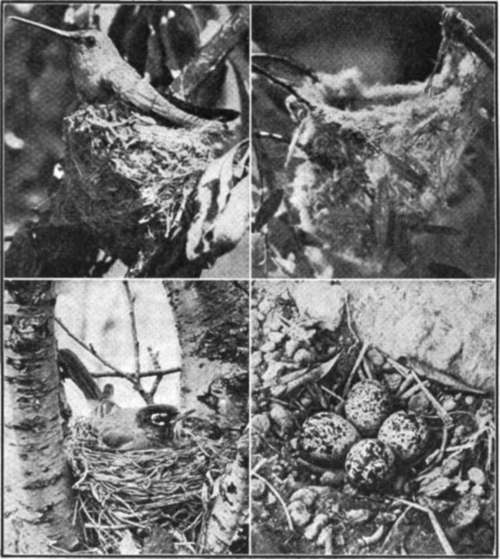
Various Types of Nest Architecture. At the top, from left to right, are nests of the humming bird and the oriole. Below them, again from left to right, are nests of the robin and the killdeer.
Continue to:


My Books

