


Bird Builders
Description
This section is from the book "Time Out for Living", by Ernest DeAlton Partridge and Catherine Mooney. Also available from Amazon: Time Out for Living.
Bird Builders
Coming North to rear a family is not the simple thing that one would suspect. Besides traveling long distances, the bird must cope with countless enemies and antagonistic forces of nature. Snakes, cats, birds of prey, and man are all sources of trouble to the bird parents in their struggle to raise a family successfully. In addition to avoiding these animal enemies, the bird must provide against wind and rain if the eggs are to become full-sized birds.
One of the most important jobs in rearing a family is to provide a suitable home. During May and June most of the birds select the sites for their homes and proceed to make them livable. In studying the construction of a nest, one should not destroy or harm it during the summer months, but should wait until fall or winter. Otherwise the nesting might be disturbed.
Generally speaking, there are three types of nest; holes in trees, nests resting on or suspended from trees, and nests in or on the ground. The type of nest that is built depends upon the species of bird. Nest building seems to be a matter of instinct; that is, the bird inherits the ability to build the nest from his parents without learning how. This is no doubt why each kind of bird has his own particular way of solving the housing problem.
As everyone knows, woodpeckers make their homes in holes they themselves drill in trees. The woodpecker is not the only bird that lives in such holes. As a matter of fact, the hard-working woodpecker furnishes holes for many of his near and distant relatives. Bluebirds, chickadees, house wrens, great-crested flycatchers, screech owls, and some wild ducks use natural holes or deserted woodpecker homes. The bluebirds, chickadees, and wrens usually are the ones that nest in birdhouses.
A woodpecker usually selects a place on a dead tree far above the ground. He chips off small pieces of wood with his bill and thus makes a hole straight into the wood. After going inward for a few inches, he digs the hole downward. As you can imagine, this is a long and tedious process and takes many days. One can often see piles of small chips at the foot of a tree in the spring that indicate a woodpecker is or has been busy above.
When another bird takes over a last-year's woodpecker hole, he usually redecorates the inside; or perhaps it would be more accurate to say he re-upholsters it. For this purpose string, feathers, hair, fine grass or moss, and many other materials may be used. If you sec a bird carrying any such material in his mouth, you can be pretty well assured that some nest building is going on near by.
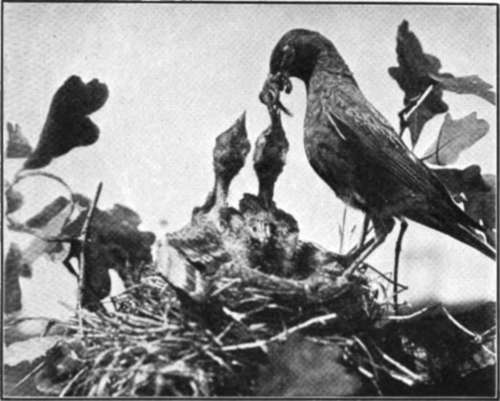
A Robin Brings Supper to the Young Ones in the Nest.
There are more than 200 different kinds of birds that build nests in trees or shrubs. These nests are generally of two types: those built up and those built downward or suspended. Large built-up nests made of sticks are apt to belong to hawks, eagles, crows, magpies, or herons. Some of them are as large as several bushel baskets. Small built-up nests, somewhat bulky and plastered inside with mud, are apt to belong to a member of the thrush family. The robin, a member of this family, makes a mud cup inside of his home and one can usually tell his nest by this cup. If there are several light blue eggs in the nest, you can be certain that it belongs to a robin.
The nests that are suspended from limbs are perhaps the most interesting and require the most skillful craftsmanship. Conspicuous in this type of nest is that of the Baltimore oriole. His particular construction job affords excellent protection against wind, rain, and preying hawks. The illustration on page 547 shows how the oriole's unusual nest is built. In this connection it is interesting to note that birds of brilliant plumage usually have covered nests. No doubt they cover the nests to protect themselves from birds of prey flying overhead.
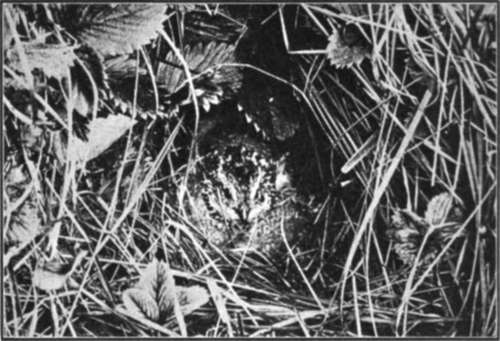
Bobwhite Quail, in its nest in a strawberry patch.
The chimney swift builds a most curious nest. With sticky saliva from his own mouth, this fellow glues sticks to the side of the chimney and upon these fashions a livable nest.
From the variety of nests that are described above it is quite apparent that among the birds there is almost every conceivable kind of craftsman. The types of work done on the nests suggest weavers, carpenters, frescoers, decorators, upholsterers, skilled mechanics, shiftless unskilled workers, and parasitic tramps. Furthermore, the range of material used in the construction of nests is really amazing. One should not be surprised to find any of the following in a nest: hay, sticks, string, feathers, hair, moss, bark, fur, hog-bristle, dandelion-down, mud, seed pods, paper, rags, or yarn.
A word should be said about the shiftless workers and the tramps. The English sparrow's nest, as nearly everyone knows, is just a pile of odds and ends, predominantly grass, thrown together with no particular rhyme or reason. If he can, this bird finds some place under the eaves of a house or in some other protected spot and then hauls in everything he can find to make it soft and warm.
One of the tramps among birds is the cowbird. This lazybones does not even bother to build a nest; in fact, even the raising of his young birds he leaves to someone else. When it comes time for egg laying, the female bird looks around for some nest that another bird has completed and then slips into it, when the owner is away searching for food, and deposits an egg among those that are already there. Upon returning to the nest, the warbler, sparrow, or whatever kind of bird it is, is apt to be excited. Calling its mate, they discuss the unwelcome guest noisily and then either decide to leave it there or abandon the nest. Usually they accept it and proceed to hatch it with their own. But their troubles do not end there. After the egg is hatched, the young cowbird eats more than its share, and is cross and unthankful for its many favors. As soon as it is able to fly, it leaves the nest to repeat the process. Thus, the cowbird leaves the raising of its young almost entirely to other more industrious birds.
Continue to:


My Books

