


Braiding. Continued
Description
This section is from the book "Time Out for Living", by Ernest DeAlton Partridge and Catherine Mooney. Also available from Amazon: Time Out for Living.
Braiding. Continued
The Turk's-Head Ending
Now there are two more things that the craftsman should know about braiding before he can go ahead and make articles. One is the Turk's-Head ending and the other is the sliding knot.
The Turk's-Head ending is started in the same way as the square braid. After beginning in the same way, choose any one of the four strands and, proceeding again in a counter-clockwise direction, take it under the next strand and up through the center as shown in figure 13 on page 216. Use the marlin spike for opening the center to allow the strand to go through. Do the same thing with the next strand, under the one next to it and up through the center. Continue in this way with the two remaining strands, the last one going around under the next strand (although this strand, being the first one to go up through the center, is not sticking out as the others were). Now tighten your work by following each strand through from the beginning of the knot to the end and pulling it through by inserting the marlin spike under the thong and pulling it up gently to take up the slack. Do not try to tighten the knot by pulling all of the strands at once, or by jerking hard on one strand at a time. It will not pull evenly this way, and the appearance of the knot will be spoiled. Practice this knot (figures 13-16) several times, using shoelaces, until you definitely know it. You will find it handy in more ways than one in your craftwork.
Sliding Knots
Sliding knots are useful in joining a lanyard, hatband, or watch fob, when a loose loop that can be made long or small is desired. There are several different kinds of sliding knots, only one of which will be presented here. You will find many uses for this knot in other crafts besides leathercraft.
The knot is first formed with a single strand around the two braided sections, as shown in the accompanying illustrations from 1 to 10. The process is then repeated by following the single strand completely around again the second time. You will have the double-weaving effect shown in figure 12. The knot is finished by tucking the end in at the starting point. Practice this knot with a shoelace on a pencil until you can do it readily.
When tying the sliding knot on a lanyard or watch fob, it is a good plan to wrap a piece of paper, slightly longer than the knot, around the lanyard where the knot is to be tied. If you paste the edge of this paper down, you will have a small cylinder on which it is much easier to work. The paper can be slipped out after you have finished the knot.
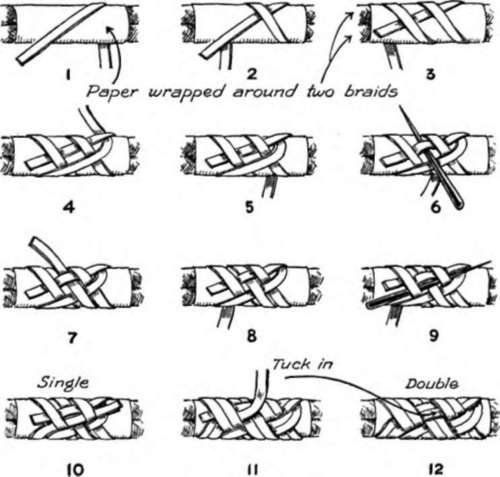
SLIDING KNOT
Leather For Braiding
Now comes a question of great importance. What kind of leather should be used in braiding of this kind and where can it be obtained? The answer to these questions depends on several things, such as what use you intend to make of the finished article, the amount of money you have to spend, and whether or not you would like to cut out the strips yourself.
First of all, it might be well to show how leather strips can be cut from old discarded leather, such as boots and shoes. Sometimes it is possible to secure scraps of leather from factories or upholstery shops, in which case the same method of cutting can be used. In this way, braiding need not cost much and very beautiful articles can be made.
Scraps of leather can be cut into braiding thongs by the following process:
Cut the leather into round disks about three inches in diameter, or as near that as you can with the leather you have.

Sharpen a thin blade of a knife until it cuts the leather very easily. It is best to finish the sharpening by whetting the blade on the sole of a shoe or on some other leather until the edge is very keen. Cut a small stick the shape of the one shown in the illustration. The notch at "A" should be just as deep as the leather to be cut is thick.
Cut a strip of leather the width you wish from the round disks, as shown in figure 2. Cut it with a knife, and make it about two inches long.
Stick a knife into a board as shown in figure 3, being careful that it does not cut you by closing on your finger. Use a little precaution in this operation.
Set the notched stick up against the sharp edge of the knife, leaving just as much space between the edge of the notch and the blade as the width of the strand you wish to cut.
Start the end of the strip which you have cut on the disk through this opening and then pull it gently against the sharp edge of the knife. The disk will turn as the thong is cut and a strip of leather the width desired will be the result. Some practice is needed to do the operation successfully, but once you have mastered the trick it is amazingly simple. A good grade of calfskin is perhaps the best to use if one is going to buy leather to make his own thongs. Calfskin can be bought in several colors and hence it is good for this purpose.
Leather for braiding can be secured already cut, in a variety of colors. It costs more than if you cut it yourself, but the grade is fine and the quality consistent. A list of supply houses will be found at the end of Chapter 12.
Recently imitation leather in strips has become very popular for braiding. You can get it in many colors and it is very strong. It can be had either flat or round. Some people prefer imitation leather to real leather because of its bright colors, low cost, and durability. This material can also be secured from the sources listed at the end of Chapter 12.
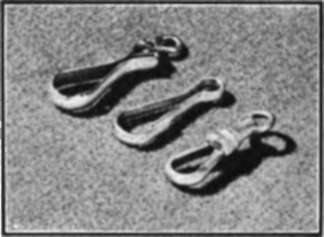
Swivels.
Other Material
If you are going to braid such articles as watch fobs and lanyards you will want to have some swivels, or snaps, similar to those shown here. These can be secured from a leather house for a few cents each.
Some Interesting Things To Do
1. Make a list of leather objects that serve you (as book covers, desk sets, camera cases, belts).
2. Learn to braid with a pair of shoe laces. If possible, ask someone who knows how to show you.
3. Make a device such as that described on page 220 for cutting leather thongs. Try it on some old leather.
4. Find some person who knows leathercraft and talk to him about his hobby. Find out what attracts him to the hobby.
Some Leather Articles. Belts, key cases, purses, lanyards, and watch fobs can be made quite easily if you know the tricks of the trade.
Continue to:


My Books

