


If You Are A Guest
Description
This section is from the book "Time Out for Living", by Ernest DeAlton Partridge and Catherine Mooney. Also available from Amazon: Time Out for Living.
If You Are A Guest
Invitation Received
There are many things a guest should consider, and if you are the right kind of guest you will do the right kind of thing.
Usually it is polite to let the host or hostess know whether or not you are coming. Answer an invitation with a short note or a phone call, depending on the type of invitation received. If the invitation includes the initials R.S.V.P. down in the corner, an acknowledgment is expected. (These letters are an abbreviation of the French phrase Repondez s'il vous plait, meaning "Please reply.")
What To Wear
Unless otherwise specified, the dress is informal - an afternoon dress or a dark business suit if it is an evening party. In the summer, men may wear light suits on such occasions. If you are in doubt as to the dress, telephone your host or hostess to make certain.
Bringing A Friend
Do not bring a friend along unless you have first called the hostess for permission to do so. The hostess will usually invite your friend to come, but it is required of the guest that he secure this permission.
At The Party
The guest should have a good time and help others to enjoy themselves. He should not monopolize the conversation or the games by keeping in the center of the stage, but he should co-operate in the activities and show an interest in what is being done. A considerate guest does not wait to be coaxed to enter activities.
Some Interesting Things To Do
1. Start a hostess pleasure chest or party box for your home. See the suggestions on pages 390-391.
2. Keep a scrapbook of party suggestions.
3. Make a list of the different kinds of special parties you could have in your home.
4. Make a list of your friends and their talents and decide which type of party suggested on pages 391-395 would be best suited to them.
5. Plan a party in your home. State the number of guests, the kind of decorations, the activities, and the food for the occasion. Check the menu with your home-economics teacher. Make a budget and estimate how much it will cost.
6. Plan an invitation to a friend inviting him or her to your house to a party. Be sure you include the time, place, dress, and occasion. Whether it is by note, card, or phone, it must be told in an attractive manner.
7. Food is important at a party. Magazines and papers are full of new ideas on menus. Start a file (of clippings) now. You'll enjoy it.
8. Make some sample place cards for a party. If possible, use materials from around the house that will not cost any money.
9. What awkward moments have you noted or heard about? Why not dramatize a few for the class?
10. You have been assigned the task of producing a movie showing how a guest at a party should behave. Make a list of scenes you would include in this movie.
Helpful References
Bancroft, J. H., Games for the Playground, Home, School and Gymnasium.
Bond, R. A., Beginners' Book of Modern Backgammon.
Faurot, W. L., Art of Whittling.
Fikes, N., Can You Answer It?
Geistcr, E., Geister Games.
Geistcr, E., Let's Play.
Geister, E., What Shall We Play?
Goodrich, L. B., Living with Others.
Hirschbcrg, A., Can You Solve It?
Houdini, H., Houdini's Magic.
Hoyle, E., Games.
Keasbey, W. P., Big Trick and Puzzle Book.
Leamy, H., Collier's Nameographs. Linscott, H. B., Bright Ideas for Entertaining.
Lippy, J. D., Chemical Magic. Mcnaker and Folsom, The Life of the Party.
Meyer, J. S., More Fun for the Family. Murray and Rigney, Fun with Paper Folding.
Rodgers, M. A., Handbook of Stunts. Rulon, P. J., Brain Teasers. Schaad, C. G., Ping-Pong. Shcdlock, M. L., Art of the Story-Teller. Spayth, H., Checkers for Beginners. Spraguc, C., How to Draw Silhouettes. West, and others, Show 'Em Up in Anagrams. Wheeler, R., Let's Play Charades.
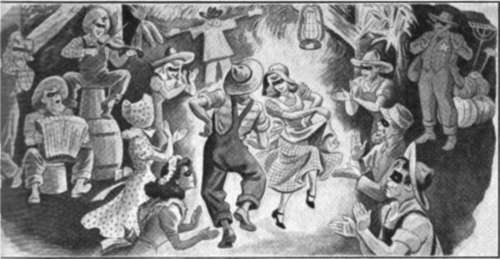
The Good Old Hallowe'en Barn Dance.
Continue to:


My Books

