


Instruments Of Bygone Days
Description
This section is from the book "Time Out for Living", by Ernest DeAlton Partridge and Catherine Mooney. Also available from Amazon: Time Out for Living.
Instruments Of Bygone Days
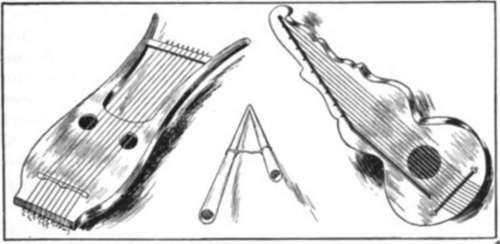
The Greek lyre, on the left, was used for striking chords to accompany singing. It was never used alone. The double pipe, shown in the center, was developed from the simple reed. At the right is an eighteenth-century zither. To play it, the musician laid it flat on the table and plucked the strings.
The gem of all stringed instruments is the violin, a small, delicate instrument that has an interesting history. Years of experimentation were necessary before the present shape and dimensions were perfected. Today this small instrument, weighing only a few ounces, can play our smoothest music. Without it, music would not be half so pleasing.
Not only have the various instruments been through a long process of development, but music itself in its various forms has come down to us with a very interesting history. There is a long drama, filled with gripping human incidents, extending from the early musical sounds made on the crude instruments of the cave men to the highly trained and perfectly organized orchestras of today. Unfortunately, many pages of this drama will never be filled with facts. They remain blank because it was not possible to make any record of the music of those days. Crude instruments could be left to tell their stories to modern man, and drawings on the walls of tombs and temples teach us something about Egyptian instruments, but we are quite ignorant of the kind of music these instruments produced.
It is no easy matter to trace the threads of our modern music back to their beginnings. The different types of music that stand out distinctly today, such as the dance, opera, hymn, symphony, and chamber music, have threads that reach into the distant past and cross one another and weave together continually. The music of various countries - each national type portraying the temper and emotion of the particular people from which it came - has been intertwined. In modern America we enjoy music that is a combination of the best that music creators the world over have contributed.
Primitive music was always used in connection with the rituals or ceremonies of the tribes. There was little or no attempt, at first, to produce melodies on these instruments. They were used mostly for rhythm. Even today we find that some of the forms of rhythm of the primitive people are most complicated. Oriental music, for example, may have several different kinds of rhythm going along at the same time and all following one beat which is kept going steadily. If you have never heard recordings of primitive music, you may be interested in hearing it sometime at a music store. You will be amazed at the difficulty of the rhythms.
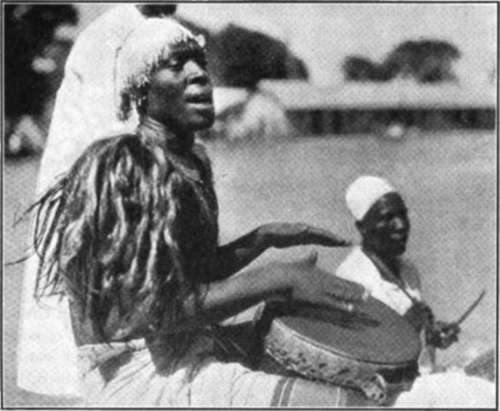
The drum is a very old instrument, originally used to set the rhythm for dancing and also to relay messages over long distances. The modern drum, of course, is used in orchestras and bands.
Early vocal music was usually sung upon one pitch by one principal singer. No doubt there was some inflection, or rising and falling of the voice, which led to the fixing of certain tones and which, in turn, made it possible to sing more than one tone in a song. Occasionally we find people today who seem unable to distinguish between one tone and another. Authorities say that this tonal deafness is rare, but sometimes around the camp-fire or on a hayride, we doubt it.
The ancient Greeks made great strides in vocal music. They considered music as important as mathematics or astronomy. Our good friend Plato was forever singing the praises of music and its value to society. The Greeks developed a system of scales which they called modes. If you are interested in finding out more about them, the books listed at the end of this chapter will help you.
At first the Greek singers sang the same note, and if there was an accompaniment by any instrument, they played the same note. However, as they became more experienced, part singing came into being; and this brought harmony, or the carrying on of several parts, to produce a pleasing effect.
While the Greeks were enjoying their music, the people in the Orient had developed music to an even higher degree. Many of the things used in modern music developed originally in China. The Chinese were perhaps the first to invent a system of scales in which tones and half tones were used. Another eastern country, Persia, developed a very complicated scale, which they use to this day. The contributions to our music from the East probably came when the Roman legions conquered most of the known civilized world. The soldiers learned new tricks with instruments and notes and brought them back home.
In the early days of musical history, when there was no way to write music so that it could be passed around as it is today, songs must have traveled very slowly and changed as they were sung in different ways. Songs that originated as war chants may later have become folk songs, which were used when groups got together for any purpose. We know, too, that some of these same tunes were used in church services, and with different arrangements they became the dignified music used with worship.
Many of these folk tunes that were sung by groups of people, who congregated to have a good time or dance in the village square, were later used by great composers in developing the themes for their dances, symphonies, and other compositions. This is one reason why the music of each country has its own peculiar melodies and rhythms. In a way, it can be said that music is created by all of the people who sing and play. The composer simply interprets what he finds about him.
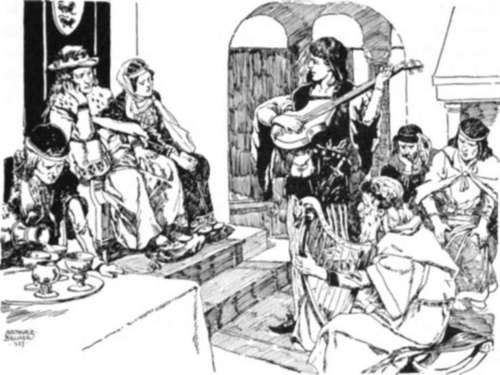
During the Middle Ages traveling singers went from one town to another, appearing in castles, squares, manor houses, and inns. They carried the news and also entertained by singing songs of their own composition as well as the popular ballads.
Continue to:


My Books

