


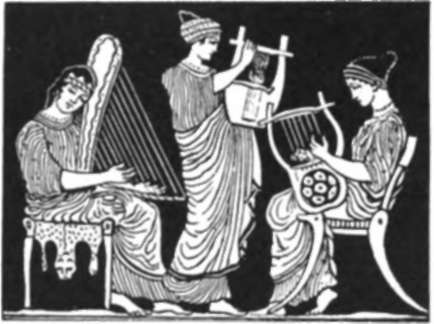
Design From A Greek Vase
Description
This section is from the book "Time Out for Living", by Ernest DeAlton Partridge and Catherine Mooney. Also available from Amazon: Time Out for Living.
Design From A Greek Vase
To the ancient Greeks music was an important subject. They not only sang and accompanied their singing, but they also used music as a theme for painting and sculpture.
Between these early flutes and whistles and our modern orchestral instruments, such as the flute, clarinet, and oboe, there were thousands of years of experiments. When man came to know more about music and how to construct it, he wished to have instruments that could be tuned and played in regular tonal steps. Succeeding generations tried various ways of making regular tonal steps. At first they did not know where to place the holes in the whistle or flute to control the sound. Even as late as two or three hundred years ago, the flute was the cause of much unhappiness to orchestra leaders, because it was clumsy and complicated to play.
Another section of the wind instruments in the symphony-orchestra comprises the various horns. In the family history of these music makers there are many fascinating tales. The blare of trumpets resounds down through the pages of history. Horns are usually associated with battles, contests, and hunting parties. You will recall that horns of various kinds are quite frequently mentioned in the Bible. The walls of Jericho trembled and fell to the concerted blasting of trumpets.
The name "horn" is interesting in itself. Many people do not realize that it comes from the horns of animals, which were no doubt the first horns to produce calls of various kinds. Somehow, somewhere, ancient man found that by opening the small end of an animal horn he could produce shrill sounds with his pursed lips. From these crude beginnings have come elaborate modern instruments with their many turns, twists, and valves, producing many and varied sounds. However, between the early animal horns and those in the brass section of our modern orchestras there is a long chain of thrilling events.
Quite early in this history of the horn, man found that by varying the length of the horn he could produce different kinds of sounds. By making the horn extremely long, say six feet, he could produce a much greater variety of sounds and with much more brilliance. Even as long ago as the early Egyptian days, there were long trumpets that must have rolled weird sounds across the Nile. The horn was a useful instrument in battle because it could be used for signals. It could be heard above the clatter of arms, the cursing of men, and the neighing of horses. Even today the bugle is still used in the armies of the world for much the same reason.
The horn has long been associated with hunting, too. That is one of the reasons why music intended to describe hunting uses various combinations of horns to get its effects. During the chase, the horn was important as a means of telling the various hunters whether their quarry had been found, cornered, or killed. At first, short horns were no doubt used, but it was found that the longer ones could produce more brilliant tones and be heard farther. However, a long horn is not an easy thing to carry when one is dashing through the woods in pursuit of a boar or a stag. The hunters got around this easily by curving the horn in such a fashion that it would fit over the shoulder, with the mouthpiece in front and the bell-shaped end in back. Later this kind of horn found its way into the orchestras that played before the French kings and, since it was first introduced in this court, it has come to be known as the French horn.
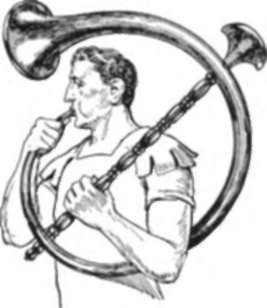
A Roman War Trumpet.

Primitive man no doubt made the first horn by boring a hole in the small end of an animal horn. With this simple device as a start, man has experimented until he has developed the modern instrument.
Of course, there has been more experimenting on the horn. Besides trying out various sizes and shapes, musicians wanted to control the notes more carefully. For instance, they tried making holes for their fingers to control the notes. Out of many years of experimenting have come our modern brass instruments with their valves and winding shapes. Their tones have been carefully developed to blend with the rest of the orchestra.
The most expressive and delicate section of our modern instruments is made up of stringed instruments. Stringed instruments are generally of two kinds - those that are plucked (such as the harp, the guitar, and the mandolin) and those that are scraped (such as the violin and the cello). The violins and their relatives are, perhaps, the most expressive of all musical instrumerits. They rank next to the human voice in their ability to express feeling.
It is just possible that the stringed instruments had their beginnings with the bow and arrow. As everyone knows, the bow hums a definite musical note when it sends an arrow speeding to the mark. Plucking the string of a bow produces an interesting musical effect. No doubt, since the bow has been used as a weapon for many centuries, those who used it came to recognize that bows of different sizes produced different tones. They might have used the bow to accompany themselves as they sang songs around the campfire at night. Then, somehow, someone may have noticed that drawing one string over another produces an interesting sound. These things must have been discovered a very long time ago, because we find evidence in the records of ancient Egypt that very elaborate harps were used in those days. In fact, there are records that tell of great concerts with hundreds of players.
People of various parts of the world have all tried to make different sorts and shapes of stringed instruments. Very early in the history of music, it was found that a sounding board, or broad base upon which the strings are attached, improves the sound of the strings. That is why the Egyptians made the base of their harps broad and why, later, in their stringed instruments they made a hollow box over which the strings were stretched.
Continue to:


My Books

