


Chapter Eight. Oh Shoot!
Description
This section is from the book "Time Out for Living", by Ernest DeAlton Partridge and Catherine Mooney. Also available from Amazon: Time Out for Living.
Chapter Eight. Oh Shoot!
As in any other sport, the archer needs certain articles of equipment. He must have a bow, arrows, an arm guard, and some sort of finger protection. There are other accessories which may and usually do form a part of his tackle, but the above are absolutely essential.
The Bow
The flat or semi-flat type of bow, modeled after the English longbow, is the one most commonly used today. It is usually made from lemonwood, yew, or Osage-orange. Yew is accepted by most as being the best, but lemonwood is by far the most practical, for Americans, as it is more durable and less expensive.
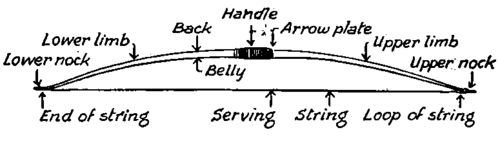
If you have never seen a modern bow, the diagram on the next page will help you to picture one. You will note that the wood between the handle and the ends of the bow is not of equal length. The upper limb is always longer and it is this end of the bow which must point up to the sky when the bow is drawn in preparation for a shot. The nocks of the bow are the grooves in which the string fits. This string is made of linen thread. It may have two loops, one to fit in each nock, or it may be tied at the bottom with a timber-hitch knot and have a loop only in the upper end. The arrow plate is a small piece of leather, mother-of-pearl, or other durable substance on which the arrow rests; it protects the bow from the continual rubbing of an arrow against it.
The Arrow
The diagram below shows you an ordinary target arrow and its parts. You will see that the point is smooth, with only a sharpened end. Perhaps the arrows you have been thinking of are those with barbed knife points such as the Indians used. But for target shooting and other types of competition the smooth point is used. You must remember, however, that an arrow with even this harmless-looking point is still very dangerous. Shot even from a fairly light bow at any distance, it can seriously injure a person if it hits him.
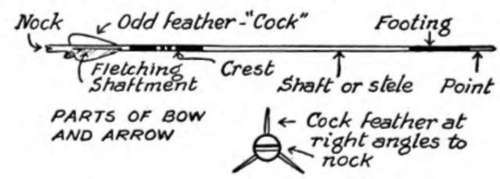
There are three feathers on an arrow; as a rule there are one white and two gray feathers. This white or odd one is called the cock feather. You might call the other two the hen feathers and keep in mind that the cock feather is the one which has the place of importance, as you will discover when you begin to shoot. The nock of the arrow is the groove into which the string fits. The crest is the colored part of the shaft, and it is this crest which distinguishes your arrows from those of your fellow archers. Some arrows are reinforced with heavier wood near the point. This hard wood is called the footing and makes the arrow more durable.
The Arm Guard
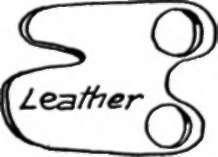
The left wrist must wear some kind of protection in case it is hit by the string as the arrow is released. It is no fun to bruise your arm. There are several types of protectors; a common one is shown here. It is a simple matter to make one of these for yourself from any piece of leather, if your shoe-repairer helps you to put hooks on it. The guard must fit snugly on your arm and must not be so long that it impedes the action of your elbow.
Finger Protectors
The three fingers which draw the string would become very sore were they not covered with something.
The finger tab serves this purpose well. It is inexpensive to buy and it can be made easily. If you do not find it comfortable, however, you can find other articles which will serve the purpose. All archery companies offer three-fingered gloves. Perhaps for a while you could use one of your old gloves, from which the thumb and little finger have been cut. The surface of any protector must be smooth, so that it will not hinder the release of the arrow, and it must be heavy enough to protect your fingers adequately. Cordovan leather is the best for this purpose.

Leather arm guard should fit snugly from wrist half-way to the inside of elbow bend.
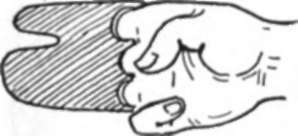
Tab, or finger guard

Myrtle Miller, International Women's Champion, exhibits one style of finger tab.
Other Accessories
It is awkward to have to stop to pick up your arrows from the ground when you are shooting. Boys have the advantage here, for they can put six arrows in a back pocket. For all purposes, however, a quiver or arrow carrier is best. The Indian and the ancient warrior carried their quivers on their backs, but today archers wear them on their belts. They are a nice part of personal equipment which you will eventually want to have and which you may find pleasure in making. They can be fashioned quite easily from leather or from even less-expensive materials. Ground quivers can be made from wire very simply and are useful when a number of people must use the same contrivance.
Many archers carry also a large wool tassel which they use to wipe arrows which are wet or muddy. Girls will perhaps want to make one to match the crest of their own arrows. Perhaps you would like to crochet a small purse to carry the smaller articles of tackle, such as a range stick and point-of-aim which you will learn about later. Such a purse can be made very attractive if crocheted in yarns the same colors as those on the target face.
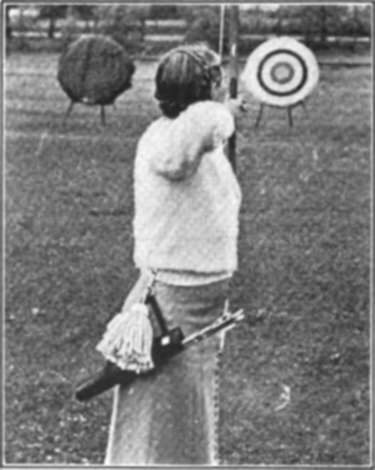
An arrow quiver and a wool tassel for wiping arrows are hooked on the belt.
The Target
Obviously, in this day when there are no king's deer to be taken by a youthful Robin Hood, archers must have some object at which to train their trusty arrows. The target of standard size is forty-eight inches in diameter. It is usually made of straw and bound with heavy cord. Good targets are expensive to buy. A cheaper substitute can be made and used until such time as funds are available for the regulation target. Straw butts may be used; they are constructed of several bails of straw piles one on top of the other. To these can be pinned or sewed the regulation target face. The target face is made of oilcloth or a similar material. On it are painted five colored circles as follows: the center circle is painted gold and is 9.6 inches in diameter; red, blue, black, and white rings follow, each 4.8 inches in width. If possible, make a regulation face for the target, so that you can compare your scores with established records. Each color hit entitles the archer to a definite score: nine points are allowed for hitting the gold, seven for the red, five for the blue, three for the black, and one for the white. The regulation straw target is placed on a wooden three-legged target stand similar to an easel.
Some archers have found it profitable to construct targets from bulrushes found in near-by swampy areas. These targets are simple to construct and are very light and durable, and, of course, the cost is not high.

A Homemade Target can be constructed from bulrushes.
Continue to:


My Books

