


Shooting Technique. Part 3
Description
This section is from the book "Time Out for Living", by Ernest DeAlton Partridge and Catherine Mooney. Also available from Amazon: Time Out for Living.
Shooting Technique. Part 3
Range Stick
When you begin to shoot at several different distances during practice, you will want to have a range stick. This piece of flat wood - a tongue presser or piece of old arrow will do - will help you locate your points without so much guesswork. Find your points by experimenting first, as explained above, and then mark them on this stick in the following manner: Stand in your shooting position and extend your left arm and the range stick out towards the target at arm's length. Sight the top of the stick in the center of the gold and then note the place at which the point comes. Mark it with your thumb nail and later with a pencil. Do this for all distances (illustration 2).
To set your points with the assistance of your range stick, go through the same process used in marking the points. Sight the top of the stick into the gold and find a tuft of grass or some object which corresponds with the mark on the stick. Keep your eye on the object while you walk up and set your point on the same spot. Check it again from the shooting line to make sure that it is correct. To mark a point which is above or beyond the target, hold the range stick so that the lower end sights into the gold and then mark the stick above this in the proper place so that the point of aim is beyond the target.
Release
Up to this point you have been doing all of the work of shooting. Now it's the bow's turn. The more work that you allow the bow to do, the better release you will have and the better your shot will be. When you are ready to release, simply relax the fingers of the right hand and let the string roll off the fingers. All three fingers should release the string simultaneously. If you do this, your shoulders will involuntarily spread a bit further, your right hand moving slightly backward (illustrations 8, 9). Keep pushing and pulling until you're ready to release, and then completely relax your muscles and let the bow send your arrow.
Follow-Through
As in all sports, a follow-through is important. The follow-through, however, is not a continuation of action but a mere holding of the position which follows the release of the arrow. Your shooting position must be held until the arrow hits the target. You will find this follow-through very helpful. Watch your left hand, see that it is relaxed and has not gripped the bow too tightly at the time of release.
Co-Ordination
While all of these points of shooting must be learned and mastered separately, it is important to remember that shooting should be one continuous process. You will learn to feel the thrill of this co-ordination of your mind, nerves, and muscles. Don't try to absorb each little point all at once; go about it gradually, and reread the directions often and carefully.
Practice
When you first begin to shoot, work toward getting a good group of arrows in the target. To get your arrows all in the same close group is much more important and much more difficult than to shoot an occasional gold and then have all the rest of the arrows all over the face of the target. Shoot without a target face on the target for a while and do not begin to score until you can group your arrows consistently. Then put the face on, keep your scores daily, and just watch your improvement. As you master each distance, move back to a longer distance.
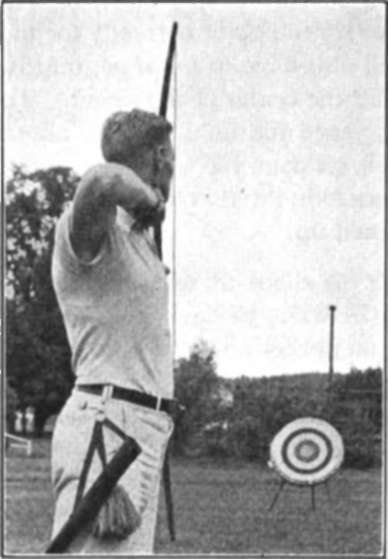
8. Release. Hold the position until the arrow strikes.

9. Release. Note how loosely the bow is held in the left hand.
When several persons are practicing, everyone should keep back of the shooting line until all have finished. Remember, the bow is still a weapon and a dangerous one, even if it is used for sport.
In pulling arrows from the target, push your hand against the target face and grasp the arrow in the other hand between first and second fingers, close to the target. Pull the arrow straight out, so that you will not bend it. If an arrow penetrates the target or grass on the ground so far that the feathers are partly buried, draw the arrow through from the other side.

The Correct Way to Pull Arrows from the Target.
The Archery Outdoor Range
An outdoor range should be at least forty yards long and twenty feet wide. The field should be as level as possible and free from rocks or other obstructions which may damage arrows. If it is covered with grass, the grass should be kept trimmed, for arrows snake under the turf and arc easily lost. It is well to have a permanent range with the proper shooting line and the distances properly marked off for the various rounds. Targets should be staked to the ground. If the wind should blow a target over, every arrow in it might be broken.
The Indoor Range
In a way, it might be said that indoor archery is one third of outdoor archery. The target is just one third as wide, and the distances for shooting are usually one third of those in the outdoor sport. There is no official round for indoor shooting, but some archers prefer to shoot a round similar to the American. Instead of shooting at 60, 50, and 40 yards, they measure off 60, 50, and 40 feet or just one third the distance outdoors. When space does not permit these distances, it is possible to hold satisfactory practice in a room 15 yards long, provided that it is at least 8 1/2 feet high.
In a room 40 feet wide, approximately ten archers can shoot at one time. Eight persons can shoot in a room 30 feet wide. It is not advisable to have too many persons shooting at a target indoors because so many arrows go into the target that some of them may be split by other arrows.
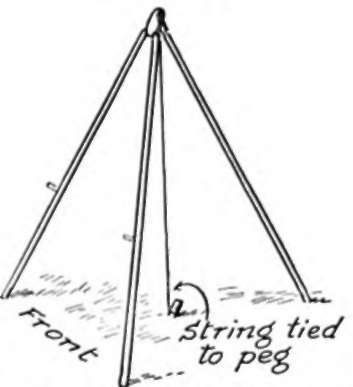
PROPERLY ANCHORED TARGET STAND
Indoor Targets
Many groups use the regular forty-eight inch outdoor targets for their indoor shooting. The legs of the stand are roped together to keep them from spreading. A sixteen-inch target can be pinned to the regular face, or the larger face can be used if it is made clear that only arrows in the center two circles, gold and red, count in the scoring.
A very practical, and yet very inexpensive, backing for a target can be made from several bales of straw. These bales stacked one upon the other on a movable frame and covered with burlap will stand heavy use. A simple frame such as that shown in the accompanying illustration can easily be made movable by mounting it on four rubber casters. The straw bales are held in position by heavy clothesline wire. The total cost of a target such as this would probably be less than a regular target, especially if you could arrange with your local dealer to exchange bales of straw when the center bales had been well punctured by arrows.
The Backstop
An experienced archer will not miss the target at 30 yards, but beginners will, and unless a backstop is provided the number of broken arrows will be discouraging. The proper setting up of targets and backstop will reduce the breakage to a minimum.
There arc several types of backstop. Felt is very satisfactory, but quite expensive. Usually arrows rebound from the felt, and in rebounding are not harmed in themselves, nor do they hurt the floor. Three pieces of felt six feet by nine feet and three-eighths inch thick are necessary for two targets. The backstop should be placed about two feet away from the wall, in order to keep the arrows from hitting the wall. When felt is not easily available, several thicknesses of heavy burlap, old rugs, or canvas will serve the same purpose.
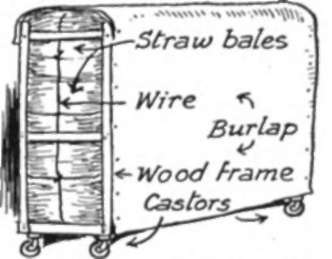
TARGET BACKGROUND FOR INDOOR ARCHERY
Some archery clubs have used soft wall board or celotex for backstops. These large boards are mounted and moved about like large screens. They are cheap and stop the arrows successfully.
Indoor Quivers
There are several simple ways of making stands for holding arrows indoors. Old mailing tubes mounted on heavy boards are quite satisfactory. Sections of large bamboo can be used in a similar manner. The quiver should be approximately 12 inches high. One group of archers used as an arrow stand a milk bottle filled partly with sand to make it heavy.
As you can see, a great deal of the real sport of archery rests in figuring out new ways of meeting the problems that so often arise. The ingenuity and the inventiveness of the archer are frequently challenged as well as his skill, strength, and muscular co-ordination. It is no wonder that this ancient sport fascinates so many people and holds their interest for so long a period of time.
Continue to:


My Books

