


Care Of Equipment
Description
This section is from the book "Time Out for Living", by Ernest DeAlton Partridge and Catherine Mooney. Also available from Amazon: Time Out for Living.
Care Of Equipment
Care Of The Bow
A bow is made to draw a definite length of arrow. It must not be drawn farther than the longest arrow which its capacity allows for. Obviously, you cannot tell how far back you are drawing a string if you do not have an arrow on it. You must remember this very important fact when you begin shooting and must remember it when you are helping other beginners. Never draw a bow back without an arrow unless you are told to do so by an instructor.
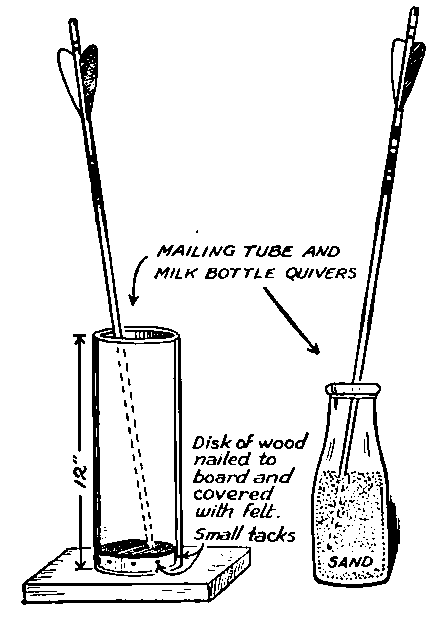
Bows, especially yew bows, are apt to become cracked or weakened if roughly treated. You should never poke the end of your bow into the ground and then lean on it as you would a pole. Be careful, too, that you do not drop the bow carelessly when you move up to the target to retrieve arrows. It is not necessary to unstring a bow each time you go to the target.
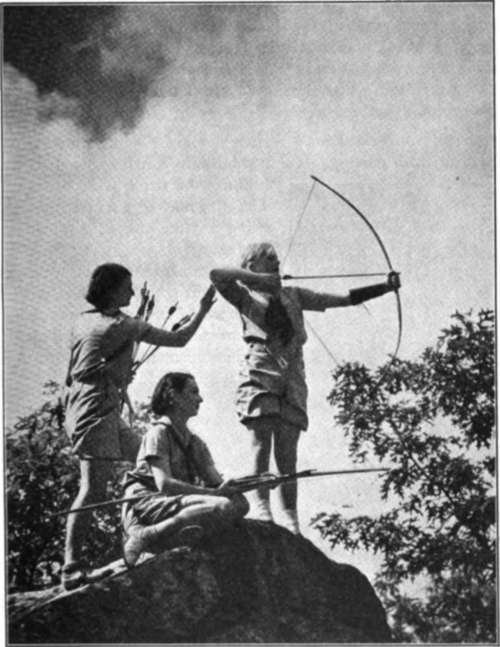
Take Care of Your Archery Equipment. Handle the bow carefully at all times. Do not drop it thoughtlessly upon the ground when you are not using it. Keep the arrows dry.
When not in use, bows should be unstrung and kept hanging from wooden pegs. Bows should have tiny holes bored above the upper nock and should be hung by string drawn through these holes rather than by the bowstring itself. The temperature of the room where the bow is left should not be higher than 65 degrees.
Care Of The Bowstring
Strings should be kept from wearing fuzzy or from parting. These conditions can be prevented by rubbing the string with beeswax. The wax may be rubbed into the string by the use of a piece of leather.
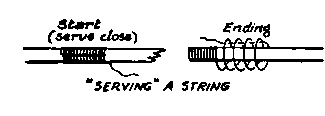
The greatest spot of wearing on the string is the place where the nock of the arrow fits. This should always be covered with a reinforcement, an additional wrapping of heavy linen thread or cotton thread (Meyer's #18 shoe thread). This reinforcement archers call the serving. You have already noted its location on the diagram showing the parts of the bow (page 122). The serving is easily applied, and every archer should know how to do it. Watch the nocking point carefully; and as soon as the threads begin to wear through, apply a new serving. If one strand of your string should begin to break, put a new string on the bow. If the string breaks while you are drawing the bow, it may break the bow too.
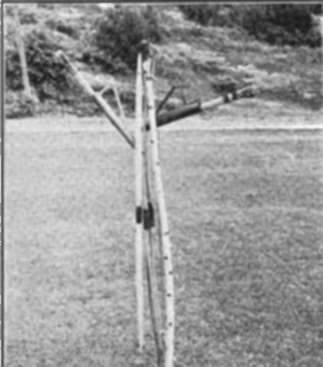
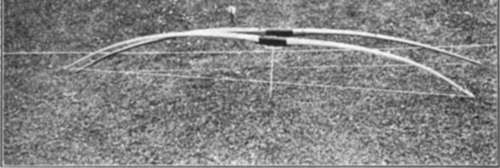
Practical Ways to Keep Equipment Off the Ground. The small picture shows a rough stick with branches near the top, upon which bows and quivers can be hung. The larger picture shows a simple wire stand.
Care Of Arrows
Caution should be taken that arrows do not get damp, for a warped arrow cannot be expected to fly straight. The biggest problem in the care of arrows is to keep them straight. They are apt to become bent, even with the best of care, by the necessary shock which comes when they hit the target or a hard object. Arrows must not be left standing in a corner because the feathers get mussed and the shaft is liable to sag in the middle. An arrow rack can be simply constructed if you are clever enough. It is convenient to make an arrow case which can be carried from place to place. If feathers become mussed, it is possible to smooth them by holding them over a steaming teakettle.
Points which have not been pinned or knurled on may come off. They can be re-cemented with ferrule cement or gum shellac. To recement a point, place the cement inside the point, heat it over a candle flame until it is hot, and then force the shaft into the point. If the point breaks off completely, a new point can be put on and the resulting shorter arrow used by a member of your group who requires a shorter arrow.
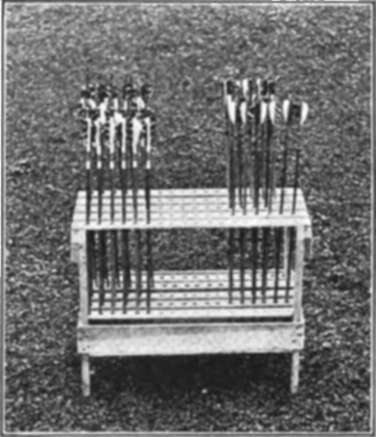
An Excellent Rack for Holding Arrows. This kind of rack for storing arrows can be used indoors or outdoors on the range.
For refeathering, it is best to send the arrows back to the manufacturer. It is almost impossible to repair a split arrow or one with a broken nock. If the point of your arrow has hit a rock and has been driven up into the shaft, leaving ragged edges of wood overhanging it, it is best to sandpaper the edges. There is danger not only of getting splinters in your hand, but also of further splitting the arrow. It is advisable to clean the shaft with fine steel wool and apply floor wax or varnish to keep the wood well preserved.
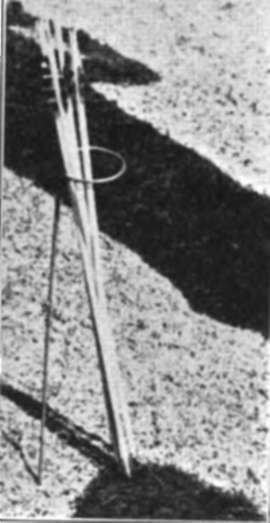
A Simple Ground Quiver can be made from heavy wire.
Care Of Targets
Targets are expensive, and care must be taken to make them last. The first precaution is to keep them flat when they are not in use. They should not be rolled out upon the field, nor down the steps to the equipment room. If it is impossible for one person to carry a target to the field, a simple stretcher or other contrivance should be constructed.
When a target gets old and begins to flatten out and loosen, it should be repaired by tightening all of the strings which hold it together. Lay the target flat on the ground. Always begin from the center and tighten as you move along toward the outside. Wear heavy gloves to protect your hands and flat-soled shoes so that you will not injure or make holes in the target. It is possible to replace or strengthen the center of the target, should the gold become worn. The one thing to remember is not to use anything on the target that will injure the arrows or stop their penetration of the target.
Some Interesting Things To Do
1. Draw a diagram of a bow and arrow and name the various parts.
2. Draw at least three types of arrows, showing the differences in their points, nocks, feathers, and size. (Target, hunting, and flight arrows, for example.)
3. Find out from the chart on page 127 and by trying various bows and arrows what your strength of bow and length of arrow should be.
4. Draw and color several crests which you would like to have on your own arrows. Select the one that appeals to you most.
5. Secure a catalogue on archery equipment and figure out how much it would cost you to get started in this sport.
6. If there is a public shooting range near your home where arrows can be rented, go with a friend and practice the proper techniques outlined in this chapter. By taking this book along, your friend can read the directions to you as you do the shooting.
7. Make a target from bulrushes, such as the one shown on page 125.
8. Make yourself either a belt quiver or a ground quiver. If you make a belt quiver, the suggestions for decorating leather in Chapter 12 will help you.
9. Make yourself a finger protector similar to the one on page 123.
10. Make yourself an arm guard according to the pattern on page 123.
11. Make an archery purse as follows: Select colors of yarn to match color on a target. Crochet two small target faces. Sew these together, insert a lining, and close with a zipper. Stiffening between the outside of the lining and the inside of the purse will help to keep it looking nice. You may double one large target face and make the purse in the shape of a half moon.
12. Make a small point-of-aim by coloring a piece of cardboard like a target. Fasten it to a sharp object which will stick in the ground.
13. Make an arrow rack like the one shown on page 143.
Sources Of Information On Archery
National Archery Association, Committee on Camp and School Archery. For information, write to Mrs. Myrtle Miller, 254 Seaman Avenue, New York City.
National Archery Association. For information, write to Louis C. Smith, Secretary-Treasurer of N.A.A., 77 Franklin St., Boston, Mass.
National Junior Archers. For information, write to George Cooper, Y.M.C.A., South Bend, Indiana.
Helpful References
Duff, J. L., Bows and Arrows. Elmer, R. P., Archery. Hoogcrhydc and Thompson, Archery Aims.
Reichart and Keasey, Modern Methods in Archery. Lambert, A. W., Modern Archery.
Pope, S. T., Hunting with the Bow and Arrow.
Pope, S. T., Study of Bows and Arrows. Shane, A., Archery Tackle. Sumption, D., Archery for Beginners. Thompson, J. M., The Witchery of Archery.
Continue to:


My Books

