


Part 4. Heavens Above. Chapter Nine. Star Gazing
Description
This section is from the book "Time Out for Living", by Ernest DeAlton Partridge and Catherine Mooney. Also available from Amazon: Time Out for Living.
Part 4. Heavens Above. Chapter Nine. Star Gazing
We are all in the very center of the universe and the world is built around us - so we think. Why shouldn't we think this? As far back as we can remember we have seen land, buildings, and water about us, much as if we were in a theater, where there were stages on all sides, each set with different scenery and sometimes showing different plays. Everyone has this feeling because it is so very natural. Of course, we know that this idea of our own importance is not correct, but our remote ancestors believed that they were the most important things in all the world. They felt perfectly sure that they were in the center of the universe.
To our ancestors the world was small and very terrifying. They knew almost nothing about the causes of earthquakes, volcanic eruptions, and storms. When a natural catastrophe demolished a community, its people were stricken with mortal fear and attributed the strange phenomenon to the wrath of cruel gods because they did not understand the workings of nature.
The Greeks were the first to discover that the earth revolves around the sun. It was a long time before the other people of Europe believed these ancient astronomers. About 1500 a.d., Copernicus introduced the idea into northern Europe. After that, the earth became subordinate to the sun in the mind of man. Now astronomers have explored vast areas of space, but there are still even greater areas about which we know absolutely nothing. The more we learn about the universe, the more we realize its grandeur and our own comparative insignificance.
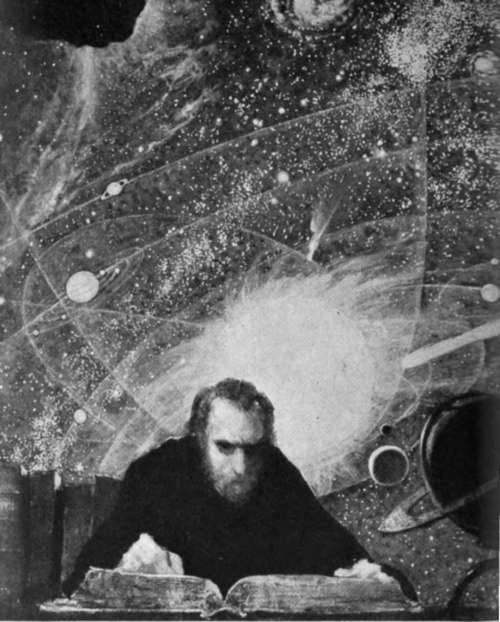
The World of the Astronomer Has No Boundaries.
We are living on a little round ball, about eight thousand miles in diameter and somewhat flattened at the poles. It is a little pressed down at the North and South poles because it is spinning around on its axis once in 24 hours, as you well know. This fairly rapid rotation makes the land near the equator have a tendency to fly off into space. Of course, it cannot do anything of the kind. If we thought of it as an animal, we would say that it had a desire to leave the earth and that it yielded just a trifle to that desire. The result is that the diameter of the earth is slightly larger at the equator than at the poles.
* Written in collaboration with W. Maxwell Reed.
Egyptian Astronomy
The laws of gravity were not known to the Egyptians. They wondered what made the sun rise in the east and set in the west. In those days the Egyptians had no horses, so they could not picture the sun in a chariot drawn by four magnificent horses as the Greeks did. A boat was the only thing they knew of which was big enough for the purpose. Hence the mural painting, of which this is a photograph.
Our earth is surrounded by air, called "atmosphere." We naturally think that there is an unlimited amount of air, and that it extends up into the sky for an enormous distance. Our ancestors used to think that it extended throughout the universe. To them, there was no place in all the universe where there was no air. As a matter of fact, compared with the size of the earth, we are living in a very thin film of air. Beyond this shallow atmosphere there is pure space, with the exception of some stars and a little dust.

Should you ever go to the top of Mt. Washington in the White Mountains, you most likely would have difficulty in breathing. If you should run, you would get out of breath much more easily than you would if you were at the seashore. That is because you would be very high up above sea level. There the air is thin or rare. High above sea level there are fewer particles of air in a cubic foot than at the seashore.
It is hard to imagine how thin is this film of air in which we live in comfort. The distance from New York City to San Francisco is about three thousand miles. If, on our map of the United States, one of those cities is ten inches from the other, the film of air between them would be represented by a layer of cellophane one three-hundredths of an inch thick. In other words, the cellophane must be so thin that 300 sheets would be one inch thick.
If you examine a map on which the height of the land above sea level is marked in colors, you will find that most people live at an altitude of less than a mile. The higher we go from the earth, the more rare the air gets. Even at an altitude of 150 miles there is some air, but by no means enough to keep us alive.
Continue to:


My Books

