


Part 9. Music For Moderns. Chapter Eighteen. Our Heritage Of Music
Description
This section is from the book "Time Out for Living", by Ernest DeAlton Partridge and Catherine Mooney. Also available from Amazon: Time Out for Living.
Part 9. Music For Moderns. Chapter Eighteen. Our Heritage Of Music
Music in Modern Life. Hop into our fast airplane. We are going to take a quick trip over one of our American cities to see how important music is in modern life. As our machine roars up toward the clouds, we are gliding through air filled with music, night and day, by radio broadcasting stations. Most of those homes below, large and small, have radio sets to catch this music in the air. Some are listening to mighty symphonies, others are tuned in to modern swing rhythms, and still others to the soft strains of chamber music.
If we could come closer, we would hear music in various forms playing its part in the lives of those below. Take the houses in this residential area, for example. In one, a mother is singing her child to sleep with songs taught her by her own mother. In another, a group of young people have gathered around the piano to enjoy singing together, and in still another some new phonograph records are being enjoyed for the first time by the members of the family.
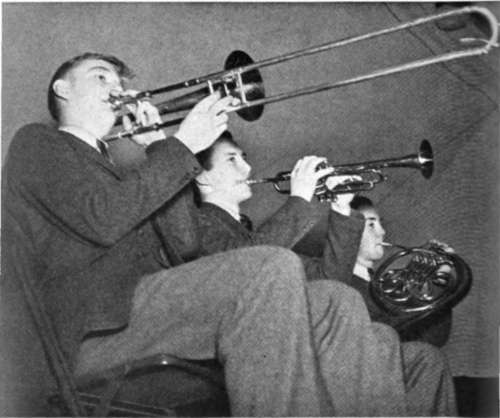
Many Young People in America Enjoy Making Music Together.
That larger building off to the right is a high school. This very night the student orchestra is giving a concert. The hall is packed with those interested in music. The school also has a band, two or three choral groups, and many individual students who are studying instruments. Look at that huge crowd gathering in the stadium below. A football game? No! A symphony orchestra is giving its weekly outdoor concert and the microphones are carrying the strains of this large orchestra across the land to those who are not fortunate enough to be present themselves.
* Prepared in collaboration with Prof. Miles A. Dresskell, Assistant Professor of Music Education, Teachers College, Columbia University.
Perhaps you are now convinced of the tremendous part music plays in modern American life. It is, no doubt, one of our most important leisure-time activities, and one of the most valuable. How did we get music? How did this great gift come to man? Like many other things we enjoy today, music in its present form is the result of hundreds of years of development and of the struggle and genius of thousands of people.
There are many reasons why music plays an important role in American life. First of all, we have inherited a rich legacy from our forefathers. The instruments we have today and our various forms and pieces of music have come down to us through hundreds, yes, thousands of years of hard work and experimentation. Then, too, in America we enjoy a standard of living that permits us to make many musical instruments and sell them relatively cheap. Also, millions of our homes can afford to own a radio and hear the performances of the best musicians in the country by a simple click of the dial.
Most people like some form of music. We all admire beauty in any form, and since good music is beauty expressed by sound, produced vocally or with instruments, we are pleased and thrilled by listening to it. You may have a different taste in music from that of your friends, or from that of your brothers and sisters. What is best for you, however, is what you like, if it is good music and expresses beauty. Beauty has many forms and variations, and individuals have different likes and dislikes.
Some music is designed to entertain us. It is light and frivolous and makes us want to laugh or dance. Other types of music reach deep into our being, bringing pleasure and satisfaction that nothing else can bring. It is for this reason that the more serious music should be cultivated and understood. Life would indeed be very different from what it is without music. Gaiety, sadness, love, vigor, joy, and understanding all find expression in musical sounds. The man who makes a poor shot in golf sometimes gives expression to his feelings by breaking his club. A happy young person sometimes finds it necessary to break out into song to express his feelings. Music is simply a delicate and refined way of expressing feelings, and it expresses them in such a way that everyone who listens has somewhat the same kind of feeling.
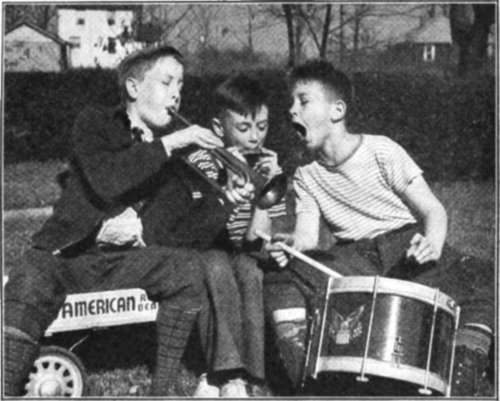
Modern Music in the Making.
Life without music in one or more of its many forms would be very drab. Think what it would be like if you could not hear the songs of birds, the wind sighing through the trees, the blowing of a gale through the shrouds of a ship, or the dashing of waves against the rock-strewn shore. These things are not unlike the singing of a mother to her child, the band playing a stirring march, or the orchestra interpreting a symphony by one of the great composers.
Not only has the history of music been a long one - it is also fascinating. Our ancestors, who through their ceaseless efforts have given us modern music, had many thrilling experiences in searching out the things that have gone to make our music what it is.

The Usual Seating Plan for a Symphony Orchestra. The next time you go to a symphony concert, try to identify the instruments in the orchestra by the grouping of the musicians.
Perhaps the most perfect modern organization for making music is the symphony orchestra. In the symphony orchestra, scores of expert musicians, who have devoted their lives to acquiring a high degree of skill, work together as one with instruments that are in perfect tune. The result is smooth, flowing music that rises and falls in response to the movements of the leader's direction.
It has not always been thus! You would be surprised to learn how new in the history of man are great orchestras made up of men who devote all of their time to producing music. Indeed, it was only a few hundred years ago that music was first written in such a form that it could be reproduced by those who had never heard the melody before.
No one seems to know just how music started or what the first musical instrument was. The beginnings of this great art are lost somewhere in the aeons of unrecorded history. Since music is a method of expressing how one feels, it is quite certain that some form of music must have existed hundreds of thousands of years ago. Early cave men who hunted the mastodon must have been angry at times and happy at others. They no doubt had their own particular way of expressing these feelings. Maybe the shaggy cave man hammered on his chest or with a stick on a log when he wanted to tell the world about his wrath. The resulting sound could easily have led him to make a drum from a hollow log. Nearly every primitive people we know about has some form of drum or percussion instrument.
When he was happy or in love, primitive man must have listened to the pleasant sounds around him - the rustling of the leaves in the spring breeze, the mating calls of birds, the rhythms of singing insects. Man, too, is full of rhythm. The beat of his heart, the measure of his step must have made primitive man feel that his being was in tune with the rhythmic sounds of nature. Early relics found in caves, telling us about the life of pre-historic men, reveal crude whistles made from bone. As you will recall, the American Indians had drums, flutes, and whistles when they were discovered by white men. Singly or together, these instruments can produce a crude form of music.
The ancient Greeks had a legend about the discovery of a simple instrument known as the Panpipes. You are no doubt familiar with the story of how the Greek god Pan discovered the reed pipes. At one time he frightened the nymph Syrinx and she changed herself into reeds along the shore. Pan, hearing the wind sighing through these reeds, cut them and blew across them. He found that tones were produced. The Panpipes exist as a musical instrument even to this day in Italy. In this country you may also have heard the Panpipes played by the scissors-and-knife grinder, who comes around to sharpen your cutlery, or in performances of Punch and Judy shows. The instrument is a series of reeds, some longer than others, and arranged in the order of their size. The reeds are sealed at one end. By blowing across the tops of them in the same manner as you blow across the top of an empty bottle, a pleasing whistling sound is heard. It was upon this principle that the first flutes are said to have been invented.
Continue to:


My Books

