


Chapter Nineteen. Helpful Invensions
Description
This section is from the book "Time Out for Living", by Ernest DeAlton Partridge and Catherine Mooney. Also available from Amazon: Time Out for Living.
Chapter Nineteen. Helpful Invensions
The Magic Of Radio
Press a button, turn a dial, and almost instantly your radio comes to life. You are now ready to select speeches, music, plays, or news from the air. The magic of radio! Aladdin himself could not have expected more from his magic lamp. With a movement as simple as snapping your fingers, you have the world's best music at your command.
As you know, radio is a very recent gift of science. Only within the last twenty years has this great instrument of communication come into full stride. The history of radio is fascinating, and you will enjoy reading it in some of the books listed at the end of this chapter. This modern mechanical marvel is one of your most valuable servants, and you should become acquainted with it so that you can use it to the best advantage.
A recent survey in New York City showed that the average young person listened in on the radio about two hours a day, but that the choice of programs was not very good. These facts would probably be true of other cities as well. If so, people are not getting as much benefit from their receiving sets as they should. Perhaps they need to learn more about it.
Getting Acquainted
There arc many ways of becoming better acquainted with your radio. If you live in a large city, or near one, you can secure tickets to broadcasts. Seeing the artists perform before a "mike" will give you a greater appreciation for the music that comes into your own home through the tubes. Sometimes it is necessary to write to the sponsor of the program if you wish to attend, especially if it is a "commercial." Commercials are the programs which pay the cost of operating and maintaining radio stations.
Suppose you decide to attend the Fred Allen broadcast. You write to the company which is sponsoring his program at the present time. (Its name and mailing address are given over the air.) Your request for tickets is placed along with others in the order of their receipt. When your turn comes, you will be sent tickets. It is then up to you to go and see the fun. This is the procedure that holds for all commercials.
It seems to be a common human trait to be interested in other persons. We arc especially interested in those whom we hear on the radio, see on the screen, or read about in the newspapers. You will find that the musical programs on the radio will mean much more to you if you become acquainted with the persons who produce the music - not only the composers of the music but also those who direct it or play it.
Much of this information can be gained by watching the newspapers or the current magazines. If you consult the Readers' Guide in your library, you will find many interesting articles about great musicians of yesterday and today.
If you wish to enjoy a great piece of music, it is important that you know something about the man who wrote it. Music is usually an expression of one's interpretation of life or of some feeling about life, and it is almost impossible to understand the theme the composer is trying to convey unless you know what kind of individual he is or was. There is a reason why the compositions of Chopin have a melancholy strain and why those of MacDowell are wistful and tender. It is through explorations of this kind that music can come to mean more in your life.
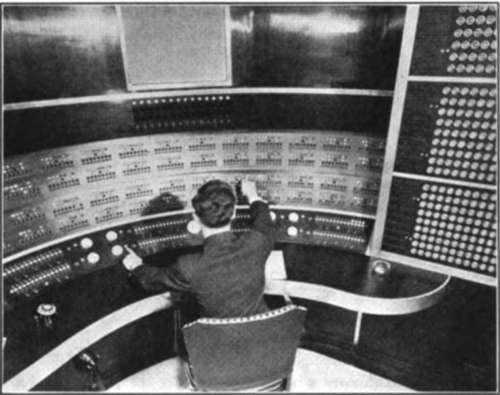
The Control Room of a large broadcasting studio is a complicated affair.
The engineer must be well trained and alert.
Another thing that will help you enjoy the radio is to check the daily list of current programs printed in most of the leading newspapers of the country. These schedules of radio broadcasts will help you plan your own programs of listening and participation, and you will be rewarded by many a delightful hour that you otherwise might have missed. If your home-town paper does not supply this service, a letter addressed to the broadcasting company will usually bring you a detailed outline.
Now if you are the least bit musically minded, and know anything about musical notes, you will enjoy securing from any music house a miniature score of a symphony that is to be played. Having looked it over in advance, you will have a rather clear picture of the composition in mind. Even though you cannot read the entire score, you can follow the music in general and appreciate it as it goes along. In time you will find that reading the score trains you to listen more intelligently for inner voices and interesting themes that previously may have escaped your attention. These scores are inexpensive and one can assemble a fine library of musical compositions by using judgment in selecting them wisely. If a group of music lovers started a circulating library of scores, it would be even easier on the pocketbook.
Playing At Home
If you play some instrument reasonably well, you may enjoy playing with what is, perhaps, the largest symphony orchestra in the world. The Home Symphony Hour makes your participation possible. To play along in this broadcast, you must write to the station nearest you which broadcasts this program and secure a part for whichever instrument you play. With your instrument and music before you, you wait before your own radio at the appointed hour. The signal is given for tuning up with the station orchestra. When all is ready, the director tells you where to begin and on what count to start. You will profit greatly from such an experience and it will give you a chance to test your ability in playing with a group of excellent musicians. People enjoy this symphony hour very much and come to feel that they are a real part of the main orchestra in New York City.
The Radio And The Home
As you can see, the radio has had a decided influence upon the home. Whereas for many years the field of commercial amusement had lured people away from the fireside, the invention of the radio bringing music, news, and drama has made the home a more interesting place. The telephone companies have reported that during the broadcasting of some of the popular programs telephone calls are much fewer than usual. This lessening of calls shows that a great number of people listen to the radio, to some programs especially.
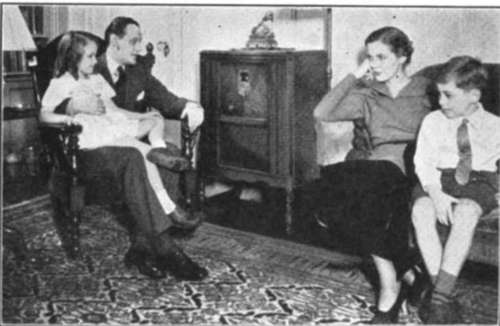
The radio brings wonderful entertainment into the home. You can hear the world's finest symphony concerts by merely turning the dial.
Another thing that the radio has done is to bring into the home certain programs that parents do not like to have their children hear. This may result in disagreement between members of the family. Also, when two or more members of the same family wish to listen to different programs at the same time, there may be trouble. You can no doubt think of other ways in which this instrument has changed modern family life.
How To Select A Radio
There are many different kinds of radio receiving sets on the market. You have no doubt noticed their variety in visiting your friends and seeing displays in store windows. Naturally, some radios are better than others. What you should be concerned about is getting the most for the money your family has to spend on a set. Here are a few things that will help in selecting a new radio, or in taking care of one which you already own.
One of the most important items to watch in purchasing a radio is its tonal range, that is, how low and how high a note it will produce clearly. This item is important because if the radio has no wide range, some of the instruments of the orchestra and band will not be heard correctly. You have probably heard a radio that gives mostly what is known as "highs" - upper tones predominating, with few of the lower notes distinctly heard. On the better radios there is a tone control with which you can balance the higher and lower tones and in this way control to some extent the type of tone you desire. It is best to balance your radio so that you get a clear rendition of the music, including both the high tones and the low tones, with neither predominating. In other words, you want as natural a representation of the original as possible.
Using A Radio
If you wish to get the most enjoyment from your radio, don't turn it up too high. The neighbors will also appreciate your attention to this detail. Most radios are built to produce a certain volume of sound; when the radio is forced beyond that, the music becomes rough and harsh. One should never adjust the volume of sound by tuning the radio slightly off the station. This distorts the sound and gives unpleasant effects. Control the volume always by the volume knob or dial. Learn to adjust your radio so that it is pleasant to listen to.
"Sick" Radios
Sometimes a radio will get "sick" and make peculiar noises. If you notice that the sound is unusually harsh or indistinct, or if it fades and then comes back again, there is apt to be something wrong with it. Other symptoms are sputtering (aside from static), rattling in the speaker unit, and so forth. If your radio displays any of these symptoms, it is not well and may need the services of a radio doctor. A good plan is to have the radio serviced in the fall before the winter season starts, so that you and your friends can enjoy it at its best.
Now here are some things you can do to improve your radio yourself. Check up on your aerial wire. Be sure that it is not touching any metal and that it docs not swing back and forth in the wind. If your aerial is not well insulated, it may cause unpleasant little sounds to creep into the loud speaker. Another thing is to be sure that the ground wire is well connected both at its source and to the radio. The places where these wires connect are usually clearly marked and you should have no difficulty in tracing them.
Sometimes difficulties can be traced to tubes. If you have an idea that some of your radio tubes arc not functioning properly, you can remove them and take them to a reliable radio store, where they will be tested for you free of charge. If you find one or two tubes which arc not functioning at their best, replace them with new ones in order to improve the quality of reception.
Learning To Listen
The chances are that you will learn to appreciate good music if you deliberately go about finding the better programs. You will come to see that there is a great difference between types of music and also between the various bands or orchestras. This is true of any form of music, whether it be the classics or modern swing. By careful listening you will come to recognize good themes and the skillful use of instruments. Unless you can learn to discriminate in this way, you will not be able to appreciate the radio as much as you might.
Continue to:


My Books

