


Music Collections
Description
This section is from the book "Time Out for Living", by Ernest DeAlton Partridge and Catherine Mooney. Also available from Amazon: Time Out for Living.
Music Collections
There are many good collecting hobbies in the music field. The collection of musical programs is a fascinating hobby for anyone who enjoys musical explorations. With the co-operation of your friends, you can assemble unusual programs from various parts of the world to add to your collection. While classifying these programs, you become better acquainted with the various conductors and other artists who make great music possible. As one goes about, it is easy to acquire a significant collection as a start.
Another good idea is to collect pictures of various musical matters. Pictures, helped with actual phonograph records, can greatly enrich the report of your explorations. Often, too, the local newspaper will carry items of interest to one who keeps a musical record. A certain young man became interested in the various forms of Chinese music. He made a collection of instruments from the East which has grown into a home museum. It was not enough for him to collect the instruments. Because he lived in New York, it was possible for him to go down into Chinatown and study these instruments and learn how to play them. He has given many lectures on Chinese music and has played the instruments for his audience. By dressing in Chinese costume, he creates the proper atmosphere and presents a very interesting evening.
When one thinks of the many different races and stages of civilization in the world, the field of exploration in music becomes very extensive. In fact, it has no limits. It leads you on and on. Many things indirectly related to your subject will naturally come to your attention, too, just as they do to the scientist, who can stop to enjoy a beautiful scene while in pursuit of a new fossil or different kinds of birds.
Some Interesting Things To Do
1. Some primitive instruments can easily be made of things you have around the house. Why not try at least one type, or, better still, invent a new one?
2. Demonstrate the principle of producing tones on wind instruments.
3. Make an Aeolian harp.
4. Signaling by means of drums is great fun. Try it.
5. Explore the four corners of the earth for unusual music.
6. Plan an imaginary journey to the Orient to hear the music of Eastern lands.
Give an illustrated music program of and talk on some little-known country.
Find out what the minstrel did to make the early English ballads popular.
Produce an original pageant or play depicting medieval days in England, with a minstrel singing to the court such ballads as "Barbara Allen," "The Rich Lady from London," "Lord Randal," and "Young Beichan."
10. Find some ballads that show the development of the following themes: tragedy in family life, the supernatural, outlaw life, a love story, a historical situation, sea and river episodes, the big brutal city, lumberjacks.
11. Present a program of ballads and songs from the Mississippi Valley, such as "The Cruel Brother," "Shooting of His Dear," "The Little Black Mustache," "The Frog and the Mouse," and "Old Blue."
12. Compare the place of the minstrel show in former times with that of the radio today. How do they differ?
13. Stories of the lives of early musicians are fascinating. Get acquainted with some of them by dramatizing the highlights of their careers.
14. Play for the class some records of the great composers of the past as well as those of today.
15. Make a collection of folk songs that appeal to you and that you do not want to forget.
16. Plan a caroling party for Christmas time; some hillbilly music for Hallowe'en.
17. Make a collection of music representative of each period in the development of America.
18. Plan a typical Ozark play-party during a class period or some night at home. Games may be played to the tune of old ballads such as "Skip to My Son," "Old Dan Tucker," "Four in the Middle," "Sugar and Tea," and "Turkey in the Straw."
19. Analyze the regional differences of America as portrayed in the ballads "Cowboy Song" and "Levee Moon."
20. In your interviews or investigations, have you discovered any materials of local historical interest which would be suitable as subjects of a ballad? Compose one.
21. Read and report on the life and work of Sir Arthur Sullivan of Gilbert and Sullivan fame, Edward MacDowell, or a composer of your own choosing.
22. Write and present a minstrel show, using the following ballads as songs: "Walky-Talky Jenny," "Hayseed," "Good-bye, Liza Jane," "Wizard Oil," or other well-known pieces. -
23. Invite an "old-timer" in to play and sing some of the old ballads for you.
24. Ask some of the older inhabitants of your neighborhood to teach you some of the local ballads. Jot down the words in your scrapbook.
25. Collect programs from now on, and file them.
26. Find out all vou can about the work of two modern American composers and report on them to the class.
Helpful References
Baker, E., The Wonder Jul Story oj Music. Bauer and Peyser, How Music Grew. Birge and Earhart (editors), Master Musician Series. Bragg, W. H., The World of Sound. Brown, A. F., Boyhood of Edward MacDowell. Browne, C. A., Story of Our National Ballads.
Buchanan, F. R., Story of How Man Made Music. Coleman, S. N., Creative Music in the Home.
Copland, A., What to Listen jor in Music.
Ewen, D., Composers of Today. Ewen, D., Composers of Yesterday. Faulkner, A. S., What We Hear in Music.
Feldman, H. A., Music and the Lis-tener.
Gunn, G. D., Music: Its History and Enjoyment.
Johnson, W. W., Intelligent Listening to M usic.
Kinscella, H., Music and Romance. La Prade, E., Alice in Orchestralia. Macy, J. C.j Young People's Illustrated History of Music. McGehee, T. C, People and Music. McKinney and Anderson, Discovering Music.
Morse, C, Music and Music-Makers. Scobey and Home, Stories of Great Musicians. Scholes, P., Complete Book of Great Musicians. Schwartz, H. W., The Story of Musical Instruments. Singleton, E., The Orchestra and Its Instruments. Spaeth, S. G., The Art of Enjoying Music.
Thompson, O., How to Understand Music. Victrola Book of the Opera.
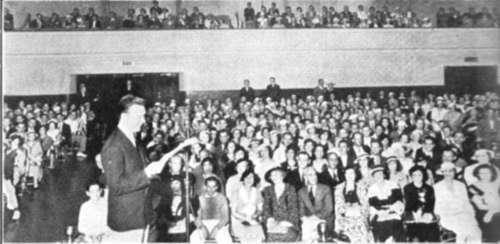
Fred Allen broadcasts to a large audience. Some of his listeners are present in person, but most of them are attending through their radio receiving sets.
Continue to:


My Books

